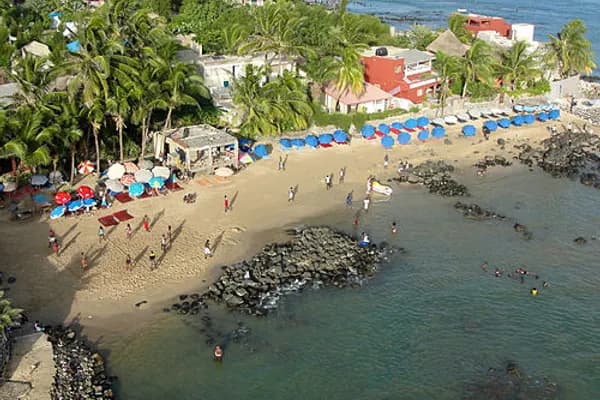
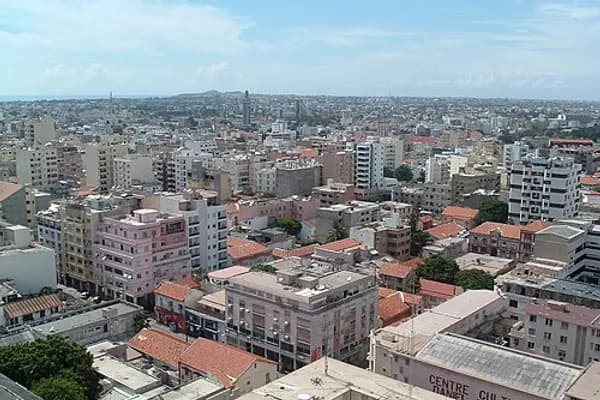
About the neighborhood
Capital and the largest city of Senegal
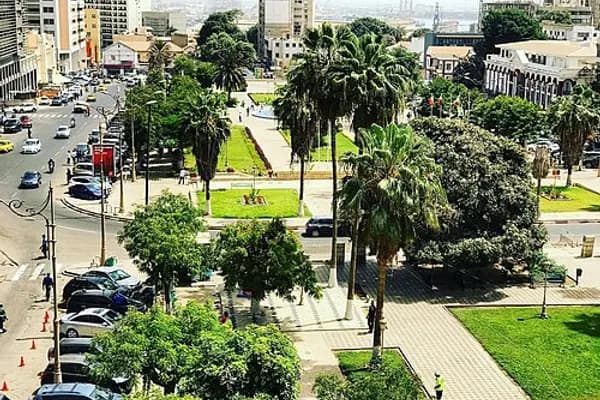
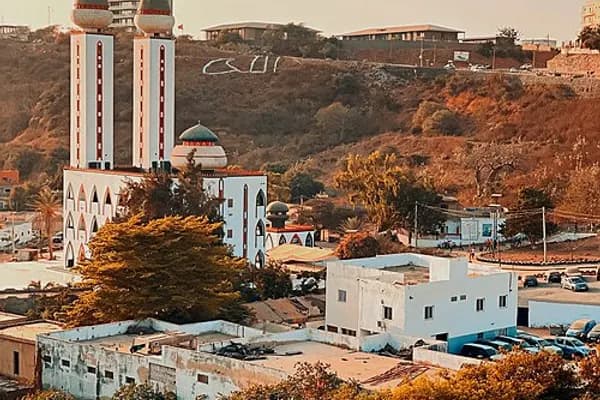
Dakar (/dɑːˈkɑːr, dæ-/ UK also: /ˈdækɑːr/; French: dakaʁ; Wolof: Ndakaaru) is the capital and largest city of Senegal. The department of Dakar has a population of 1,278,469, and the population of the Dakar metropolitan area was at 4.0 million in 2023.
Dakar is situated on the Cap-Vert peninsula, the westernmost point of mainland Africa. Cap-Vert was colonized by the Portuguese in the early 15th century. The Portuguese established a presence on the island of Gorée off the coast of Cap-Vert and used it as a base for the Atlantic slave trade. France took over the island in 1677. Following the abolition of the slave trade and French annexation of the mainland area in the 19th century, Dakar grew into a major regional port and a major city of the French colonial empire. In 1902, Dakar replaced Saint-Louis as the capital of French West Africa. From 1959 to 1960, Dakar was the capital of the short-lived Mali Federation. In 1960, it became the capital of the independent Republic of Senegal. Dakar will host the 2026 Summer Youth Olympics.
History
Foundation and European Trade
The Cap-Vert peninsula was settled no later than the 15th century by the Lebu people, an aquacultural subgroup of the Wolof ethnic group. The original villages—Ouakam, Ngor, Yoff and Hann—still constitute distinctively Lebou neighborhoods of the city today.
In 1444, the Portuguese reached the Bay of Dakar. Peaceful contact was finally opened in 1456 by Diogo Gomes, and the bay was subsequently referred to as the "Angra de Bezeguiche" (after the name of the local ruler). The bay of "Bezeguiche" would go on to serve as a critical stop for the Portuguese India Armadas of the early 16th century, where large fleets would routinely stop, both on their outward and return journeys from India, to repair, collect fresh water from the rivulets and wells along the Cap-Vert shore and trade for provisions with the local people for their remaining voyage. (It was famously during one of these stops, in 1501, where the Florentine navigator Amerigo Vespucci began to construct his "New World" hypothesis about America.) A town grew on the bay that was one of the major ports of Cayor, a constituent kingdom of the Jolof Empire that broke away in 1549.
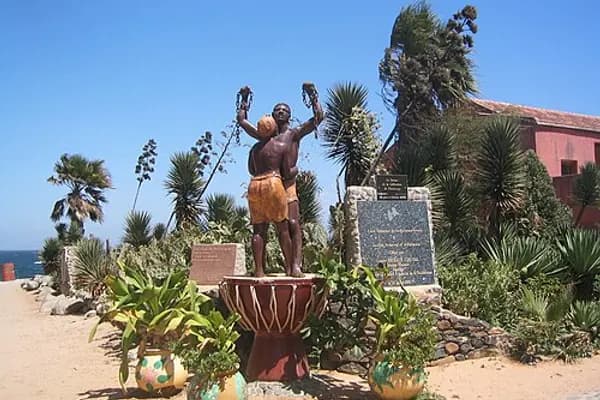
The Portuguese founded a settlement on the island of Gorée (then known as the island of Bezeguiche or Palma), which by 1536 they began to use as a base for slave exportation. A new Lebou village, called Ndakaaru, was established directly across from Gorée in the 17th century to service the European trading factory with food and drinking water. Gorée was captured by the United Netherlands in 1588, which gave it its present name (spelled Goeree, after Goeree-Overflakkee in the Netherlands). The island switched hands between the Portuguese and Dutch several more times before falling to the English under Admiral Robert Holmes on January 23, 1664, and finally to the French in 1677. Though under continuous French administration since, multiracial people, descended from Dutch and French traders and African wives, dominated the slave trade. The infamous "House of Slaves" was built at Gorée in 1776.
Lebou Republic
By the 1780s, Dakar was one of the largest towns in Cayor. In 1795, the marabouts of Cayor revolted against the Damel, inspired by the Futanke revolution in Futa Toro. The Lebou community joined the uprising under the leadership of the Diop, a Muslim clerical family originally from Coki. After some initial victories, the Muslim armies were defeated at Loofe, and the Lebou fell back on the Cap Vert. They built a series of defensive walls out of laterite blocks, the longest of which stretched across the entire peninsula from Yoff to Hann, and successfully repulsed the Damel's army. With this victory, Jaal Joop declared a new, independent, theocratic state, subsequently called the "Lebou Republic" by the French, with the capital at Ndakaaru. The Serigne of Ndakaaru is still recognized as the traditional political authority of the Lebou by the Senegalese State today.
The slave trade was abolished by France in February 1794. However, Napoleon Bonaparte reinstated the slave trade in May 1802. The slave trade continued at Gorée until 1848, when it was finally abolished throughout all French territories. To replace trade in slaves, the French promoted peanut cultivation on the mainland. As the peanut trade boomed, tiny Gorée Island, whose population had grown to 6,000residents, proved ineffectual as a port. Traders from Gorée decided to move to the mainland, and a "factory" with warehouses was established in Rufisque in 1840. In 1857, the French established a military post at Ndakaaru (which they called "Dakar") and annexed the Lebou Republic, though its institutions continued to function nominally.
Colonial Dakar
Large public expenditure for infrastructure was allocated by the colonial authorities to Dakar's development. The port facilities were improved with jetties, a telegraph line was established along the coast to Saint-Louis, and the Dakar-Saint-Louis railway was completed in 1885, at which point the city became an important base for the conquest of the Western Sudan.
Gorée, including Dakar, was recognised as a French commune in 1872. Dakar itself was split off from Gorée as a separate commune in 1887. The citizens of the city elected their own mayor and municipal council, and helped send an elected representative to the National Assembly in Paris. Dakar replaced Saint-Louis as the capital of French West Africa in 1902. A second major railroad, the Dakar-Niger built from 1906 to 1923, linked Dakar to Bamako and consolidated the city's position at the head of France's West African empire. In 1929, the commune of Gorée Island, now with only a few hundred inhabitants, was merged into Dakar.
Urbanization during the colonial period was marked by forms of racial and social segregation—often expressed in terms of health and hygiene—which continue to structure the city today. Following a plague epidemic in 1914, the authorities forced most of the African population out of old neighborhoods, or "Plateau", and into a new quarter, called Médina, separated from it by a "sanitary cordon". As first occupants of the land, the Lebou inhabitants of the city successfully resisted this expropriation. They were supported by Blaise Diagne, the first African to be elected Deputy to the National Assembly. Nonetheless, the Plateau thereafter became an administrative, commercial, and residential district increasingly reserved for Europeans and served as a model for similar exclusionary administrative enclaves in French Africa's other colonial capitals (Bamako, Conakry, Abidjan, Brazzaville). Meanwhile, the Layene Sufi order, established by Seydina Mouhammadou Limamou Laye, was thriving among the Lebou in Yoff and in a new village called Cambérène. Since independence, urbanization has sprawled eastward past Pikine, a commuter suburb whose population (2001 est. 1,200,000) is greater than that of Dakar proper, to Rufisque, creating a conurbation of almost 3million (over a quarter of the national population).
In its colonial heyday, Dakar was one of the major cities of the French Empire, comparable to Hanoi or Beirut. French trading firms established branch offices there, and industrial investments (mills, breweries, refineries, canneries) were attracted by its port and rail facilities. It was also strategically important to France, which maintained an important naval base and coaling station in its harbor, and which integrated it into its earliest air force and airmail circuits, most notably with the legendary Mermoz airfield (no longer extant).
In 1940, Dakar became involved in the Second World War when General de Gaulle, leader of the Free French Forces, sought to make the city the base of his resistance operations. The object was to raise the Free French flag in West Africa, to occupy Dakar and thus start to consolidate the French resistance of its colonies in Africa. The plan had British naval support when fighting alone against the Axis powers. However, due to delays and the plan becoming known, Dakar had already come under the influence of the German-controlled will of the Vichy government. With the arrival of French naval forces under Vichy control and faced by stubborn defences onshore, de Gaulle's proposals were resisted, and the Battle of Dakar ensued off the coast, lasting three days 23–25 September 1940, between the Vichy defences and the attack of the Free French and British navy. The enterprise was abandoned after appreciable naval losses. Although the initiative on Dakar failed, General de Gaulle was able to establish himself at Douala in the Cameroons, which became the rallying point for the resistance of the Free French cause.
In November 1944, West African conscripts in the French army mutinied against poor conditions at the Thiaroye camp, on the outskirts of the city. The mutiny was seen as an indictment of the colonial system and constituted a watershed for the nationalist movement. On 1 December 1944, French soldiers guarding the camp opened fire on the West African soldiers. Accounts of the death toll range from around 35 (the official French account) to over 300 (army veterans active at the time).
Independence
Dakar was the capital of the short-lived Mali Federation from 1959 to 1960, after which it became the capital of Senegal. The poet, philosopher and first President of Senegal Léopold Sédar Senghor tried to transform Dakar into the "Sub-Saharan African Athens" (l'Athènes de l'Afrique subsaharienne), as his vision was for it.
Dakar is a major financial centre, home to a dozen national and regional banks (including the Central Bank of West African States (BCEAO) which manages the unified West African CFA franc currency), and to numerous international organizations, NGOs and international research centers. Dakar has a large Lebanese community (concentrated in the import-export sector) that dates to the 1920s, a community of Moroccan businesspeople, as well as Mauritanian, Cape Verdean, and Guinean communities. The city is home to as many as 20,000French expatriates. France still maintains an air force base at Yoff, and the French fleet is serviced in Dakar's port.
Beginning 1978 and until 2007, Dakar was frequently the ending point of the Dakar Rally.
Geography
Dakar is located on the Cap-Vert peninsula on the Atlantic coast and is the westernmost city on the African mainland.
Climate
Dakar has an ocean-influenced tropical hot semi-arid climate (Köppen climate classification: BSh), with a short rainy season and a lengthy dry season. Dakar's rainy season lasts from July to October, while the dry season covers the remaining eight months. The city sees approximately 411mm (16.2in) of rainfall per year.
Dakar between December and May is usually very warm with daily temperatures around 25–28°C (77.0–82.4°F). Nights during this time of the year are warm, some 18–20°C (64.4–68.0°F). However, between May and November, the city becomes decidedly hotter with daily highs reaching 29–31°C (84.2–87.8°F) and night lows a little bit above 23–25°C (73.4–77.0°F). Notwithstanding this hotter season, Dakar's weather is far from being so hot as experienced in inland Sahelian cities like Niamey and N'Djamena, where temperatures hover above 36°C (96.8°F) for much of the year. Dakar is cooled year-round by sea breezes.
Climate change
A 2019 paper published in PLOS One estimated that under Representative Concentration Pathway 4.5, a "moderate" scenario of climate change where global warming reaches ~2.5–3°C (4.5–5.4°F) by 2100, the climate of Dakar in the year 2050 would most closely resemble the current climate of Praia in Cape Verde. The annual temperature would increase by 1.5°C (2.7°F), and the temperature of the warmest and the coldest month by 1.4°C (2.5°F) and 1.6°C (2.9°F), respectively. According to Climate Action Tracker, the current warming trajectory appears consistent with 2.7°C (4.9°F), which closely matches RCP 4.5.
Moreover, according to the 2022 IPCC Sixth Assessment Report, Dakar is one of 12 major African cities (Abidjan, Alexandria, Algiers, Cape Town, Casablanca, Dakar, Dar es Salaam, Durban, Lagos, Lomé, Luanda and Maputo) which would be the most severely affected by future sea level rise. It estimates that they would collectively sustain cumulative damages of US$65 billion under RCP 4.5 and US$86.5 billion for the high-emission scenario RCP 8.5 by the year 2050. Additionally, RCP 8.5 combined with the hypothetical impact from marine ice sheet instability at high levels of warming would involve up to US$137.5 billion in damages, while the additional accounting for the "low-probability, high-damage events" may increase aggregate risks to US$187 billion for the "moderate" RCP4.5, US$206 billion for RCP8.5 and US$397 billion under the high-end ice sheet instability scenario. Since sea level rise would continue for about 10,000 years under every scenario of climate change, future costs of sea level rise would only increase, especially without adaptation measures.
Administration
The city of Dakar is a commune (also sometimes known as commune de ville), one of the 125communes of Senegal. The commune of Dakar was created by the French colonial administration on 17 June 1887, by detaching it from the commune of Gorée. The commune of Gorée, created in 1872, was itself one of the oldest Western-style municipalities in Africa (along with the municipalities of Algeria and South Africa).
The commune of Dakar has been in continuous existence since 1887, being preserved by the new state of Senegal after independence in 1960, although its limits have varied considerably over time. The limits of the commune of Dakar have been unchanged since 1983. The commune of Dakar is ruled by a democratically elected municipal council (conseil municipal) serving five years, and a mayor elected by the municipal council. There have been 20mayors in Dakar since 1887. The first black mayor was Blaise Diagne, mayor of Dakar from 1924 to 1934. The longest-serving mayor was Mamadou Diop, mayor for 18years between 1984 and 2002.
The commune of Dakar is also a department, one of the 45departments of Senegal. This situation is quite similar to Paris, which is both a commune and a department. However, contrary to French departments, departments in Senegal have no political power (no departmental assembly), and are merely local administrative structures of the central state, in charge of carrying out some administrative services as well as controlling the activities of the communes within the department.
Encyclopedic content adapted from the Wikipedia article on Almadies, used under CC BY-SA 4.0.