About the neighborhood
Lake in Hangzhou, China
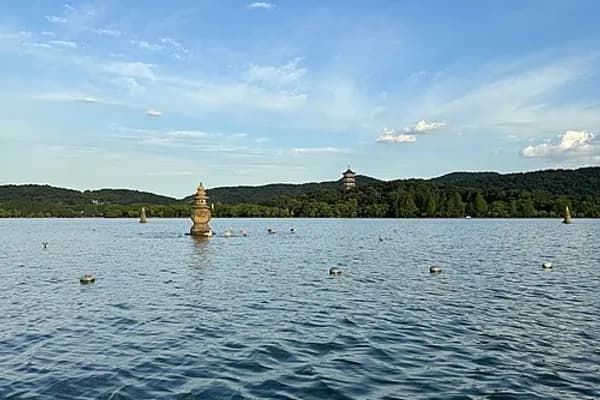
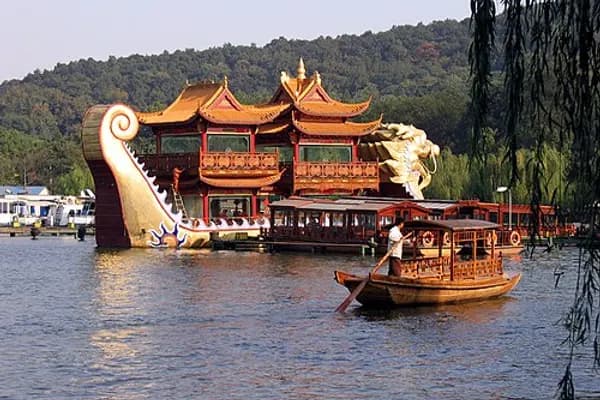
Location Shore length is not a well-defined measure. West Lake, also known as Xihu and by other names, is a freshwater lake in Hangzhou, China. Situated to the west of Hangzhou's former walled city, the lake has a surface area of 6.39km (2.47sqmi), stretching 3.2km (2.0mi) from north to south and 2.8km (1.7mi) from east to west. In the lake are four causeways, three artificial islands, and Gushan, the only natural island. Gentle hills surround the lake on its north, west, and south sides, with the Leifeng and Baochu pagodas standing in pair on the south and north banks. Several famous temples are nestled in the mountains west of the lake, including Lingyin and Jingci Temples.
A tourist attraction since the Tang dynasty (618–907), the lake has influenced poets and painters throughout Chinese history for its natural beauty and historic relics. By the Song dynasty (960–1279), during which the dynastic capital moved to Hangzhou, it had become a cultural landmark and one of the most visited tourist destinations of China. Introduced to Europeans by Marco Polo, the lake was once a symbol of Chinese urban culture. It has been featured on Chinese currency, including the one-yuan banknote in the 1979 Bank of China Foreign Exchange Certificate and the 2005 Renminbi, as well as in the Chinese passport. A UNESCO World Heritage Site since 2011, the lake is recognised to have influenced garden designs in China, Japan, and Korea over the centuries as "an idealised fusion between humans and nature."
The lake, along with the surrounding hills, constitutes the West Lake Scenic Area, which is governed by the Management Committee of Hangzhou West Lake Scenic Area, a special administration dedicated to cultural preservation and gardening under the Hangzhou municipal government since 2002. The first major Chinese tourist attraction to cancel admission fees, the scenic area is crowded during public holidays. Over the 2024 National Day holiday, the area received 4.426 million visitors in seven days, a 30.92% rise from the previous year.
Names
Historically, the lake has been referred to by various names, including Qiantang Lake. The first description of the waters near Hangzhou was made in the Book of Han finished in 111, which states,
The Western Commandery Captain of Qiantang was stationed at the Wulin Hills, where the Wulin River originates. The river flows eastward into the sea, covering a distance of 830 li [350 km; 220 mi].
This statement about the Wulin River (武林水) is widely interpreted as the first mention of West Lake, while the Wulin Hills (武林山) are believed to be the hills near the Lingyin Temple.
Bai Juyi was among the first to refer to the lake as "West Lake", due to its location to the west of the city. Su Shi was the first to use the name in official documents, in his request to the Imperial Court for the dredging of the lake in 1090. 16th-century Chinese scholars considered the West Lake of Hangzhou to be the most famous among the 35 other lakes with the same name in China. In English, the name has also been variously translated and romanized as the West Lake, the Western Lake, Si-hu, Hsi Hu, Xi Hu, Lake Si, Lake Hsi, Lake Hsi-hu, and Xi Lake. Due to Su Shi's famous comparison with Xizi, the lake is also sometimes described in Chinese as Xizi Lake.
History
Natural formation and dredging efforts
About 4,400 to 2,500 years ago, as sea levels fell, the Hangzhou-Jiaxing-Huzhou plain began to emerge, while West Lake was merely a shallow bay. Over time, the Qiantang River gradually deposited sand and rocks outside this bay. About 2,000 years ago, a lagoon was formed. Streams from the surrounding mountains transformed the water into freshwater, but ongoing silt deposits gradually reduced the lake to a swamp. In local folklore, when Qin Shi Huang (259–210BC), the first emperor of China, visited Hangzhou, West Lake was still part of the Qiantang River. The giant rock on the north bank of West Lake was said to be where the emperor anchored his fleet. According to Records of the Grand Historian, during his visit in 210 BC, the emperor was halted in Hangzhou by the strong tide of the Qiantang River and had to take a detour westward to reach Shaoxing. During the Eastern Han era (25–220), local official Hua Xin ordered the construction of a seawall to completely cut the lake off from the sea. In 591, the government seat of Hangzhou, originally on the west shore, was relocated to the newly built walled city east to the lake. With the completion of the Grand Canal, Hangzhou, as its destination, became a transport hub of China.
Before the Tang dynasty (618–907), West Lake was a shallow body of water, but continuous dredging efforts prevented it from becoming a swamp. During the Jianzhong period (780–783) of the Tang dynasty, local official Li Bi diverted water into Hangzhou via an underground pipes, creating six ponds to secure the city's water supply. In 822, Bai Juyi dredged West Lake and used the silt to build a long causeway between Qiantang and Yuhang Gates, which was named in his memory. Under the Wuyue Kingdom (907–932), with Hangzhou being the capital, King Qian Liu ordered annual dredging of West Lake with soldiers to maintain water quality for water supply. In the Song dynasty, Su Shi (1037–1101) ordered the construction of the Su Causeway from dredged silt in 1089. He designated an area of the lake with three stone pagodas to prevent water chestnut planting and reduce silting, which may mark the origin of the "Three Ponds Mirroring the Moon." By 1275, military patrols were appointed to maintain and police the lake, where littering of any rubbish or planting additional lotuses or water-chestnuts were forbidden.
From literary tradition to tourism
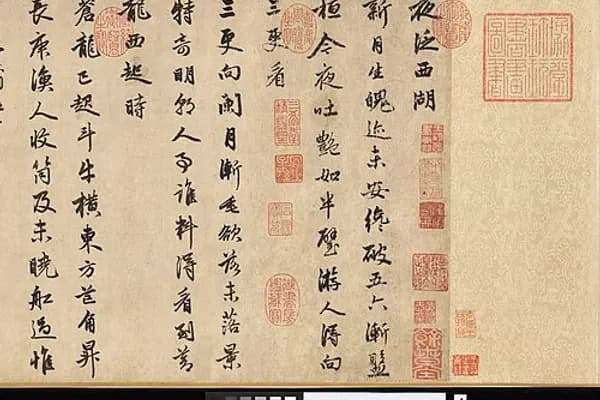
Literary works by renowned literati contributed to the fame of Hangzhou's West Lake among Chinese intellectuals. Especially, the lake became associated with the two greatest poets of Middle-Period China, Bai Juyi and Su Shi. Su Xiaoxiao, a famous courtesan and poet of Southern Qi (479–502), was buried upon West Lake. Her life and poetry have inspired later poets, including Li He and Wen Tingyun. Over time, local history became intertwined with the natural beauty. For example, Bai Juyi celebrates Su Xiaoxiao's beauty and her connection to the enchanting scenery of the lake in one of his poem. When Su Shi (1037–1101) famously compared West Lake to Xizi, one of the Four Beauties of ancient China, the lake also became known as the Xizi Lake:
水光瀲灧睛方好,
山色空濛雨亦奇。
欲把西湖比西子,
淡妝濃抹總相宜。
Translation: The shimmering water shines in clear light,
While misty mountains bring rain's charm to sight.
If West Lake I liken to Xizi fair,
Both light and heavy makeup suits her well.
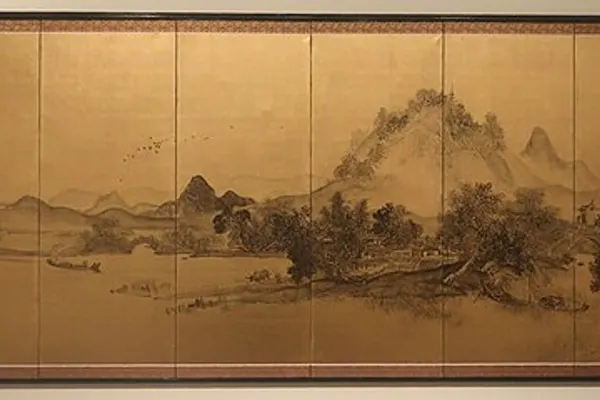
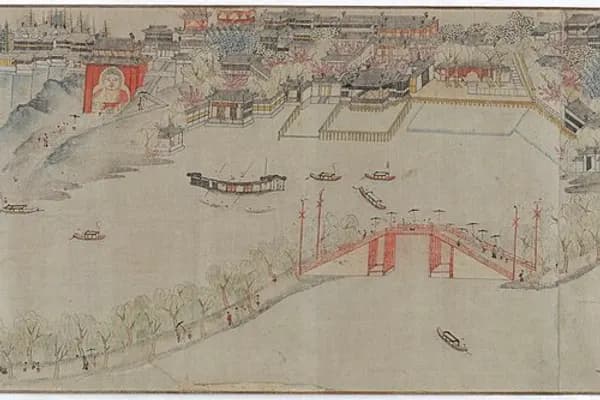
During the period of Wuyue Kingdom (907–978), numerous temples, pagodas, shrines, and grottoes were built or expanded around the lake, including Lingyin, Zhaoqing, Jingci, Li’an, Liutong, and Taoguang temples, as well as the Baochu, Liuhe, Leifeng, and White pagodas, due to the devotion of its rulers to Buddhism. Since the 12th and 13th centuries, these temples, frequently visited by Japanese monks, played a significant role in circulating cultural images of the lake across East Asia, as these visitors returned to their home countries.
Wars and conflicts in northern China during the Song dynasty—including invasions by the Khitan, Jurchen, and Mongols—triggered significant migration southward to the new capital, leading to urbanisation and economic prosperity. With city walls blocking much of the natural scenery, West Lake became a favoured destination for urban residents seeking respite from the demands of city life and political turmoil. Since 1129, the capital of the Song dynasty was relocated to Hangzhou, after the country lost its northern territories to the Jurchen. The imperial examination held every three years filled Hangzhou with educated individuals, who often enjoyed the lake's beauty and consulted fortune-tellers at lakeside temples. Visiting West Lake inspired poems that reflected on their experiences and memories of the scenery.
By the late Song dynasty, West Lake had evolved into a significant hub where tourism emerged. While pilgrimage and contemplative retreat had previously been the main motives for travel, sightseeing gained wide acceptance as an activity focused on enjoyment and the appreciation of natural beauty, roughly at the same time as in western Europe. Aesthetic appreciation of landscapes became a popular business, with diverse entertainment options which involved standardised routes and viewing orders made available to cater to various preferences and budgets. Tour guides, seasonal markets and specialty shops emerged. The notion of Ten Scenes of West Lake was invented. Boating on the lake was a popular pastime, with records noting hundreds of intricately carved, elegantly decorated boats gliding gracefully over the water.
Shortly after the Mongol conquest of China, West Lake remained socially vibrant. The official records show that in 1309, the city received more than 1,200 foreign visitors within half a year, many from Turkestan and Europe. West Lake was dredged and renamed the “Pond of Freeing Captive Animals” under Kublai Khan, while parts of the lake area were gradually cultivated into farmland. Among the visitors was Marco Polo, who describes the lake in his book,
Inside the city there is a Lake which has a compass of some 30 miles: and all round it are erected beautiful palaces and mansions, of the richest and most exquisite structure that you can imagine, belonging to the nobles of the city. There are also on its shores many abbeys and churches of the Idolaters. In the middle of the Lake are two Islands, on each of which stands a rich, beautiful and spacious edifice, furnished in such style as to seem fit for the palace of an Emperor.
Mongol rule and fall of tourism
The booming tourism led to different interpretations. The lake was regarded as a literary tradition, a symbol of the state and a part of local history and knowledge, but for some, a symbol of extravagance and luxury. One of the most famous portrayal comes from Lin Sheng, who penned a poem as a satirical commentary on how people were engrossed in their indulgence in Hangzhou's pleasures, rather than making efforts to reclaim the lost northern capital:
山外青山樓外樓,
西湖歌舞幾時休?
暖風熏得遊人醉,
直把杭州作汴州。
Translation: Beyond the hills, more hills rise, beyond the pavilions, more pavilions stand.
When will the songs and dances on West Lake finally end?
The warm breeze intoxicates the travellers,
Making them mistake Hangzhou for Bianzhou.
In 1142, Yue Fei, a hawkish Chinese general known for his determined efforts to reclaim northern China, was executed by the dovish emperor and his chief councillor. Yue's death marked the end of attempts to recapture the north, as the emperor prioritised peace despite the Song army's successes. Yue Fei remained widely admired among Chinese people and was widely celebrated as a national hero. In 1162, his wrongful execution was acknowledged, and his remains were moved to a tomb by West Lake. Since 1221, a nearby temple has been repurposed in his memory.
The Mongol-led Yuan dynasty (1271–1368) saw the decline of tourism at West Lake. Government support for maintaining the lake diminished, as Mongol rulers placed their political and economic focus on northern China rather than the south. The Mongol rulers, as well as local residents, blamed the lavish life upon the lake for the fall of Song. Therefore, the lake was abandoned. When the Ming dynasty replaced Mongol rule, Hangzhou gradually regained its prosperity by the mid-15th century. However, the lake experienced droughts in 1442 and 1456, causing it to dry up temporarily.
Revitalisation in Late Imperial China
Since the mid-Ming era, renewed dredging projects rekindled public interest in West Lake. As Hangzhou developed as a publishing centre, the production of geographic texts stimulated tourism, which in turn further fuelled the publishing industry. In 1508, Hangzhou governor Yang Mengying led a major dredging effort, repairing the Su and Bai Causeways and creating the Yanggong Causeway in his memory. This restoration returned the lake's appearance to its Tang dynasty splendour. Further construction works in 1576, 1607-1611 and 1621 built the Mid-Lake Pavilion and the Lesser Yingzhou Islet. The period of time saw the publication of a series of books on local history and culture which depicted West Lake, inspiring Japanese gardens such as the Kyū Shiba Rikyū Garden.
The Manchu conquered Hangzhou in 1645, which led to the construction of residences alongside the lake. During the High Qing era (1683–1799), emperors frequented southern China, to symbolise their control. Due to the visits by the Qing emperors, the lake was fully dredged and renovated. In 1689, a temporary imperial palace was built on Gushan. In 1722, Zhejiang governor Li Wei was ordered to dredge the lake. In 1809, Ruan Gong Islet was built with silted soil, which was named after Ruan Yuan, then governor of Zhejiang.
The emperors revived and standardised the notion of the Ten Scenes of West Lake. The Kangxi Emperor inscribed titles for these scenes, which were later carved into stelae beneath ten pavilions. The Qianlong Emperor composed poems during his visits, which were then inscribed on the reverse side of Kangxi's stelae. He further inscribed the Eight Scenes of Dragon Well in the surrounding hills. In Beijing, imperial gardens, including the Garden of Delighted Spring and the Old Summer Palace, were designed to imitate the landscape designs of West Lake.
After the Taiping Rebellion (1850–1864) destroyed various buildings beside the lake, West Lake revived as major Qing military leaders, magnates, and ranking officials, such as Peng Yulin built their villas upon the lake, which later became their memorial temples and shrines that were later maintained by a dedicated division of local government. In 1864, the West Lake Dredging Bureau was established, to manage the dredging of the lake.
Modern era
Following the 1911 revolution that ended the Qing dynasty, the Manchu quarter of the city was demolished, including both its separate fortifications and the section of the city wall that separated it from the lakefront. Qing imperial properties around West Lake were also nationalised. Land in the Manchu quarter was sold at auction to establish a New Business District and the lakefront renovated as a string of public parks, integrating West Lake into the new heart of the city. The former imperial palace on Gushan was converted into Zhongshan Park, named for Sun Yat-sen. The buildings associated with former Qing officials and generals were renamed after Ming loyalists, as with the Shrine of Former Martyrs. The railway link between Hangzhou and Shanghai, completed in 1909, stimulated local tourism.
Encyclopedic content adapted from the Wikipedia article on West Lake, used under CC BY-SA 4.0.