About the neighborhood
Capital of Somme, France
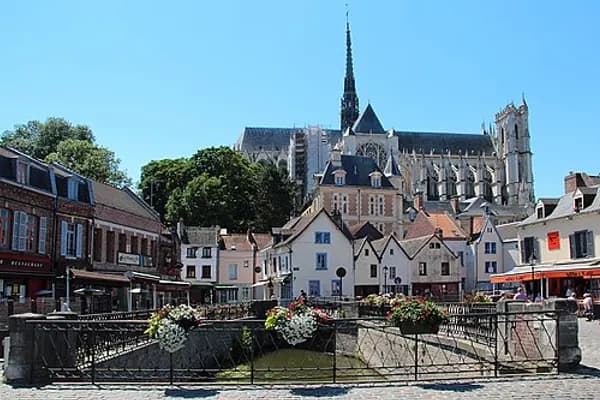
Amiens (English: /æˈmjæ̃/ or /ˈæmiənz/ AM-ee-ənz; French: amjɛ̃ ; Picard: Anmien, Anmiens or Anmyin) is a city and commune in northern France, located 120km (75mi) north of Paris and 100km (62mi) south-west of Lille. With 136,449 inhabitants (2023), it is the capital of the Somme department in the region of Hauts-de-France. A central landmark of the city is Amiens Cathedral, the largest Gothic cathedral in France. Amiens also has one of the largest university hospitals in France, with a capacity of 1,200 beds. The author Jules Verne lived in Amiens from 1871 until his death in 1905, and served on the city council for 15 years. Amiens is the birthplace of French president Emmanuel Macron.
The town was fought over during both World Wars, suffering significant damage, and was repeatedly occupied by both sides. The 1918 Battle of Amiens was the opening phase of the Hundred Days Offensive which directly led to the Armistice with Germany. The Royal Air Force heavily bombed the town during the Second World War. In the aftermath, the city was rebuilt according to Pierre Dufau's plans with wider streets to ease traffic congestion. These newer structures were primarily built of brick, concrete and white stone with slate roofs. The architect Auguste Perret designed the Gare d'Amiens train station and nearby Tour Perret.
Amiens has an important historical and cultural heritage, on which a significant amount of tourism is based. Apart from the cathedral, there are the hortillonnagesfr, the Jules Verne Housefr, the Tour Perret, the Musée de Picardie, the zoofr, and the Saint-Leu and Saint-Maurice neighborhoods. A total of 60 monuments are listed in the inventory of monuments historiques, over 1600 places and monuments listed in the general inventory of cultural heritage, and 187 objects listed in the inventory of monuments historiques. During December, the town hosts the largest Christmas market in northern France. It is known for a few local foods, including "macarons d'Amiens", almond paste biscuits; "tuiles amienoises", chocolate and orange curved biscuits; "pâté de canard d'Amiens", duck pâté in pastry; "la ficelle Picarde", an oven-baked cheese-topped crêpe; and "flamiche aux poireaux", a puff pastry tart made with leeks and cream.
History
The first known settlement at this location was Samarobriva ("Somme bridge"), the central settlement of the Ambiani tribe, one of the principal tribes of Gaul. The Romans named the town Ambianum, meaning settlement of the Ambiani people. Amiens was part of Francia starting from the 5th century. The Normans sacked the city in 859 and again in 882.
In 1113, the city was recognized by King Louis VI of France, and in 1185 it was linked to the Crown of France. In 1597, Spanish soldiers held the city during the six-month Siege of Amiens, before Henry IV regained control. During the 18th and 19th century, the textile tradition of Amiens became famous for its velours. As a result of the French Revolution, the provinces of France were dismantled and the territory was organised into departments. Much of Picardy became the newly created department of Somme with Amiens as the departmental capital. During the industrial revolution, the city walls were demolished, opening up space for large boulevards around the town center. The Henriville neighborhood in the south of the city was developed around this time. In 1848, the first railway arrived in Amiens, linking the city to Boulogne-sur-Mer. During the 1870 Battle of Amiens, the city was occupied by invading Prussian forces.
The town was fought over during both the First and Second World Wars, suffering significant damage and being occupied several times by both sides. The 1918 Battle of Amiens was the opening phase of the Hundred Days Offensive which led directly to the Armistice with Germany that ended the war. In June 1944 following D-Day, Amiens was heavily bombed by the Royal Air Force. The town was liberated by British forces on 31 August. The city was rebuilt according to Pierre Dufau's plans with a focus on widening the streets to ease traffic congestion. These newer structures were primarily built of brick, concrete and white stone with slate roofs. The architect Auguste Perret designed the Gare d'Amiens train station and nearby Tour Perret.
Geography
Location
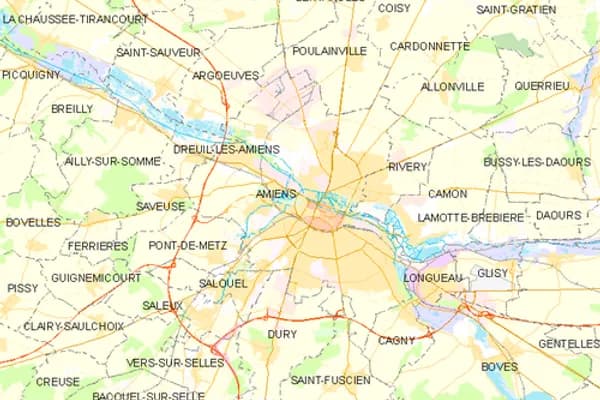
Amiens, once regional prefecture of the former Picardy Region, is the prefecture of the Somme department, one of the three departments (with Oise and Aisne) in the region. Located in the Paris Basin, the city benefits from a privileged geographical position, with close proximity to Paris, Lille, Rouen, London and Brussels. At the crossroads of major European routes of travel (A1, A16 and A29), the city is also at the heart of a major rail star.
As the crow flies, the city is 115 kilometres (71mi) north of Paris, 97 kilometres (60mi) south-west of Lille, 100 kilometres (62mi) north-east of Rouen, 162 kilometres (101mi) east-north-east of Le Havre and 144 kilometres (89mi) north-west of Reims. At the regional level, Amiens is located 53 kilometres (33mi) north of Beauvais, 71 kilometres (44mi) west of Saint-Quentin, 66 kilometres (41mi) from Compiègne and 102 kilometres (63mi) from Laon.
In area, Amiens is the third-largest settlement in the Somme, after Crécy-en-Ponthieu and Hornoy-le-Bourg.
Geography and relief
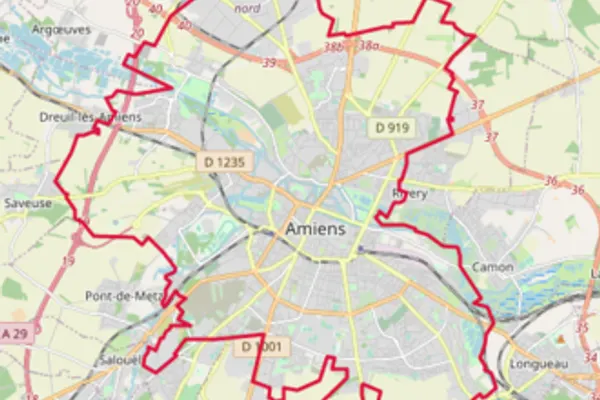
The area of the commune is 4,946 hectares (12,220 acres); the altitude varies between 14 and 106 metres (46 and 348ft).
Hydrography: Somme and canal, Avre and Selle
The main stem of the River Somme passes through Amiens and is generally benign, except during exceptional floods that can last up to several weeks (such as in spring 2001). It is also, on its southeastern outskirts, close to Camon and Longueau, the confluence with its main tributary on the left bank (to the south), and the Avre. The Selle enters from the northwest of Amiens, with two arms (including the Haute Selle) passing behind the Unicorn Stadium, the exhibition park, the megacity and horse racing track, then passing the end of the Promenade de la Hotoie and the zoo of Amiens, and to the right of the water treatment plant, in front of the island Sainte-Aragone, opposite the cemetery of La Madeleine in Amiens.
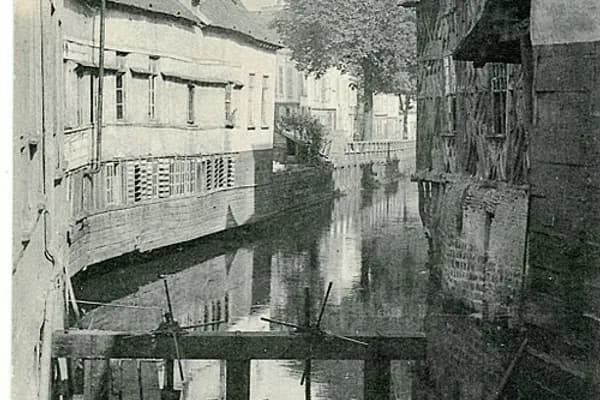
The city developed in a natural narrowing of the river due to the advance of the rim of the Picard plateau in Saint-Pierre (ford crossing). The Amiens citadel is built on this limestone butte of the Picard plateau and Rue Saint-Pierre is a slightly inclined path to leave the city from the north. At this narrowing, a network of narrow canals led to the construction of bridges and buildings including textile mills in the Middle Ages.
The marshes of the old bed of the river Somme was used to dig peat. Farmers maintained rieux, canals and ditches by cleaning out the silt and used it to append to their vegetable garden plot. During the 20th century maintenance of the canals was stopped and gardens were gradually left to lie fallow or sold to private individuals who created pleasure gardens accessible by boat.
The hydrographic network has always been an important city-operated asset. The river helped shape the identity of the landscape, urban and economic territory. It is around the Saint-Leu and Saint-Maurice neighborhoods that border the River Somme, as well as most of the administrative and civil area of the current city center which the city has developed since antiquity.
The Canal de la Somme dates from the beginning of the 19th century and the bridge at the foot of the citadel was built after World War II.
Climate
Amiens has the typical oceanic climate of the north of France, with relatively mild winters, cool summers, and rainfall well distributed throughout the year.
Transport
Amiens is a hub between the Île de France and the rest of northern France; Normandy and Benelux; and France and Great Britain. Amiens is not directly on principal European road and rail arteries, such as the A1 motorway and the Paris-Lille TGV train line, at present.
However, due to its position halfway between the urban areas of Lille and Paris, Amiens has good conditions for service and accessibility, including motorways (at the junction of the A16 and A29).
Rail
Amiens station is served by regional train services to destinations that include Rouen, Calais, Lille, Reims, Compiègne and Paris-Nord. Saint-Roch (Somme) station in the western part of the city is served by local trains towards Rouen and Abbeville. A regular bus route with the TGV Haute-Picardie station also provides access to the Charles-de-Gaulle Airport station. On the horizon of 2025, the Roissy–Picardie Link will put Amiens 55 minutes from Paris Charles-de-Gaulle Airport and its TGV station.
By train, Amiens is located at:
Roads
Since antiquity, Amiens has been a crossroads of important routes. The contemporary city is served by the A16 and A29 autoroutes. The Jules Verne Viaduct, 943 metres (3,094ft) long, crosses the River Somme to the east of the city and allows circumvention of the city by motorway-type roads. The A16 and A29 autoroutes, the RN1 and the RN25 form a bypass-type motorway around the city that the population has called the Rocade d'Amiensfr or Amiens ring road. Initially constituting national roads which are downgraded today, mostly as departmental roads, the greater urban area of Amiens is served by:
Amiens is served by several motorways:
A16 to Calais via Abbeville and Boulogne-sur-Mer
A16 to Paris via Beauvais
A29 to Rouen and Le Havre via Neufchâtel-en-Bray
A29 to Reims via Saint-Quentin and Laon
The proposed A24 autoroute from Amiens to Lille via Doullens was cancelled in 2006.
Parking
According to the urban transport plan (PDU) approved 19 December 2013 for the period 2013–2023 parking supply is considered abundant in Amiens. Although important, demand for parking is less than what is available (capacity reserves are still 20% minimum: If the road is sometimes saturated, the occupancy rate of the underground parking remains globally less than 100%).
In 2013, the city counted approximately 70,000 public parking spaces, including 8,400 in the city center and in its immediate vicinity, where 70% of places are paid.
4,400 spaces on highways (1,950 in the inner city, including 1,600 paid)
4,000 spaces in underground parking (620 other new places are programmed in a project for the Gare La Vallée development zone).
As of 2007, a residential parking system has been deployed in Saint-Anne ward to cope with congestion in the streets caused by SNCF railway station users. During the campaign for the municipal election of 2008, parking was one of the important topics of debate. A year after the change of majority, the Gilles Demaillyfr team launched a consultation with the population. From 2011, residential parking was extended to the Gare-La-Vallée and Riolan neighborhoods, then in 2012 to the Noyon neighborhood and the area east of the Riolan sector. In 2014, 2,600 parking spaces were affected by this system which allowed city residents more parking near their homes in order to promote a better rotation of vehicles in the streets and reduce permanent occupation of public space by the cars cluttering the highway.
Public transport
Amiens was once served by two tram linesfr with a combined length of 10.7 kilometres (6.6mi), opened in 1887. They intersected at Place Gambetta, one linking La Madeleine Cemeteryfr, the Church of Saint-Acheul, Cagnard bridge, Rue de Noyon and Rue Jules-Barni; the other from the Church of Saint-Pierre at the racecourse, by the streets of Saint-Leu, Frédéric-Petit and Colbert. Electrified in 1899, the network grew to seven lines totaling 19 kilometres (12mi) in 1906. From 1932, Longueau was linked to Amiens by a bus service. German bombing in 1940 destroyed most of the city center and hit the Jules-Ferry Road tram depot, totally destroying the tram fleet. Only the Longueau bus survived. A few old Parisian buses were also used in an extremely reduced service. These buses as well as the surviving bus were then converted to city gas and equipped with tanks on the roof covered by a huge white dome. This service continued until approximately 1946. There were only two urban lines: An east–west line (Saint-Acheul – Montieres) and a northeast–southwest line (Beauville – road to Rouen). It was decided after the war to serve the city by a trolleybus with one route to Longueau. This was only in part realized, serving Saint-Acheul, Rouen, La Madeleine and Saint-Pierre. In 1964, trolleybuses were abandoned and the bus became ubiquitous in Amiens transportation.
The current public transport networkfr consists of a bus network managed by the Ametis mixed economy companyfr, whose network covers Amiens Métropole, the agglomeration of Amiens. The establishment of dedicated bus lanes began in 2006. Former Mayor Gilles de Robien had envisioned the creation of a tramfr, but the choice of dedicated bus lanes had been preferred for reasons of cost and patronage. His successor, Mayor Gilles Demaillyfr, had been considering the development of a TSCP in the metropolitan area. As a result of numerous studies and conferences, elected representatives voted for the creation of a tram at the municipal Council of 15 November 2012. The project had been endorsed by the Communauté d'agglomération Amiens Métropole on 18 December 2012 and the commissioning of a first north–south tram route was scheduled for 2018/2019. Following the elections of 2014fr, which were a defeat for most municipal and community carriers of the project, the new mayor of Amiens Brigitte Fouré, and by extension the new president of Amiens Métropole Alain Gest, decided to suspend the project at least during the time of their respective mandates, thus applying a campaign promise (the tram was at the heart of debate) and despite a project announcement of trams on tyres (of TVR type). Improvement of public transit would then be only by that of the bus network. Indeed, in December of the same year, the Community Council approved funding for a study (the sixth in 20 years) relating to the establishment of a rapid transit bus network (BHNS), which should enter into service in March 2019, and whose vehicles could be electric.
Cycle networks
Amiens has developed two bike services: Buscyclette and Velamfr.
Buscyclette is a service of rental bikes on demand, created in May 1999. In 2014, nearly 2,400 "green bikes" are available for rent, essentially city bikes but also electric bikes (VAE), folding bicycles and specific bikes (such as kids bikes, child trailers, mountain bikes, cargo bikes, tandems). The rental period varies from half a day to one year.
Velam is a bike sharing system created on 16 February 2008, an adaptation of the Cyclocityfr system managed by JCDecaux, similar to Vélo'v in Lyon and Vélib' in Paris. Velam offers 313 bikes distributed every 300 to 400 metres in the center of Amiens and 26 stations.
Encyclopedic content adapted from the Wikipedia article on Vieux Nice, used under CC BY-SA 4.0.