About the neighborhood
Special ward in Tokyo, Japan
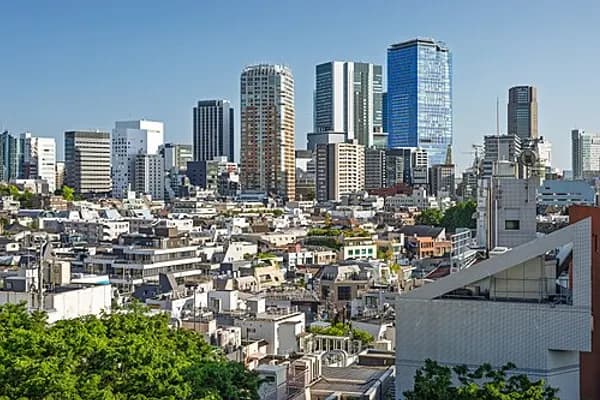
Shibuya (渋谷区, Shibuya-ku; IPA: ɕibɯja ) is a special ward in Tokyo, Japan. A major commercial center, Shibuya houses one of the busiest railway stations in the world, Shibuya Station.
As of January 1, 2024, Shibuya Ward has an estimated population of 230,609 in 142,443 households and a population density of 15,262.01 peopleper square kilometer (39,528.4 people/mi). The total area is 15.11km (5.83sqmi). Notable neighborhoods and districts of Shibuya include Harajuku, Ebisu, Omotesandō, Yoyogi and Sendagaya.
Shibuya came into the possession of the Shibuya clan in the early 1160s, after which the area was named. The branch of the clan that ruled this area was defeated by the Later Hōjō clan on January 13, 1524, during the Sengoku period, and the area then came under their control. During the Edo period, Shibuya, particularly Maruyamachō on Dōgenzaka, prospered as a town on Oyama Road (present-day Route 246), and in the Meiji era, as a Hanamachi. Shibuya emerged as a railway terminus during the expansion of the railway network beginning in the 19th century, and was incorporated as a ward in the City of Tokyo on October 1, 1932.
Shibuya, once a mediocre area developed around the railway terminus, overtook Shinjuku as a hub for youth culture in the 1970s. The coinciding competition between Seibu (whose most notable development projects include Shibuya Parco) and Tokyu (Tokyu Hands, Shibuya 109) to develop the area as a commercial center added to its appeal to young people, which in turn spread to other neighborhoods in the ward, such as Harajuku.
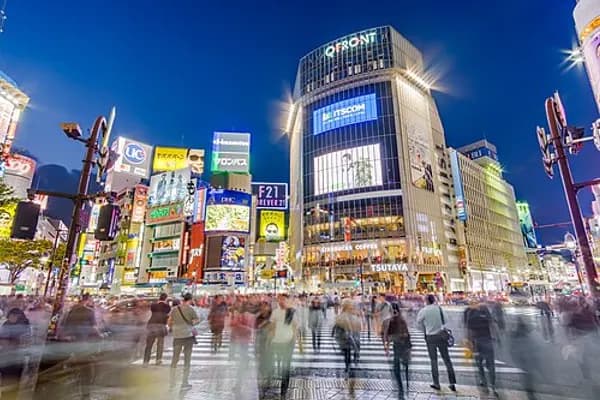
The Shibuya Crossing, known as the busiest pedestrian crossing in the world, the panoramic view of the city from the rooftop of Shibuya Scramble Square, and the statue of Hachikō are internationally recognized tourist attractions.
The area surrounding Shibuya Station has been undergoing large-scale redevelopment since 2010, with the entire project scheduled for completion in fiscal year 2034 (April 2034 to March 2035).
History
Shibuya came into the possession of the Shibuya clan in the early 1160s, after which the area was named. The clan was a cadet branch of the Taira clan descended from Taira no Yoshifumi. The clan built a fortress near the present-day Konnō Hachimangu Shrine. The branch of the clan that ruled this area was defeated by the Later Hōjō clan on January 13, 1524, during the Sengoku period, and the area then came under their control. During the Edo period, Shibuya, particularly Maruyamachō on Dōgenzaka, prospered as a town on Oyama Road (present-day Route 246), and in the Meiji era, as a Hanamachi.
The village of Shibuya was incorporated in 1889 by the merger of the villages of Kami-Shibuya, Naka-Shibuya and Shimo-Shibuya within Minami-Toshima County (Toyotama County from 1896). The village covered the territory of modern-day Shibuya Station area as well as the Hiroo, Daikanyama, Aoyama, and Ebisu areas. Shibuya became a town in 1909. The town of Shibuya merged with the neighboring towns of Sendagaya (which included the modern Senda, Harajuku and Jingumae areas) and Yoyohata (which included the modern Yoyogi and Hata areas) to form Shibuya-ku suburban ward upon being absorbed into Tokyo City in 1932. Shibuya became an urban special ward under the Local Autonomy Act in 1947.
The Tokyu Toyoko Line opened in 1932, making Shibuya a key terminal between Tokyo and Yokohama, and was joined by the forerunner of the Keio Inokashira Line in 1933 and the forerunner of the Tokyo Metro Ginza Line in 1938. The story of Hachikō, a dog who waited for his deceased master at Shibuya Station every day from 1923 to 1935, created a national sensation due to his unwavering loyalty. A statue of Hachikō was built adjacent to the station, and the surrounding Hachikō Square is now one of the most popular meeting points in the area.
During the occupation of Japan, Yoyogi Park was used as a housing compound for U.S. personnel known as "Washington Heights". The U.S. military left in 1964, and much of the park was repurposed as venues for the 1964 Summer Olympics. The ward itself served as part of the athletics 50km walk and marathon course during the 1964 games.
In the mid-1990s, Shibuya-kei, a microgenre of pop music, became mainstream in Japan. Distinguished by a "cut-and-paste" approach, it peaked in the late 1990s and declined after its principal players began moving onto other music styles.
Since the beginning of the 21st century, large-scale redevelopment has been underway in the area surrounding Shibuya Station. The scale of the project has been described as something that happens once in a hundred years. In 2005, the Japanese government designated the district as an Urban Renewal Area. Following discussions among scholars, the Ministry of Land, Infrastructure, Transport and Tourism, the Tokyo Metropolitan Government, Shibuya City Office, and railway operators such as Tokyu Corporation, JR East, and Tokyo Metro, a master plan was announced in 2008. In 2010, the Tokyo Metropolitan Government approved the implementation of the redevelopment plan, and full-scale construction officially began. As part of the redevelopment, the existing station facilities were demolished. The Tōyoko Line was moved underground, the Ginza Line platform was relocated, and the Saikyō Line platform was placed parallel to the Yamanote Line platform. Several existing commercial buildings were also demolished and replaced by high-rise complexes such as Shibuya Hikarie, Shibuya Stream, Shibuya Fukuras (ja), Shibuya Sakura Stage (ja), and Shibuya Scramble Square. Because railway operations had to continue during construction, and because the pedestrian network plan around the station was revised during the process, the overall completion of the redevelopment is now scheduled for fiscal year 2034, which is seven years later than originally planned.
Miyashita Park closed in 2017 and reopened in July 2020 as a shopping complex with a rooftop park.
Geography
Shibuya includes many well-known commercial and residential districts such as Daikanyama, Ebisu, Harajuku, Hiroo, Higashi, Omotesandō, Sendagaya, and Yoyogi.
Districts
Hatagaya Area: Sasazuka, Hatagaya, Honmachi
Yoyogi Area: Uehara, Ōyamachō, Nishihara, Hatsudai, Motoyoyogichō, Tomigaya, Yoyogikamizonochō, Yoyogi
Sendagaya Area: Sendagaya, Jingūmae
Ebisu-Ōmukai Area: Kamiyamachō, Jinnan, Udagawachō, Shōtō, Shinsenchō, Maruyamachō, Dōgenzaka, Nanpeidaichō, Sakuragaokachō, Hachiyamachō, Uguisudanichō, Sarugakuchō, Daikan'yamachō, Ebisunishi, Ebisuminami
Hikawa-Shimbashi Area: Shibuya, Higashi, Ebisu, Hiroo
Demographics
Per Japanese census data, the population is rising again after decline between 1960 and 2000.
Politics and government
Shibuya is run by a city assembly of 34 elected members. The mayor is Ken Hasebe, an independent.
Elections
2003 Shibuya mayoral election
Same-sex partnership certificate
In 2015, as the council passed "Ordinance for Promoting Respect of Gender Equality and Diversity in the Ward", Shibuya Ward became the first Japanese municipality that issues same-sex partnership certificates. According to this ordinance, same-sex couples who live in Shibuya are allowed "to rent apartments together, and have gained hospital visitation rights as family members". The ordinance was intended to bring three benefits to same-sex couples: "(1) rental housing within the ward (co-signing of tenancy agreements for municipal/public housing), (2) medical institutions within the ward (hospital visitation and medical decision-making rights as family members), and (3) employment conditions within the ward (e.g. family benefits, congratulations and condolence leave)". In order to apply for the certificate, couples must be 20-years-old or older residents of Shibuya Ward and have to state that "their relationship is based on love and mutual trust" in a notarized document. Koyuki Higashi (a former member of the Takarazuka Revue) and Hiroko Masuhara (an entrepreneur), a lesbian couple, were the first to receive this certification. Since the Shibuya Ward passed the ordinance, seven other municipalities in Japan have begun offering similar certificates.
The BBC notes that in practice, the ordinance is not binding, though their names will be posted on the ward's website if they violate the ordinance. Shimizu says the system "is not equivalent to marriage, as it does not accord same-sex couples the same rights as heterosexual couples when it comes to inheritance, joint filing of taxes, or social welfare". As it requires at least a hundred thousand yen to apply for the certificate, it can be restrictive to some couples. Shimizu argues that Shibuya Ward has been criticized for pinkwashing as "while passing this ordinance, the administration also moved to expel the homeless in Miyashita Park and other parks in the ward". Pointing out that the mayor of Shibuya Ward in an interview stated that this is not a matter of human rights, but of diversity, Yuri Horie claimed that the term of diversity seems to be used to divide citizens into the good and the bad; it raises only the ones who contribute to the consumeristic society as representer of "diversity of sexuality" while excluding the useless ones. Yuki Tsuchiya, a lesbian activist, also argues that LGBT individuals are used to promote the ward.
Sightseeing and local landmarks
Shibuya is famous for its scramble crossing, called Shibuya Crossing. It is located in front of the Shibuya Station Hachikō exit and stops vehicles in all directions to allow pedestrians to inundate the entire intersection. Shibuya Crossing is the "world's busiest pedestrian crossing", with upwards of 3,000 people at a time. A statue of the dog Hachikō, remembered for his unwavering loyalty to his deceased owner, is installed outside Shibuya Station. The statue and its surrounding Hachikō Square are a common meeting place and are almost always crowded. On the southwest side of Shibuya Station, there is a Moyai statue, given to Shibuya by the people of Niijima Island in 1980.
Green areas
Shinjuku Gyo-en, former Imperial gardens now open to the public as a park
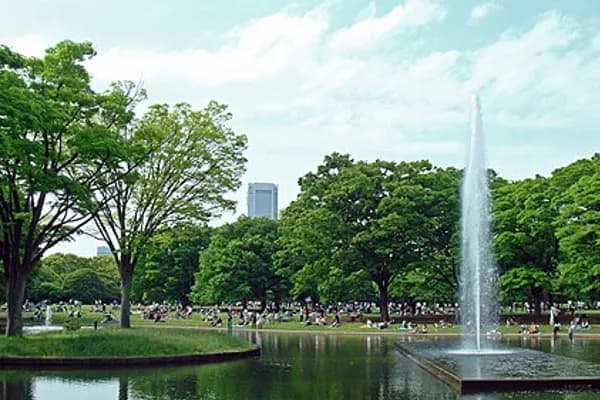
Yoyogi Park, once a training base for the Imperial Japanese Army, later the Washington Heights housing area for the Occupation of Japan, then the lodgings for contestants in the 1964 Tokyo Olympics
Commercial complexes
Cerulean Tower, formerly the tallest building in the Shibuya Station area
Omotesandō Hills, a shopping mall completed in 2006
Shibuya 109, a popular and trendy place for mostly Japanese young women to shop
Shibuya Fukurasja
Shibuya Hikarie
Shibuya Mark City
Shibuya Scramble Square
Shibuya Stream
Shinjuku Southern Terrace
Takashimaya Times Square, one of the largest department stores in Japan
Yebisu Garden Place, site of the former Sapporo Brewery, now featuring restaurants and shopping, along with the Westin Hotel
Cultural institutions
Bunka Gakuen Costume Museum
Bunkamura, a cultural center and concert hall complex
Kawamoto Kihachirō Puppet Gallery
Koga Masao Museum of Music
Kokugakuin University Museumja, a museum of Japanese archaeology and Shintō culture at Kokugakuin University
Meiji Jingū Museum
National Noh Theatre
New National Theatre, site of opera, ballet, and other performances
Shibuya Cultural Center Owadaja, a public cultural complex including lifelong learning center, planetarium and halls
Shibuya Folk and Literary Shirane Memorial Museumja, a public museum of Shibuya's local history and literary
Shoto Museum of Artja
Toguri Museum of Artja
Ukiyo-e Ōta Memorial Museum of Art
Watari Museum of Contemporary Art
Yamatane Museum
Religious institutions
Konnō Hachimangūja, a Shintō shrine on Shibuya Castleja ruins, the setting for the film Tenchi: The Samurai Astronomer
Meiji Shrine, a Shintō shrine dedicated to the souls of Emperor Meiji and Empress Shōken, surrounded by a 70-hectare forest
Catholic Shibuya Church, Hatsudai Church
Tōgō Shrine, a Shintō shrine dedicated to Admiral Tōgō Heihachirō, with naval cenotaphs
Tokyo Baptist Church
Tokyo Mosque (Tokyo Camii), the largest mosque in Japan
Tokyo Yamate Church, part of the Protestant United Church of Christ in Japan
Streets
Aoyama Dōrija, a major east–west thoroughfare
Cat Street, a promenade in Ura-Harajuku area, famous for its roadside clothing stores
Center Gai
Dōgen-zakaja, a road in central Shibuya famous for its surrounding nightclubs and love hotels
Komazawa Dōrija – running past Daikanyama, down the hill to Ebisu, crossing Meiji Dōri and up the hill through Higashi and Hiroo. The road stops at the Shuto Expressway in Minami Aoyama. Famed for its beautiful trees that turn bright yellow in autumn, cafes, restaurants, and a large replica of Michelangelo's David outside of the Papas building. Prince Hitachi and Princess Hitachi have their official residence in a palace in large gardens off Komazawadori in Higashi.
Shibuya Kōen Dōrija, in central Shibuya between Shibuya Station and Yoyogi Park
Meiji Dōri (Tokyo)ja, a major north–south thoroughfare parallel to the Yamanote Line
Miyamasu-zakaja
Shibuya Nonbei-Yokochō, an alley by the railroad tracks famous for its small bars and old Tokyo feel
Omotesandō, an avenue leading up to the Meiji Shrine with a number of famous-brand boutiques
Spain-zakaja
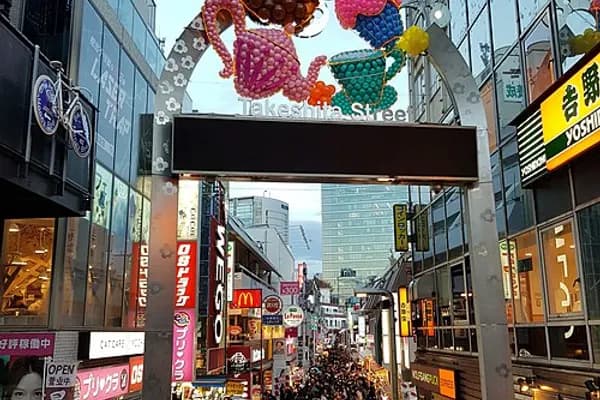
Takeshita Street, a shopping street through Harajuku
Yamate Dōri (Tokyo)ja
Others
NHK Broadcasting Center, headquarters of the NHK radio, television, and satellite broadcasting system
NTT Docomo Yoyogi Building, the fourth-tallest building in Tokyo, patterned after the Empire State Building
Shibuya Sky, a 360-degree open-air observatory on Shibuya Scramble Square, the highest point in the district of Shibuya overlooking Shibuya and the greater Tokyo skyline
Tokyo Metropolitan Gymnasium, a major indoor arena complex
United Nations University
Yoyogi National Gymnasium, designed for the 1964 Tokyo Olympics by Kenzo Tange
Transportation
Rail
The main station in Shibuya is Shibuya Station. The southern half of Shinjuku Station, including the New South Entrance, is located in Shibuya.
JR East Yamanote Line: Shinjuku, Yoyogi, Harajuku, Shibuya, Ebisu stations
Chūō Line (Rapid), Chūō-Sōbu Line: Shinjuku, Yoyogi, Sendagaya stations
Saikyō Line, Shōnan-Shinjuku Line: Shinjuku, Shibuya, Ebisu stations
Tokyo Metro Ginza Line: Shibuya station
Marunouchi Line: Shinjuku station
Hibiya Line: Ebisu station
Chiyoda Line: Meiji Jingūmae, Yoyogi Kōen, Yoyogi Uehara stations
Hanzōmon Line: Shibuya station
Fukutoshin Line: Shibuya, Meiji Jingūmae, Kitasandō stations
Tokyo Metropolitan Bureau of Transportation Toei Shinjuku Line: Shinjuku station
Toei Ōedo Line: Shinjuku, Yoyogi, Kokuritsu Kyogi-jo stations
Tokyu Corporation Tōyoko Line: Shibuya, Daikanyama stations
Den-en-toshi Line: Shibuya, Ikejiri Ohashi stations
Keio Corporation Inokashira Line: Shinjuku, Shibuya, Shinsen stations
Keiō Line: Shinjuku, Sasazuka stations
Encyclopedic content adapted from the Wikipedia article on Shibuya, used under CC BY-SA 4.0.