About the neighborhood
Capital city of Paraná, Brazil
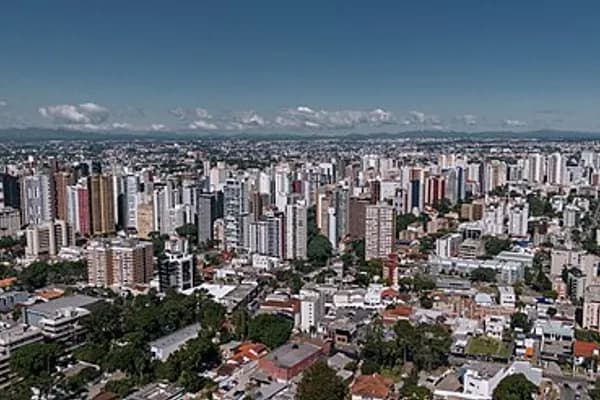
Curitiba (/ˌkʊərɪˈtʃiːbə/ KOOR-ih-CHEEB-ə; Brazilian Portuguese: kuɾiˈtʃibɐ) is the capital and largest city in the state of Paraná in Southern Brazil. The city's population was 1,829,225 as of 2024, making it the eighth most populous city in Brazil and the largest in Brazil's South Region. The Curitiba Metropolitan area comprises 29 municipalities with a total population of over 3,559,366, making it the ninth most populous metropolitan area in the country.
The city sits on a plateau at 932m (3,058ft) above sea level. It is located west of the seaport of Paranaguá and is served by the Afonso Pena International and Bacacheri airports. Curitiba is an important cultural, political, and economic center in Latin America and hosts the Federal University of Paraná, established in 1912.
In the 19th century, Curitiba's favorable location between cattle-breeding countryside and marketplaces led to a successful cattle trade and the city's first major expansion. Later, between 1850 and 1950, it grew due to logging and agricultural expansion in Paraná State (first Araucaria angustifolia logging, later mate and coffee cultivation and in the 1970s wheat, corn and soybean cultivation). In the 1850s, waves of European immigrants arrived in Curitiba, mainly Germans, Italians, Poles and Ukrainians, contributing to the city's economic and cultural development and richness in diversity. Nowadays, only small numbers of immigrants arrive, primarily from Middle Eastern and other South American countries.
Curitiba's biggest expansion occurred after the 1960s, with innovative urban planning that allowed the population to grow from some hundreds of thousands to more than a million people. Curitiba's economy is based on industry and services and is the seventh largest in Brazil. Economic growth occurred in parallel to a substantial inward flow of Brazilians from other parts of the country, as approximately half of the city's population was not born in Curitiba.
Curitiba is one of the few Brazilian cities with a very high Human Development Index (0.856) and in 2010 it was awarded the Global Sustainable City Award, given to cities and municipalities that excel in sustainable urban development. According to US magazine Reader's Digest, Curitiba is the best "Brazilian Big City" in which to live. Curitiba's crime rate is considered low by Brazilian standards and the city is considered one of the safest cities in Brazil for youth. The city is also regarded as the best in which to invest in Brazil. Curitiba was one of the host cities of the 1950 FIFA World Cup, and again for the 2014 FIFA World Cup. Curitiba’s unemployment rate was one of the lowest recorded in Brazil in 2025, at 4.3%, ranking third in terms of the economically active population, behind Palmas (TO) and Florianópolis (SC).
Etymology
One theory is that the name Curitiba comes from the Tupi words kurí tyba 'many araucária seeds' due to the large number of Paraná pines pinecones in the region prior to its founding.
Another version, also using words from the Tupi language, is that it originates in the combination of kurit 'pine tree' and yba 'large amount'.
The Portuguese, who founded a settlement on the site in 1693, named it Vila da Nossa Senhora da Luz dos Pinhais 'Village of Our Lady of the Light of the Pines'.
The name was changed to Curitiba in 1721. Curitiba officially became a town in 1812, spelling its name Curityba.
An alternative spelling was Coritiba. This was used in press and state documents. A state decree in 1919 settled the dispute by adopting Curitiba.
History
At the end of the 17th century, Curitiba's agriculture was only for subsistence and its main economic activities were mineral extraction. Waves of European immigrants arrived after 1850, mainly Poles, Italians, Germans (mostly Volga Germans from Russia) and Ukrainians.
Cattlemen drove their herds from Rio Grande do Sul to the state of São Paulo, turning Curitiba into an important intermediate trading post.
The Paranaguá–Curitiba railroad was opened in 1885.
Around the beginning of the 20th century, Curitiba benefited from the wealth of the yerba mate mills. The owners (known as "barões da erva-mate") built mansions in the capital. These have mostly been preserved in the districts of Batel and Alto da Glória.
In the 1940s and 1950s, Alfred Agache, co-founder of the French Society for Urban Studies, was hired to produce its first city plan. It emphasized a "star" of boulevards, with public amenities downtown, an industrial district and sanitation. It was followed in part, but the plan was too expensive to complete.
Curitiba has a long history of being intentional about city planning. The early leaders in Curitiba were the first people to establish building regulations. This included limiting the number of trees cut and requiring homes to have tile and not wood roofs. By 1960 Curitiba’s population had increased to 430,000 and Alfred Agache's plan for the city had not considered the future influx of immigrants. A group of young planners and architects led by Jaime Lerner from the Federal University of Paraná answered a proposal from Mayor Ivo Arzua centered around preparing Curitiba for new growth. They improved Agache’s plan by proposing adding major linear transit pathways to Curitiba to provide straightforward high-speed routes throughout the city. They also included plans for reducing downtown traffic, minimizing urban sprawl, providing easily accessible and inexpensive public transit, and preserving Curitiba’s historic district. This intelligent and well-thought-out proposal was adopted and became the Curitiba Master Plan. Jaime Lerner went on to create the city's first urban planning department in order to facilitate further redevelopment efforts.
Geography
Curitiba, the capital of the Paraná state of southern Brazil, is located near the Atlantic margin of the Brazilian Highlands and the headwaters of the Iguaçu River. It is around 3,050 feet (930 meters) above sea level.
The most important rivers that form six hydrographic basins within the municipal territory are, in addition to the Iguaçu River, the Atuba, Belém, Barigui, Passaúna, and the Padilhas stream, all with similar drainage characteristics.
The most extensive hydrographic basin in Curitiba is that of the Barigui River, which crosses the municipality from north to south and covers 139.9 km² of the municipality's area. To the south, there is the least extensive hydrographic basin in Curitiba, that of the Padilhas stream, with 33.6 km². As the relief of Curitiba is predominantly higher in the north of the municipality, six hydrographic basins, in their entirety, descend towards the south of the municipality, flowing into the Iguaçu River, the most important river in Curitiba, which, in turn, flows into the Paraná River, in the far west of the state.
Due to certain peculiarities, rainfall habitually causes significant flooding in the rivers of Curitiba, resulting in regular floods, which constantly worries the population and the public administration. Nowadays, after many studies regarding local waterways, almost all of the rivers are being channeled.
Climate
Curitiba features a temperate oceanic climate (Köppen: Cfb, Trewartha: Cfbl). Its location on a plateau and the flat terrain with flooded areas contributes to its somewhat mild and damp winters, with an average minimum temperature of 9°C (48°F) in July. Nighttime temperatures can drop below 0°C (32°F) on the coldest days. Daytime temperatures in winter are usually pleasant, around 19°C (66°F). However, during cold snaps, daytime temperatures might not rise above 10°C (50°F), and on rare occasions, above 5°C (41°F).
Snowfall was experienced in 1889, 1892, 1912, 1928 (snowstorm, two days), 1942, 1955, 1957, 1962, 1975, 1988, 2013 and 2020. Huge accumulation, however, is rarer.
During summertime, the average temperature is around 25°C (77°F) at daytime, but it can get above 30°C (86°F) on the hottest days. However, temperatures above 21°C (70°F) at night are rare.
The terrain's flatness hinders water drainage after rain, therefore providing water vapor for the atmosphere. Cold fronts come year round, often from Antarctica and Argentina, bringing extratropical cyclones, and cold winds and frost in the winter. They can move very quickly, with no more than one day between the start of the southern winds and the start of rain. Curitiba's weather is also influenced by the dry air masses that dominate Brazil's midwest most of the year, bringing hot and dry weather, sometimes even in winter.
Vegetation
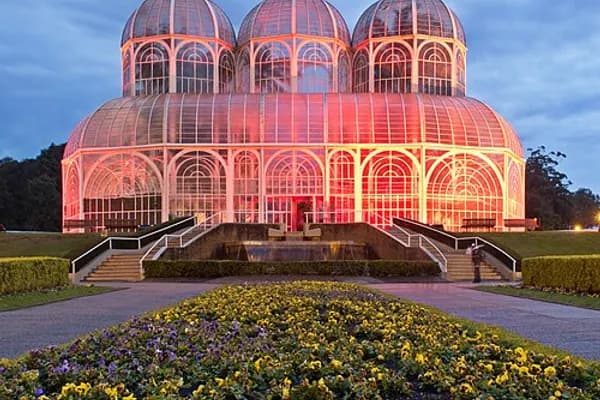
Curitiba is located in the area of the Ombrophilous Mixed Forest (also known as Araucaria moist forests), a sub-type of the Atlantic Forest. In Curitiba it is possible to find steppes, forests and other formations. The local vegetation consists of remnants of the Paraná (or Brazilian) pine (Araucaria angustifolia), which resisted the efforts of settlers. The Paraná pines are in private and public areas and are protected from logging. The Municipal Secretariat of the Environment maintains a botanical garden and three greenhouses that produce 150,000 native and exotic seedlings: 16,000 fruit trees, 260,000 flowers, foliage and underbrush specimens and the maintenance of another 350,000 seedlings.
Curitiba's green area itself matches the size of other large Brazilian cities. The vegetation of Curitiba encompasses a large population of purple and yellow ipês (tabebuias), who flower at the end of winter. The yellow ipê is one of the city's most common tree.
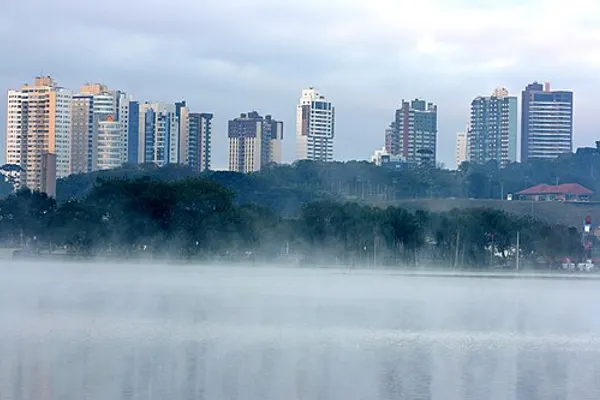
Panoramic view of Barigui Park. Hydrography
The catchment area of Curitiba consists of rivers and streams that cross the city in different directions, grouped in six river basins. The main rivers that form the city's watershed are: Atuba River, Belém River, Barigüi River, Passaúna River, Ribeirão dos Padilhas and the Iguaçu River, all with characteristics of dendritic drainage. Curitiba has been working since the 1970s on alternatives to minimize the negative impacts of urbanization on rivers. An example is the construction of parks along the rivers with artificial lakes, which absorb and retain water for longer periods of time, minimizing floods. After many studies of local water flows, most rivers were found to be subject to a canalization process. Other alternatives developed to minimize the negative effects of urbanization are the implementation of programs for environmental education, inspection and monitoring, elaboration and application of legislation and infrastructure works.
Topography
The city covers 432.17km (166.86sqmi) on the First Plateau of Paraná. Curitiba has a topography of smooth, rounded hills, giving it a relatively regular shape. The city has an average altitude of 934.6m (3,066ft) above sea level. The highest point is to the north at 1,021m (3,350ft), and with lower altitudes at 864m (2,835ft) to the south.
Mountain ranges and sets of rocky hills surround parts of the city, including the Serra do Mar, a hill range between the shore of the Atlantic Ocean and the First Plateau in Paraná.
Government
As of 2017, the mayor is Rafael Greca, who replaced Gustavo Fruet. The City Council of Curitiba has 38 councillors elected since 2004. Curitiba is divided into nine regional governments (equivalent to subprefecture), who manage the municipality's 75 districts. The Rua da Cidadania ("Street of Citizenship") is the symbol of administrative decentralization; it is a reference point and a meeting place. Several units are annexed to public transport terminals. Their nuclei offer services in the local, state and federal areas.
Jaime Lerner is perhaps Curitiba's best-known mayor. He was the mayor three times, the first time in the early 1970s. His leadership was crucial to some major changes in the city. Curitiba has built parks instead of canals to reduce flooding; used parks to make the city more liveable; pedestrianised the downtown area; built a Bus Rapid Transit (BRT), a bus system that works similarly to a light rail system; and started a massive recycling scheme that included giving people bus tokens in return for waste.
Demographics
Ethnic groups
Catholic Church (62.4%)
Protestantism (24.0%)
Spiritism (2.80%)
Other religions (3.69%)
Irreligious (6.71%)
According to the 2022 census, 1,773,718 people resided in the city of Curitiba. The census revealed 1,320,252 White people (74.4%), 355,834 Pardo (Multiracial) people (20.1%), 71,948 Afro-Brazilian people (4.1%), 23,635 Asian people (1.3%), 1,976 Amerindian people (0.1%).
Curitiba is Brazil's 8th most populous city. In 2010, the city had 359,201 opposite-sex couples and 974 same-sex couples. The population of Curitiba was 52.3% female and 47.7% male.
As with most of Southern Brazil's population, Curitiba is mostly inhabited by European descendants. The first Europeans to arrive were of Portuguese origin, during the 17th century. They intermarried with the native people and with the African slaves.
Up until the 19th century, the inhabitants of the city of Curitiba were natives and mixed-race, Portuguese and Spanish immigrants. In 1808 foreigners were granted the right to ownership of land, and in 1853 Parana became an independent province, and these events resulted in a substantial number of immigrants from Europe.
The first non-Iberian (Portuguese and Spaniard) immigrants to come to the city were German.
The Memorial of Polish Immigration was inaugurated on 13 December 1980, after the visit of Pope John Paul II in June. Its area is 46,000m (500,000sqft) and was part of the former Candles plant. The seven wooden log houses are parts of this memorial area, as a memento of the Polish immigrants' struggles and faith. Objects like an old wagon, pipe of cabbage and a print of the Black Madonna of Częstochowa (patron saint of the Polish people), form parts of the memorial. The first group of Poles arrived in Curitiba around 1871. Curitiba has the biggest colony of Polish immigrants in Brazil.
Italian immigrants started arriving in Brazil in 1875 and in Curitiba in 1878, coming mainly from the Veneto and Trento regions of Northern Italy. They settled mostly in the Santa Felicidade neighborhood, still a centre of the Italian community.
Nearly 20,000 Ukrainian immigrants settled there between 1895 and 1897, consisting mostly of peasants from Galicia who immigrated to Brazil to become farmers. Around 300,000 Ukrainian-Brazilians live in Paraná. The State of Paraná has the largest Ukrainian community and Slavic community.
Encyclopedic content adapted from the Wikipedia article on São Francisco, used under CC BY-SA 4.0.