About the neighborhood
Largest city in Hesse, Germany
Frankfurt am Main, usually shortened to Frankfurt, is the most populous city in the German state of Hesse. Its 778,589 inhabitants as of 2025 make it the fifth-most populous city in Germany. Located in the foreland of the Taunus on its namesake Main, the city forms a continuous conurbation with Offenbach am Main; its urban area has a population of over 2.7 million. Frankfurt is the heart of the larger Rhine-Main metropolitan region, which has a population of more than 5.8 million and is Germany's second-largest metropolitan region after the Rhine-Ruhr region. Home to the European Central Bank, the city serves as one of the four institutional seats of the European Union (alongside Brussels, Luxembourg and Strasbourg). Frankfurt is classified by the GaWC as an Alpha-rated world city.
Frankfurt was first mentioned in a document in 794 and has been an imperial city since 1372. Frankfurt was a city state, the Free City of Frankfurt, for nearly five centuries, and was one of the most important cities of the Holy Roman Empire, as a site of Imperial coronations; it lost its sovereignty upon the collapse of the empire in 1806, regained it in 1815 and then lost it again in 1866, when it was annexed by the Kingdom of Prussia following the Austro-Prussian War. It has been part of the state of Hesse since 1945. Frankfurt is culturally, ethnically and religiously diverse, with half of its population, and a majority of its young people, having a migrant background. A quarter of the population consists of foreign nationals, including many expatriates. In 2015, Frankfurt was home to 1,909 ultra high-net-worth individuals, the sixth-highest number of any city.
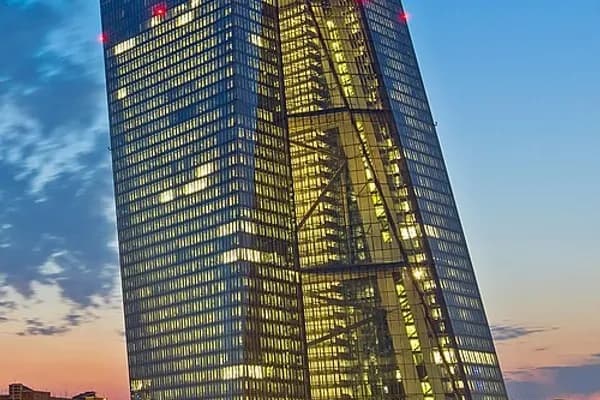
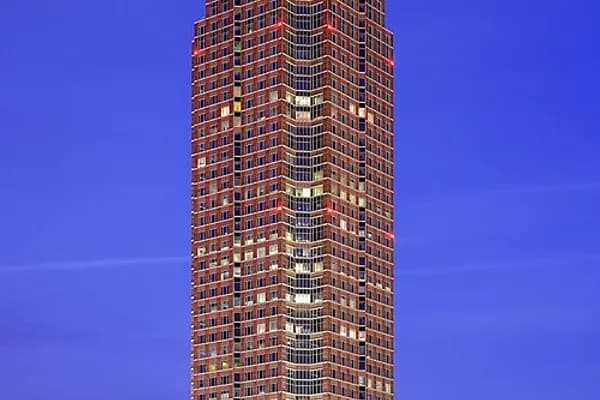
Frankfurt is a global hub for commerce, culture, education, tourism and transportation, and is the site of many global and European corporate headquarters. Due to its central location in former West Germany, Frankfurt Airport became the busiest in Germany, one of the busiest in the world, the airport with the most direct routes in the world, and the primary hub for Lufthansa, the national airline of Germany and Europe's largest airline. Frankfurt Central Station is Germany's second-busiest railway station after Hamburg Hbf, operated by Deutsche Bahn, the world's largest railway company, whose Frankfurter division DB InfraGO manages the largest railway network in Europe. Frankfurter Kreuz is the most-heavily used interchange in the EU. Frankfurt is one of the major financial and business centers of Europe, with the headquarters of the European Central Bank, Deutsche Bundesbank, Frankfurt Stock Exchange, Deutsche Bank, DZ Bank, KfW, Commerzbank, DekaBank, Helaba, several cloud and fintech startups, and other institutes. Automotive, technology and research, services, consulting, media and creative industries complement the economic base. Frankfurt's DE-CIX is the world's largest internet exchange point. Messe Frankfurt is one of the world's largest trade fairs. Other major fairs include the Music Fair and the Frankfurt Book Fair, the world's largest book fair. The city also has 93 consulates, among which the largest is the US Consulate General.
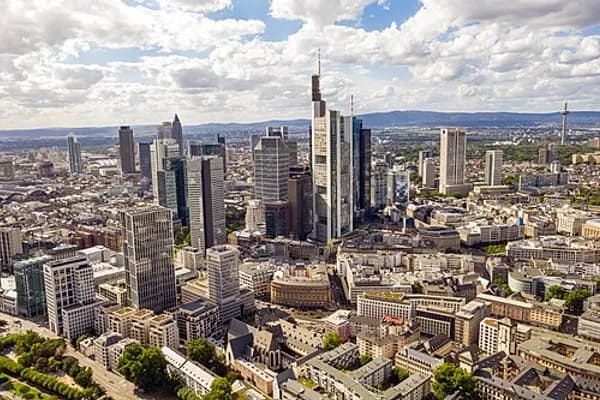
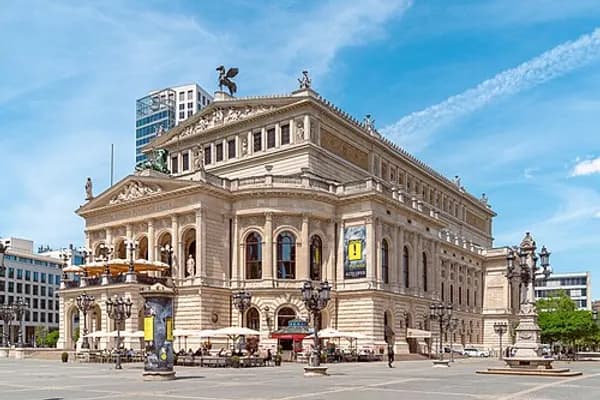
Frankfurt is home to influential educational institutions, including the Goethe University with the Universitätsklinikum Frankfurtde (Hesse's largest hospital), the FUAS, the FUMPA, and graduate schools like the FSFM. The city is one of two seats of the German National Library (alongside Leipzig), the largest library in the German-speaking countries and one of the largest in the world. Its renowned cultural venues include the concert hall Alte Oper, continental Europe's largest English theater and many museums, including the Städel, Liebieghaus, German Film Museum, Senckenberg Natural Museum, Goethe House and Schirn art venue. Frankfurt's skyline is shaped by some of Europe's tallest skyscrapers, which has led to the term Mainhattan.
The city has many parks and major botanical gardens. Roughly 52 percent of the city area is green. Frankfurt is a founding member of the Climate Alliance of European Cities and has pledged to work towards a 50 percent reduction of carbon emissions by 2030. Frankfurt is the seat of the German Football Association, is home to the first division association football club Eintracht Frankfurt, the Löwen Frankfurt ice hockey team, and the basketball club Frankfurt Skyliners, and is the venue of the Frankfurt Marathon and the Ironman Germany.
Distinctions
Frankfurt is the largest financial hub in continental Europe. It is home to the European Central Bank, Deutsche Bundesbank, Frankfurt Stock Exchange and several large commercial banks. Frankfurt has many high-rise buildings that form its renowned Frankfurt skyline. In fact, it is one of the few cities in the European Union (EU) to have such a skyline. The Frankfurt Stock Exchange is one of the world's largest stock exchanges by market capitalization and accounts for more than 90 percent of the turnover in the German market.
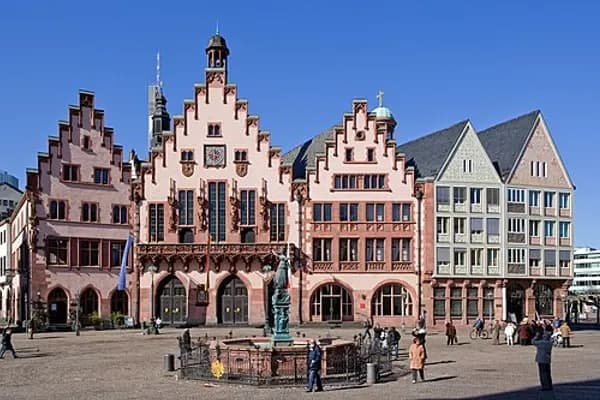
In 2010, 63 national and 152 international banks had their registered offices in Frankfurt, including Germany's major banks, notably Deutsche Bank, DZ Bank, KfW, Deka Bank and Commerzbank, as well as 41 representative offices of international banks. Frankfurt has been nicknamed Mainhattan and Bankfurt. The city is also noted for its unique timber-framed old town. The Römer area has been most recently in the Dom-Römer Project and hosts the Frankfurt Christmas Market. The Saalgasse complements the timbered romanticism with postmodern houses by 12 different architectural firms.
Frankfurt is considered a global city as listed by the GaWC group's 2012 inventory. Among global cities it was ranked tenth by the Global Power City Index 2011 and 11th by the Global City Competitiveness Index 2012. Among financial hubs, the city was ranked eighth by the International Financial Centers Development Index 2013 and ninth in the 2013 Global Financial Centres Index.
Its central location in Germany and Europe makes Frankfurt a major air, rail, and road transport hub. Frankfurt Airport is one of the world's busiest international airports by passenger traffic and the main hub for Germany's flag carrier Lufthansa. Frankfurt Central Station is one of the largest rail stations in Europe and the busiest junction operated by Deutsche Bahn, the German national railway company, with 342 trains a day to domestic and European destinations. Frankfurter Kreuz, also known as the Autobahn interchange and located close to the airport, is the most-heavily used interchange in the EU, used by 320,000 cars daily. In 2011 human-resource-consulting firm Mercer ranked Frankfurt as seventh in its annual 'Quality of Living' survey of cities around the world. According to The Economist cost-of-living survey, Frankfurt is Germany's most expensive city and the world's tenth most expensive.
Etymology
Frankonovurd (in Old High German) or Vadum Francorum (in Latin) were the first names mentioned in written records from 794. It transformed to Frankenfort during the Middle Ages and then to Franckfort and Franckfurth in the modern era. The name is derived from the Franconofurd, from the Germanic tribe of the Franks and Furt (cf. English ford) where the river was shallow enough to be crossed on foot.
Thietmar of Merseburg in the 11th century reported a founding legend in which Charlemagne and his army of Franks discovered the ford at Frankfurt when a doe crossed over it, showing them the way; in honor of this the city was named "ford of the Franks". By the 19th century, the name Frankfurt had been established as the official spelling. The older English spelling of Frankfort is now rarely seen in reference to Frankfurt am Main, although more than a dozen other towns and cities, mainly in the United States, use this spelling, including Frankfort, Kentucky, Frankfort, New York, and Frankfort, Illinois. The New York Times first used the Frankfurt spelling for Frankfurt am Main on 24 October 1953 and last used the Frankfort spelling on 10 June 1954.
The suffix am Main has been used regularly since the 14th century. In English, the city's full name of Frankfurt am Main means "Frankfurt on the Main". Frankfurt is located on an ancient ford (German: Furt) on the river Main. As a part of early Franconia, the inhabitants were the early Franks, thus the city's name reveals its legacy as "the ford of the Franks on the Main".
Among English speakers, the city is commonly known simply as Frankfurt, but Germans occasionally call it by its full name to distinguish it from the other (significantly smaller) German city of Frankfurt an der Oder in the Land of Brandenburg on the Polish border. The common abbreviations for the city, primarily used in railway services and on road signs, are Frankfurt (Main), Frankfurt (M), Frankfurt a. M., Frankfurt/Main or Frankfurt/M. The common abbreviation for the name of the city is "FFM". Also in use is "FRA", the IATA code for Frankfurt Airport.
History
Timeline of Frankfurt am Main historical affiliations
Francia, 794–843
East Francia, 843–962
Holy Roman Empire, 962–1806
Free City of Frankfurt, 1372–1806
Grand Duchy of Frankfurt, 1806–1813
Free City of Frankfurt, 1813–1866
Kingdom of Prussia, 1866–1918
German Empire, 1871–1918
Weimar Republic, 1918–1933
German Reich, 1933–1945
American occupation zone, 1945–1949
West Germany, 1949–1990
Germany, 1990–present
Early history and Holy Roman Empire
At the western borders of Frankfurt lies the Kapellenberg as part of the Taunus with one of the first Stone Age cities in Europe. The Celts had different settlements in the Taunus mountains north of Frankfurt, the biggest one the Heidetrank Oppidum. The first traces of Roman settlements established in the area of the river Nidda date to the reign of Emperor Vespasian in the years 69 to 79 AD. Nida (modern Heddernheim, Praunheim) was a Roman civitas capital (Civitas Taunensium).
Alemanni and Franks lived there, and by 794, Charlemagne presided over an imperial assembly and church synod, at which Franconofurd (alternative spellings end with -furt and -vurd) was first mentioned. It was one of the two capitals of Charlemagne's grandson Louis the German, together with Regensburg. Louis founded the collegiate church, rededicated in 1239 to Bartholomew the Apostle and now Frankfurt Cathedral.
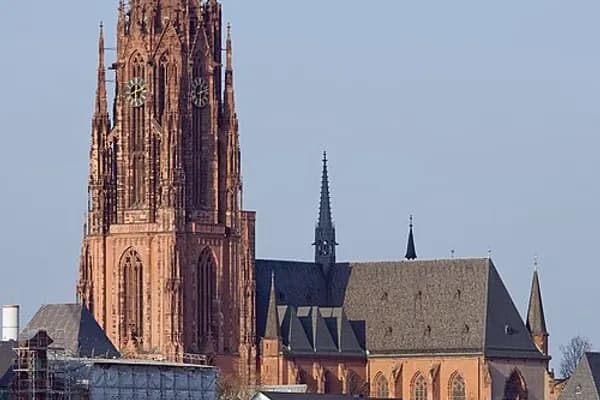
Frankfurt was one of the most important cities in the Holy Roman Empire. From 855, the German kings were elected and crowned in Aachen. In 1372, Frankfurt became a Reichsstadt (Imperial Free City) and was as such directly subordinate to the Holy Roman Emperor rather than a regional ruler or a local nobleman. From 1562 onward the kings and emperors were crowned and elected in Frankfurt, starting with Maximilian II. This tradition ended in 1792, when Francis II was elected. His coronation was deliberately held on 14 July Bastille Day, the anniversary of the storming of the Bastille. The elections and coronations took place in St. Bartholomäus Cathedral, known as the Kaiserdom (Imperial Cathedral), or the four other structures known to have existed at this location. The cathedral spire was constructed according to plans by Madern Gerthener in 1415 and is 95 meters tall.
The Messe Frankfurt ('Frankfurt Trade Fair') was first mentioned in 1150. In 1240, Emperor Frederick II granted an imperial privilege to its visitors, meaning they would be protected by the empire. The fair became particularly important when similar fairs in French Beaucaire lost attraction around 1380. Book trade fairs began in 1478. In 1585, Frankfurt traders established a system of exchange rates for the various currencies that were circulating to prevent cheating and extortion. Therein lay the early roots for the Frankfurt Stock Exchange.
Frankfurt managed to remain neutral during the Thirty Years' War, but suffered from the bubonic plague that refugees brought to the city. After the war, Frankfurt regained its wealth. In the late 1770s the theater principal Abel Seyler was based in Frankfurt, and established the city's theatrical life.
Impact of French revolution and the Napoleonic Wars
Following the French Revolution, Frankfurt was occupied or bombarded several times by French troops. It remained a Free city until the collapse of the Holy Roman Empire in 1805/6. In 1806, it became part of the principality of Aschaffenburg under the Fürstprimas (Prince-Primate), Karl Theodor Anton Maria von Dalberg. This meant that Frankfurt was incorporated into the Confederation of the Rhine. In 1810, Dalberg adopted the title of a Grand Duke of Frankfurt. Napoleon intended to make his adopted son Eugène de Beauharnais, already Prince de Venise ("prince of Venice", a newly established primogeniture in Italy), Grand Duke of Frankfurt after Dalberg's death (since the latter as a Catholic bishop had no legitimate heirs). The Grand Duchy remained a short episode lasting from 1810 to 1813 when the military tide turned in favor of the Anglo-Prussian-led allies that overturned the Napoleonic order. Dalberg abdicated in favor of Eugène de Beauharnais, which of course was only a symbolic action, as the latter effectively never ruled after the ruin of the French armies and Frankfurt's takeover by the allies.
Frankfurt as a fully sovereign state
After Napoleon's final defeat and abdication, the Congress of Vienna (1814–1815) dissolved the grand-duchy and Frankfurt became a fully sovereign city-state with a republican form of government. Frankfurt entered the newly founded German Confederation (till 1866) as a free city, becoming the seat of its Bundestag, the confederal parliament where the nominally presiding Habsburg Emperor of Austria was represented by an Austrian "presidential envoy".
After the ill-fated revolution of 1848, Frankfurt was the seat of the first democratically elected German parliament, the Frankfurt Parliament, which met in the Frankfurter Paulskirche (St. Paul's Church) and was opened on 18 May 1848. In the year of its existence, the assembly developed a common constitution for a unified Germany, with the Prussian king as its monarch. The institution failed in 1849 when the Prussian king, Frederick William IV, declared that he would not accept "a crown from the gutter".
Frankfurt after the loss of sovereignty
Frankfurt lost its independence following the Austro-Prussian War of 1866, when Prussia annexed several smaller states, including the Free City of Frankfurt. The city was subsequently incorporated into the Prussian province of Hesse-Nassau. The occupation and annexation were widely regarded in Frankfurt as a grave injustice, yet the city retained its distinctly Western European, urban, and cosmopolitan character. The formerly independent towns of Bornheim and Bockenheim were incorporated in 1890.
Encyclopedic content adapted from the Wikipedia article on Sachsenhausen, used under CC BY-SA 4.0.