About the neighborhood
Federal region of Belgium including the capital
Brussels, officially the Brussels-Capital Region, is a region of Belgium comprising 19 municipalities, including the City of Brussels, which is the capital of Belgium. The Brussels-Capital Region is located in the central portion of the country. It is a part of both the French Community of Belgium and the Flemish Community, and is separate from the Flemish Region (Flanders), within which it forms an enclave, and the Walloon Region (Wallonia), located less than 4km (2.5mi) south.
Brussels grew from a small rural settlement on the river Senne to become an important city-region in Europe. Since the end of the Second World War, it has been a major centre for international politics and home to numerous international organisations, politicians, diplomats and civil servants. Brussels is the de facto capital of the European Union, as it hosts a number of principal EU institutions, including its administrative-legislative, executive-political, and legislative branches (though the judicial branch is located in Luxembourg, and the European Parliament meets for a minority of the year in Strasbourg). Because of this, its name is sometimes used metonymically to describe the EU and its institutions. The secretariat of the Benelux and the headquarters of NATO are also located in Brussels.
Brussels is the most densely populated region in Belgium, and although it has the highest GDP per capita, it has the lowest available income per household. The Brussels Region covers 162km (63sqmi) and has a population of over 1.2million. Its five times larger metropolitan area comprises over 2.5million people, which makes it the largest in Belgium. It is also part of a large diamond-shaped conurbation, extending towards the cities of Ghent, Antwerp and Leuven, as well as the province of Walloon Brabant, in total home to over 5million people. As Belgium's economic capital and a top financial centre in Western Europe with Euronext Brussels, Brussels is classified as an Alpha global city. It is also a national and international hub for rail, road and air traffic, and is sometimes considered, together with Belgium, as Europe's geographic, economic and cultural crossroads. The Brussels Metro is the only rapid transit system in Belgium. In addition, both its airport and railway stations are the largest and busiest in the country.
Historically Dutch-speaking, Brussels saw a language shift to French from the late 19th century. Since its creation in 1989, the Brussels-Capital Region has been officially bilingual in French and Dutch, although French is the majority language and lingua franca. Brussels is also increasingly becoming multilingual. English is spoken widely and many migrants and expatriates speak other languages as well.
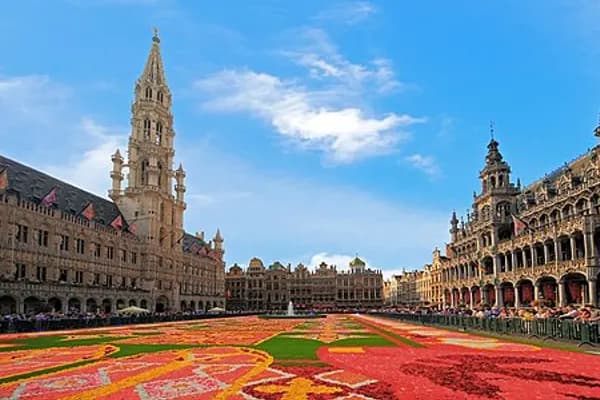
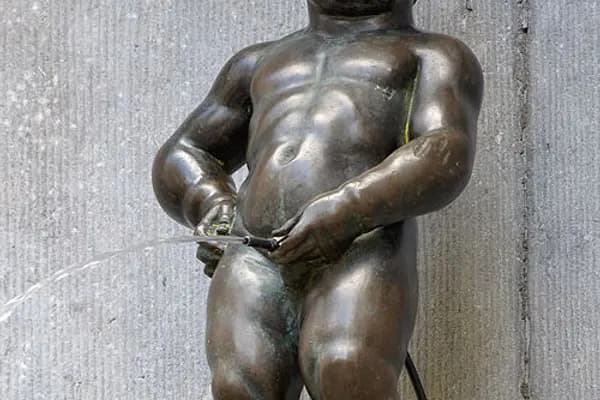
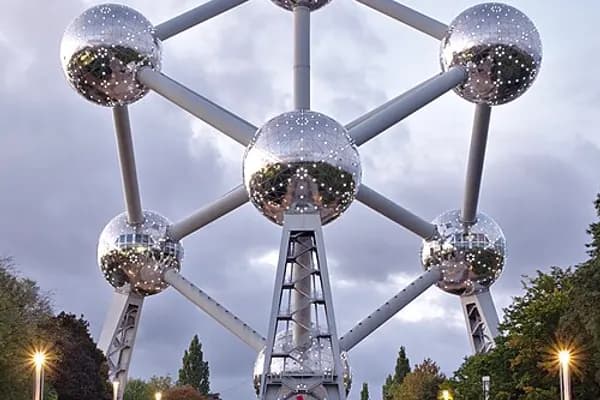
Brussels is known for its cuisine and gastronomic offer (including its local waffle, its chocolate, its French fries and its numerous types of beers), as well as its historical and architectural landmarks; some of them are registered as UNESCO World Heritage Sites. Principal attractions include its historic Grand-Place/Grote Markt (main square), Manneken Pis, the Atomium, and cultural institutions such as La Monnaie/De Munt and the Museums of Art and History. Due to its long tradition of Belgian comics, Brussels is also hailed as a capital of the comic strip.
Toponymy
Etymology
The most common theory of the origin of the name Brussels is that it derives from the Old Dutch Bruocsella, Broekzele or Broeksel, meaning 'marsh' (bruoc / broek) and 'home, settlement' (sella / zele / sel) or 'settlement in the marsh'. Saint Vindicianus, the Bishop of Cambrai, made the first recorded reference to the place Brosella in 695, when it was still a hamlet. The names of all the municipalities in the Brussels-Capital Region are also of Dutch origin, except for Evere, which is possibly Celtic or Old Frankish.
Pronunciation
In French, Bruxelles is pronounced bʁysɛl (the x is pronounced /s/ and the final s is silent) and in Dutch, Brussel is pronounced ˈbrʏsəl . Inhabitants of Brussels are known in French as Bruxellois and in Dutch as Brusselaars. In the Brabantian dialect of Brussels (known as Brusselian, and also sometimes referred to as Marollian), they are called Brusseleers or Brusseleirs.
Originally, the written x was pronounced /ks/. In the Belgian French pronunciation as well as in Dutch, the k eventually disappeared, as reflected in the current Dutch spelling, whereas in the more conservative French form, the spelling remained. The pronunciation /ks/ in French only dates from the 18th century, but this modification did not affect the traditional Brussels usage. In France, the pronunciations bʁyksɛl and bʁyksɛlwa (for bruxellois) are often heard, but are rather rare in Belgium.
History
Early history
The history of Brussels is closely linked to that of Western Europe. Traces of human settlement go back to the Stone Age, with vestiges and place-names related to the civilisation of megaliths, dolmens and standing stones (Plattesteen near the Grand-Place/Grote Markt and Tomberg in Woluwe-Saint-Lambert, for example). During late antiquity, the region was home to Roman occupation, as attested by archaeological evidence discovered on the current site of Tour & Taxis, north-west of the Pentagon (Brussels' city centre). Following the decline of the Western Roman Empire, it was incorporated into the Frankish Empire.
According to local legend, the origin of the settlement that was to become Brussels lies in Saint Gaugericus' construction of a chapel on an island in the river Senne around 580. The official founding of Brussels is usually said to be around 979, when Charles, Duke of Lower Lorraine, transferred the relics of the martyr Saint Gudula from Moorsel (located in today's province of East Flanders) to Saint Gaugericus' chapel. When Otto II, Holy Roman Emperor, appointed the same Charles to become Duke of Lower Lotharingia in 977, Charles ordered the construction of the city's first permanent fortification, doing so on that same island.
Middle Ages
Lambert I, Count of Louvain, gained the County of Brussels around 1000 by marrying Charles' daughter. Because of its location on the banks of the Senne, on an important trade route between the Flemish cities of Bruges and Ghent, and Cologne in the Kingdom of Germany, Brussels became a commercial centre specialised in the textile trade. The town grew quite rapidly and extended towards the upper town (Treurenberg, Coudenberg, and Sablon/Zavel areas), where there was a reduced risk of floods. As the town grew to a population of around 30,000, the surrounding marshes were drained to allow for further expansion. In 1183, the Counts of Leuven became Dukes of Brabant. Brabant, unlike the county of Flanders, was not fief of the king of France but was incorporated into the Holy Roman Empire.
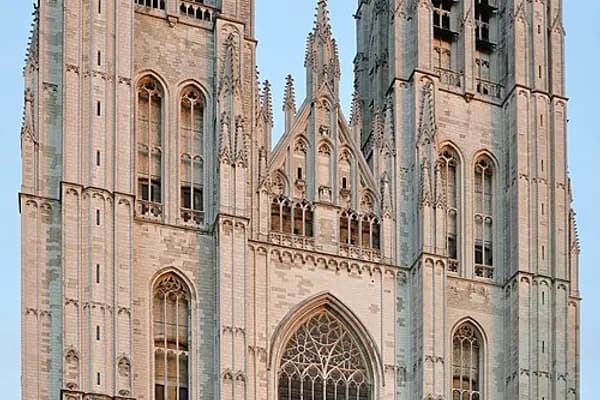
In the early 13th century, the first walls of Brussels were built and after this, the city grew significantly. Around this time, work began on what is now the Cathedral of St. Michael and St. Gudula (1225), replacing an older Romanesque church. To let the city expand, a second set of walls was erected between 1356 and 1383. Traces of these walls can still be seen; the Small Ring, a series of boulevards bounding the historical city centre, follows their former course.
Early modern
In the 14th century, the marriage between heiress Margaret III, Countess of Flanders, and Philip the Bold, Duke of Burgundy, produced a new Duke of Brabant of the House of Valois, namely Anthony, their son. In 1477, the Burgundian duke Charles the Bold perished in the Battle of Nancy. Through the marriage of his daughter Mary of Burgundy (who was born in Brussels) to Holy Roman Emperor Maximilian I, the Low Countries fell under Habsburg sovereignty. Brabant was integrated into this composite state, and Brussels flourished as the Princely Capital of the prosperous Burgundian Netherlands, also known as the Seventeen Provinces. After the death of Mary in 1482, her son Philip the Handsome succeeded as Duke of Burgundy and Brabant.
Philip died in 1506, and he was succeeded by his son Charles V who then also became King of Spain (crowned in the Cathedral of St. Michael and St. Gudula) and even Holy Roman Emperor at the death of his grandfather Maximilian I in 1519. Charles was now the ruler of a Habsburg Empire "on which the sun never sets" with Brussels serving as one of his main capitals. It was in the Coudenberg Palace that Charles V was declared of age in 1515, and it was there in 1555 that he abdicated all of his possessions and passed the Habsburg Netherlands to King Philip II of Spain. This palace, famous all over Europe, had greatly expanded since it had first become the seat of the Dukes of Brabant, but it was destroyed by fire in 1731.
In the 16th and 17th centuries, Brussels was a centre for the lace industry. In addition, Brussels tapestry hung on the walls of castles throughout Europe. In 1695, during the Nine Years' War, King Louis XIV of France sent troops to bombard Brussels with artillery. Together with the resulting fire, it was the most destructive event in the entire history of Brussels. The Grand-Place was destroyed, along with 4,000 buildings—a third of all the buildings in the city. The reconstruction of the city centre, effected during subsequent years, profoundly changed its appearance and left numerous traces still visible today.
During the War of the Spanish Succession Brussels fell in Anglo-Dutch hands following the Battle of Ramillies in 1706. In 1708, Brussels again sustained a French attack, which it repelled. Following the Treaty of Utrecht in 1713, Spanish sovereignty over the Southern Netherlands was transferred to the Austrian branch of the House of Habsburg. This event started the era of the Austrian Netherlands. Brussels was captured by France in 1746, during the War of the Austrian Succession, but was handed back to Austria three years later. It remained with Austria until 1795, when the Southern Netherlands were captured and annexed by France, and the city became the chef-lieu of the department of the Dyle. The French rule ended in 1815, with the defeat of Napoleon on the battlefield of Waterloo, located south of today's Brussels-Capital Region. With the Congress of Vienna, the Southern Netherlands joined the United Kingdom of the Netherlands, under King William I of Orange. The former Dyle department became the province of South Brabant, with Brussels as its capital.
Late modern
In 1830, the Belgian Revolution began in Brussels, after a performance of Auber's opera La Muette de Portici at the Royal Theatre of La Monnaie. The city became the capital and seat of government of the new nation. South Brabant was renamed simply Brabant, with Brussels as its administrative centre. On 21 July 1831, Leopold I, the first King of the Belgians, ascended the throne, undertaking the destruction of the city walls and the construction of many buildings.
Following independence, Brussels underwent many more changes. It became a financial centre, thanks to the dozens of companies launched by the Société Générale de Belgique. The Industrial Revolution and the opening of the Brussels–Charleroi Canal in 1832 brought prosperity to the city through commerce and manufacturing. The Free University of Brussels was established in 1834 and Saint-Louis University in 1858. In 1835, the first passenger railway built outside England linked the municipality of Molenbeek-Saint-Jean with Mechelen.
During the 19th century, the population of Brussels grew considerably; from about 80,000 to more than 625,000 people for the city and its surroundings. The Senne had become a serious health hazard, and from 1867 to 1871, under the tenure of the city's then-mayor, Jules Anspach, its entire course through the urban area was completely covered over. This allowed urban renewal and the construction of modern buildings of Haussmann-esque style along grand central boulevards, characteristic of downtown Brussels today. Buildings such as the Bourse Palace (1873), the Palace of Justice (1883) and Saint Mary's Royal Church (1885) date from this period. This development continued throughout the reign of King Leopold II. The International Exposition of 1897 contributed to the promotion of the infrastructure. Among other things, the Palace of the Colonies, today's Royal Museum for Central Africa, in the suburb of Tervuren, was connected to the capital by the construction of an 11km-long (6.8mi) grand alley.
Brussels was one of the major European centres of the Art Nouveau style in the 1890s and early 1900s. The architects Victor Horta, Paul Hankar, and Henry van de Velde, among others, were known for their designs, many of which survive today.
20th century
During the 20th century, the city hosted various fairs and conferences, including the Solvay Conference on Physics and on Chemistry, and three world's fairs: the Brussels International Exposition of 1910, the Brussels International Exposition of 1935 and the 1958 Brussels World's Fair (Expo 58). During World War I, Brussels was an occupied city. It escaped large-scale destruction, although the interwar period would still see a significant amount of (re)construction. In November 1918, after the German Revolution had broken out, Brussels was embroiled in street battles between revolutionary soldiers who wanted to end the occupation and their imperialist counterparts; additionally, explosives left behind by retreating German troops damaged infrastructure and around 2,300 houses.
During World War II, Brussels was occupied by German forces once again. While it was again spared major damage, a deadly bombing took place on 7 September 1943. It was carried out by the American airforce, which had tried to aim at SABCA facilities in Haren, but accidentally struck an area in Ixelles, killing 282 civilians. The city was liberated by the British Guards Armoured Division on 3 September 1944. Brussels Airport, in the suburb of Zaventem, traces its roots to a German military airport that was built in nearby Melsbroek.
After World War II, Brussels underwent extensive modernisation. The construction of the North–South connection, linking the main railway stations in the city, was completed in 1952, while the first premetro (underground tram) service was launched in 1969, and the first Metro line was opened in 1976. Starting from the early 1960s, Brussels became the de facto capital of what would become the European Union (EU), and many modern offices were built. Development was allowed to proceed with little regard to the aesthetics of newer buildings, and numerous architectural landmarks were demolished to make way for newer buildings that often clashed with their surroundings, giving name to the process of Brusselisation.
Contemporary
Encyclopedic content adapted from the Wikipedia article on Sablon, used under CC BY-SA 4.0.