About the neighborhood
Capital of Cambodia
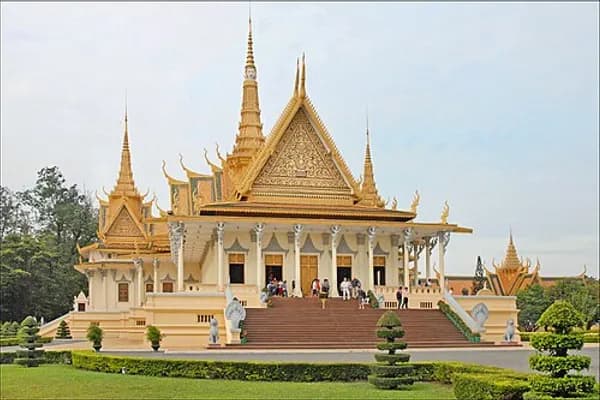
Phnom Penh is the capital and most populous city of Cambodia. It has been the national capital since 1865 and has grown to become the nation's primate city and its political, economic, industrial, and cultural centre. The city's name derives from Wat Phnom, a Buddhist temple, and Lady Penh, the city's founder. It sits at the confluence of the Tonlé Sap and Mekong rivers, and is the start of the Bassac River. It is also the seat of Cambodia's monarchy, based at the Royal Palace.
Founded in 1372, Phnom Penh succeeded Angkor Thom as the national capital in 1434 following the fall of Angkor, and remained so until 1497. It regained its capital status during the French colonial era. It underwent a period of investment and modernization during Cambodia's independence period, earning the nickname the "Pearl of Asia" for its colonial French, New Khmer and Art Deco architecture. The city's population swelled in the 1960s and 1970s as refugees fled from civil war and American bombing during the Vietnam War. Phnom Penh's entire population was forcibly evacuated in 1975 by the Khmer Rouge, and faced persecution, forced labour and genocide. Phnom Penh remained largely uninhabited during the Democratic Kampuchea era until Vietnam-backed forces took the city in 1979. The city was reconstructed and infrastructure improved in the modern era with the support of international investment and aid. By 2019, it was home to more than 2million people, approximately 14% of the Cambodian population.
The Greater Phnom Penh area includes the nearby Ta Khmau city and some districts of Kandal province. The city formerly functioned as a processing center, with textiles, pharmaceuticals, machine manufacturing, and rice milling. Its cultural institutions and events have made it a hub for domestic and international tourism. The city has hosted regional and international events, including the 2002, 2012, and 2022 ASEAN Summit, the 32nd Southeast Asian Games, and the 12th ASEAN Para Games. Phnom Penh will be the first Cambodian city and the second city in Southeast Asia to host the Asian Youth Games in 2031.
Etymology
Phnom Penh (lit.'Penh's hill') takes its name from the Wat Phnom (lit.'hill temple'), or from the Funan Kingdom, which existed from the 1st to the 7th century AD in Southeast Asia and was the forerunner of the Cambodian monarchy. Legend has it that in 1372, a wealthy widow named Penh found a Koki tree floating down the Tonlé Sap River after a storm.
Phnom Penh's former official name is Krong Chaktomuk Serei Mongkol (Khmer: ក្រុងចតុមុខសិរីមង្គល, lit. "city of Brahma's faces"), in its short form as Krong Chaktomuk (lit.'city of four faces'). Krong Chaktomuk is an abbreviation of the full name, given to it by King Ponhea Yat: Krong Chaktomuk Mongkol Sakal Kampuchea Thipadei Serei Theakreak Bavar Intabat Borei Roat Reach Seima Moha Nokor (Khmer: ក្រុងចតុមុខមង្គលសកលកម្ពុជាធិបតី សិរីធរបវរ ឥន្ទបត្តបុរី រដ្ឋរាជសីមាមហានគរ kɾoŋ catomuk mɔŋkɔl sakɑl kampuciətʰəpaɗəj serəj tʰeareaɓɑːʋɑː ʔenteapat ɓorəj rɔətʰariəcsəjmaː mɔhaːnɔkɔː). This loosely translates as "the place of four rivers that gives the happiness and success of the Khmer Kingdom, the highest leader as well as impregnable city of the God Indra of the great kingdom".
History
The initial settlement of Phnom Penh is believed to have been established since the 5th century AD, according to the discovery of kiln site in Choeung Ek commune of Dangkao district, southern part of central Phnom Penh in the 2000s. Choeung Ek archaeological site was one of the largest kiln pottery center in Cambodia and the earliest known kiln sites in Southeast Asia to produce the ceremonial vessels known as kendi from 5th to 13th century. Archaeologists stated that a large community is surrounded by a circular earthwork structure that is 740 metres in diameter and 4 metres high, built in the 11th century. There are remnants of other village infrastructure, irrigation system, inscription, Shiva linga and a brick temple foundation and its ornate remains which dated back to Funan era.
First recorded a century after it is said to have taken place, the legend of the founding of Phnom Penh tells of a local woman, Penh (also referred to as Daun Penh (Lady Penh in Khmer), living at Chaktomuk, the future Phnom Penh. It was the 14th century, and the Khmer capital was still at Angkor near Siem Reap 350km (217mi) to the north. Gathering firewood along the banks of the river, Lady Penh spied a floating koki tree in the river and fished it from the water. Inside the tree she found four Buddha statues and one of Vishnu.
The discovery was taken as a divine blessing, and to some a sign that the Khmer capital was to be brought to Phnom Penh from Angkor. To house the new-found sacred objects, Penh raised a hill on the west bank of the Tonle Sap River and crowned it with a shrine, later known as Wat Phnom at the north end of central Phnom Penh. "Phnom" is Khmer for "hill" and Penh's hill took on the name of the founder, and the area around it became known after the hill.
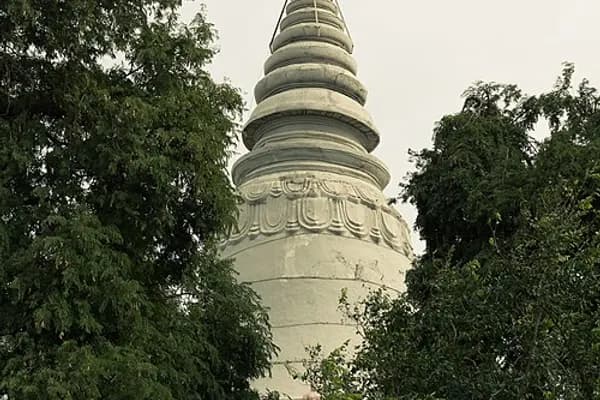
Phnom Penh first became the capital of Cambodia after Ponhea Yat (c. 1390 – 1463), king of the Khmer Empire, moved the capital from Angkor Thom after it was captured and destroyed by Siam years earlier. There is a stupa. In the 17th century, Japanese immigrants settled on the outskirts of what later is Phnom Penh. A Portuguese community survived in Phnom Penh until the 17th century, undertaking commercial and religious activity in the country.
Phnom Penh remained the royal capital for 73 years, from 1432 to 1505. It was abandoned for 360 years (from 1505 to 1865) by subsequent kings due to internal fighting between the royal pretenders. Later kings moved the capital several times and established their royal capitals at locations in Tuol Basan (Srey Santhor), Pursat, Longvek, Lavear Em and Oudong. From 1673 to 1674, Phnom Penh was the stronghold of rebel king Kaev Hua II.
During the Vietnam War, Cambodia was used as a base by the People's Army of Vietnam and the Viet Cong, and thousands of refugees from across the country flooded the city to escape the fighting between their own government troops, the People's Army of Vietnam, the Viet Cong, the South Vietnamese and their allies, the Khmer Rouge, and American air strikes. By 1975, the population was 2–3million, the bulk of whom were refugees from the fighting. The Khmer Rouge cut off supplies to the city for more than a year before it fell on 17 April 1975. Reports from journalists stated that the Khmer Rouge shelling "tortured the capital almost continuously", inflicting "random death and mutilation" on millions of trapped civilians. The Khmer Rouge forcibly evacuated the entire city after taking it, in what has been described as a death march: François Ponchaud wrote that "I shall never forget one cripple who had neither hands nor feet, writhing along the ground like a severed worm, or a weeping father carrying his ten-year old daughter wrapped in a sheet tied around his neck like a sling, or the man with his foot dangling at the end of a leg to which it was attached by nothing but skin"; Jon Swain recalled that the Khmer Rouge were "tipping out patients from the hospitals like garbage into the streets....In five years of war, this is the greatest caravan of human misery I have seen". All of its residents, including the wealthy and educated, were evacuated from the city and forced to do difficult labour on rural farms as "new people".
The Khmer Rouge were driven out of Phnom Penh by the People's Army of Vietnam in 1979, and people began to return to the city. A period of reconstruction began, spurred by the continuing stability of government, attracting new foreign investment and aid by countries including France, Australia, and Japan. Loans were made from the Asian Development Bank and the World Bank to reinstate a clean water supply, roads and other infrastructure. The 1998 Census put Phnom Penh's population at 862,000; and the 2008 census was 1.3million. By 2019, its population reached over 2.2 million, based on general population census.
Geography
Phnom Penh is in the south-central region of Cambodia, and is fully surrounded by the Kandal province. The municipality is on the banks of the Tonlé Sap, Mekong, and Bassac Rivers. These rivers provide freshwater and other natural resources to the city. Phnom Penh and the surrounding areas consist of a typical flood plain area for Cambodia. While Phnom Penh is at 11.89 metres (39ft) above the river, monsoon season flooding is a problem, and the river sometimes overflows its banks. Boeung Kak, Phnom Penh's largest freshwater lake, was controversially filled in 2010 to make way for property development.
Climate
Phnom Penh has a tropical wet and dry climate (Köppen climate classification Aw). The climate is hot year-round with only minor variations. Temperatures typically range from 22 to 35°C (72 to 95°F) and weather is subject to the tropical monsoons. The southwest monsoon blows inland bringing moisture-laden winds from the Gulf of Thailand and Indian Ocean from May to November, sees high temperatures accompanied by high humidity. The dry season lasts from December to April; when overnight temperatures can drop to 22°C (72°F).
Administration
Phnom Penh is an autonomous municipality of area 678.46 square kilometres (261.95sqmi) with a government status equal to that of the provinces. The autonomous municipality is subdivided into 14 administrative divisions called khans (sections). The districts are subdivided into 105 sangkats (quarters), and further subdivided into 953 phums (villages).
Phnom Penh is governed by the governor who acts as the top executive of the city and overseeing the Municipal Military Police, Municipal Police, and Bureau of Urban Affairs. Below the governor is the first vice governor and five vice governors. The chief of cabinet, who holds the same status as the vice governors, heads the cabinet consisting of eight deputy chiefs of cabinet who in turn are in charge of the 27 administrative departments. Every khans has a chief.
▶+– -25800 360° Panorama of Phnom Penh
Demographics
As of 2019, Phnom Penh had a population of 2,129,371 people, with a total population density of 3,136 inhabitants per square kilometre in a 679 square kilometres (262sqmi) city area. A survey by the National Institute of Statistics in 2017 showed that 95.3% of the population in Phnom Penh are Khmer, 4% Chams, and 0.7% others, predominantly Chinese, Vietnamese, and other ethnic groups who are Thai, Budong, Mnong Preh, Kuy and Chong.
The official language is Khmer, and English and French are also used in the city. The number of slum-inhabitants at the end of 2012 was 105,771, compared with 85,807 at the start of 2012.
Note: As stated in the "History" paragraph (The 1998 Census put Phnom Penh's population at 862,000; and the 2008 census was 1.3million.) the information collides with the information provided in the "Historical population" table. Needs editing.
Religion
Buddhism (97.8%)
Islam (1.60%)
Christianity (0.50%)
Animism and Other religions (0.10%)
Politics
Phnom Penh is allocated 12 seats in the National Assembly, making it the largest constituency.
Members of Parliament
Economy
The economy is based on commercial interests such as garments, trading, and small and medium enterprises. In some years the property business has been booming, with increasing real estate prices. Tourism is also a contributor in the capital as more shopping and commercial centres open. According to the World Travel and Tourism Council, tourism made up 19.2% (US$2,053million) of Cambodia's GDP in 2009 and accounts for 13.7% of total employment. One of the areas in Phnom Penh for tourists is Sisowath Quay, alongside the Tonle Sap River. Sisowath Quay is a five kilometre strip of road that includes restaurants, bars, and hotels.
The US$2.6 billion new urban development, Camko City, is meant to bolster the city landscape. The Bureau of Urban Affairs of Phnom Penh Municipality has plans to expand and construct new infrastructure to accommodate the growing population and economy. High rise buildings will be constructed at the entrance of the city and near the lakes and riverbanks. New roads, canals, and a railway system will be used to connect Camko City and Phnom Penh.
Other projects include:
Grand Phnom Penh International City (under construction)
Gold Tower 42 (On hold 32 floors construction begins again in the mid of 2018)
Kokling super second floor house
Vattanac Capital Tower
The Peak
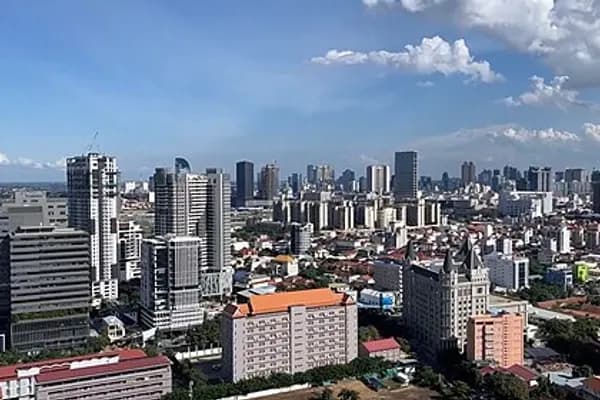
The tallest skyscraper in Phnom Penh is Vattanac Capital Tower at a height of 188 metres (617ft), dominating Phnom Penh's skyline with its neighbour skyscraper Canadia Tower (OCIC Tower).
Education
Universities and colleges
Primary schools, secondary schools, and high schools
International schools
Supplementary and extra schools
The Japanese Supplementary School of Phnom Penh, formerly known in English as the Phnom Penh Japanese School, is a part-time Japanese School, operated by the Japanese Association of Cambodia (JACAM;カンボジア日本人会 Kambojia Nihonjin-kai). It is in Sangkat Toek Thla in Sen Sok. It was established in 2002. It had 60 students in June 2011.
Culture
The city hosts a number of music events throughout the city. Indie bands have grown in number due also in part to the emergence of private music schools such as SoundsKool Music (also operating in the city of Siem Reap), and Music Arts School (registered as a non-governmental organization). The Cambodian fishing dance originated in Phnom Penh at the Royal University of Fine Arts in the 1960s.
Water Festival
The largest annual festival in Phnom Penh, this lively gathering celebrates the reversing of the flow of the Tonlé Sap River. The holiday lasts three days as people flood into the city to enjoy the fireworks, boat races, live concerts, eating and partying. The boat racing dates back to times marking the strengths of the Khmer marine forces during the Khmer Empire.
On 22 November 2010, at least 348 people were crushed to death in a bridge stampede at the festival.
Cityscape and architecture
Encyclopedic content adapted from the Wikipedia article on Riverside, used under CC BY-SA 4.0.