About the neighborhood
Public market in Seattle, Washington
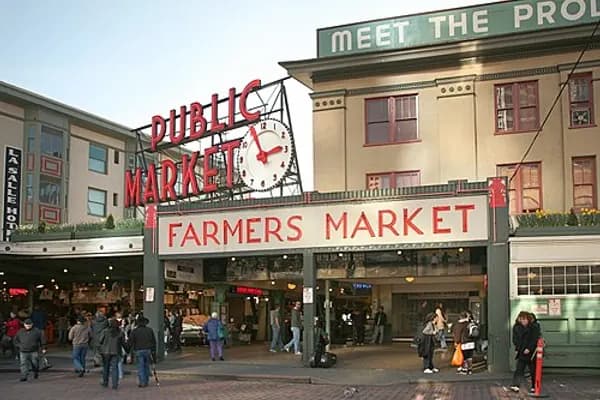
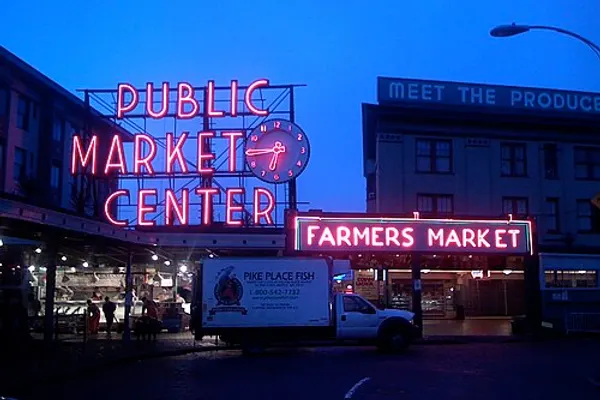
Pike Place Market is a public market in Seattle, Washington, United States. It opened on August 17, 1907, and is one of the older continuously operated public farmers' markets in the United States. Overlooking the Elliott Bay waterfront on Puget Sound, it serves as a place of business for many small farmers, craftspeople and merchants. It is named for its central street, Pike Place, which runs northwest from Pike Street to Virginia Street on the western edge of Downtown Seattle. Pike Place Market is Seattle's most popular tourist destination, with more than 20 million annual visitors.
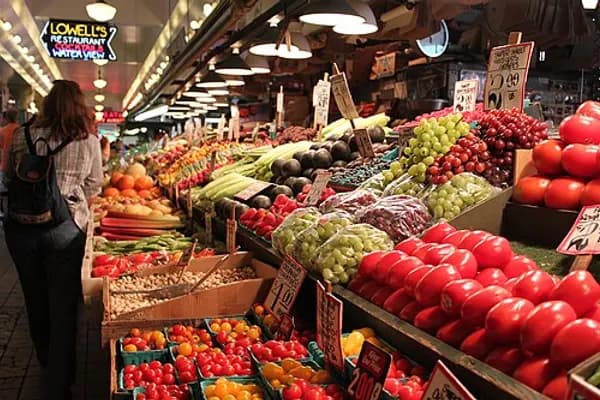
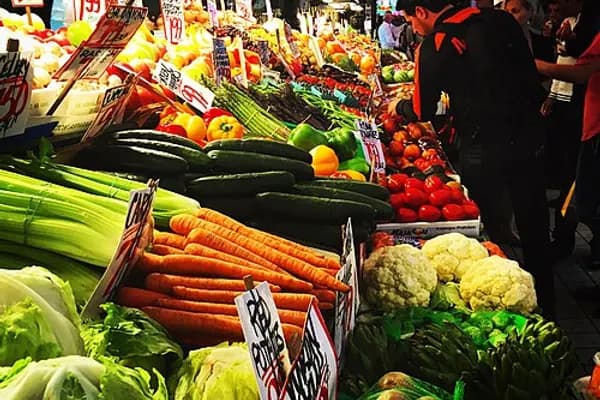
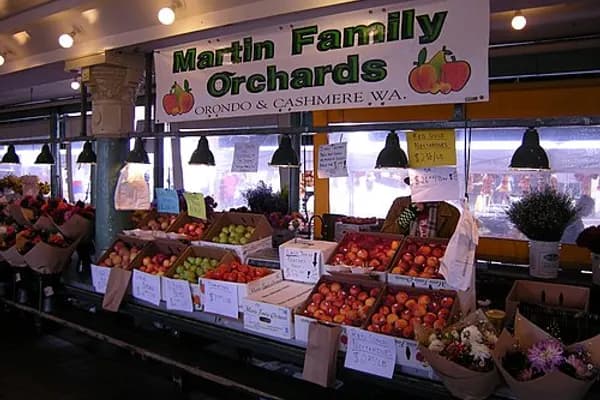
The Market is built on the edge of a steep hill and consists of several lower levels located below the main level. Each features a variety of unique shops such as antique dealers, comic book and collectible shops, small family-owned restaurants, and one of the oldest head shops in Seattle. The upper street level contains fishmongers, fresh produce stands and craft stalls operating in the covered arcades. Local farmers and craftspeople sell year-round in the arcades from tables they rent from the Market on a daily basis, in accordance with the Market's mission and founding goal: allowing consumers to "Meet the Producer".
Pike Place Market is home to nearly 500 residents who live in eight different buildings throughout the Market. Most of these buildings have been low-income housing in the past; however, some of them no longer are, such as the Livingston Baker apartments. The Market is run by the quasi-governmental Pike Place Market Preservation and Development Authority (PDA).
Location and extent
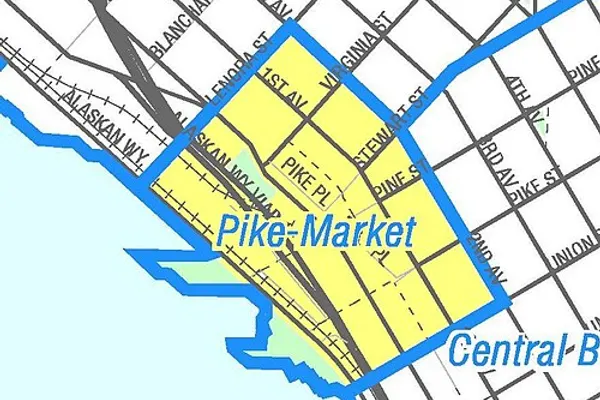
The Market is located roughly in the northwest corner of Seattle's central business district. To its north is Belltown. To its southwest are the central waterfront and Elliott Bay. Boundaries are diagonal to the compass since the street grid is roughly parallel to the Elliott Bay shoreline.
As is common with Seattle neighborhoods and districts, different people and organizations draw different boundaries for the market. The City Clerk's Neighborhood Map Atlas gives one of the more expansive definitions, defining a "Pike-Market" neighborhood extending from Union Street northwest to Virginia Street and from the waterfront northeast to Second Avenue. Despite coming from the City Clerk's office, this definition has no special official status.
The smaller "Pike Place Public Market Historic District" listed on the U.S. National Register of Historic Places is bounded roughly by First Avenue, Virginia Street, Western Avenue, and a building wall about halfway between Union and Pike Streets, running parallel to those streets.
In a middle ground between those two definitions, the Seattle Department of Neighborhoods' official 7-acre (28,000m) "Pike Place Market Historical District" includes the federally recognized Pike Place Public Market Historic District plus a slightly smaller piece of land between Western Avenue and Washington State Route 99, on the side of the market toward Elliott Bay.
To some extent, these different definitions of the market district result from struggles between preservationists and developers. For example, the National Historic Preservation Act of 1966 created the Washington Advisory Council on Historic Preservation. Victor Steinbrueck, at one point in the late 1960s, convinced the Advisory Council to recommend designating 17 acres (69,000m) as a historical district. Pressure by developers and the "Seattle establishment" soon got that reduced to a tenth of that area. The present-day historic district designations lie between these extremes.
Part of the market sits on what was originally mudflats below the bluffs west of Pike Place. In the late 19th century, West Street (now Western Avenue, angling away from Pike Place) was already a through street running more or less parallel to the shore. Railroad Avenue (now Alaskan Way) was built farther out on pilings; it was not filled in until the 1930s. Nearby piers with warehouses for convenient stevedoring had already been completed by 1905, two years before the market opened.
History
The market was created in 1907 when Seattle City Council member Thomas P. Revelle took advantage of an 1896 ordinance that allowed the city to designate tracts of land as public markets and designated a portion of the area of Western Avenue above the Elliott Bay tideflats off Pike Street and First Avenue. The market was opened August 17, 1907, by City Council President Charles Hiram Burnett Jr. The first building at the Market, the Main Arcade, opened November 30, 1907.
Demand for stalls grew and by 1911 the number of available stalls had doubled. The west side of the stall lines were soon covered in an overhead canopy and roofing, becoming known as the "dry row". In 1916 the market expanded into the Economy Market.
Throughout the early 1920s, the north side of the Corner Market became known as the Sanitary Market and the area developed into a social scene. A new ordinance forbidding farmers' stalls to be placed in the street resulted in proposals to move the market, but in 1921 the City Council voted to retain the existing location and work on expanding in place.
In 1963, a proposal was floated to demolish Pike Place Market and replace it with Pike Plaza, which met community opposition, including help from Betty Bowen, Victor Steinbrueck, Ibsen Nelsen, and others from the board of Friends of the Market. An initiative was passed on November 2, 1971, that created a historic preservation zone and returned the Market to public hands.
In the 1980s, a nonprofit group, the Pike Place Market Foundation, was established by the PDA to raise funds and administer the Market's free clinic, senior center, low-income housing, and childcare center. The 1983 Hildt Amendment or Hildt Agreement (named after City Council member Michael Hildt) struck a balance between farmers and craftspeople in the daystalls which set a precedent for allocation of daystalls.
In 1998, the PDA decided to end the Hildt Agreement; a new agreement, the Licata-Hildt agreement, was adopted in February 1999.
In 2008, Seattle voters approved a six-year property-tax levy to fund critical repairs and improvements, which were completed in 2012.
Operation
Organizations
The Pike Place Market is overseen by the Pike Place Market Preservation & Development Authority (PDA), a public development authority established under Washington State law. It is overseen by a 12-member volunteer council. Its members serve four-year terms. Four members are appointed by mayor, four by the current council, and four by the Pike Place Market Constituency. The Market PDA sets the policies by which the Pike Place Market is managed and hires an executive director to carry out those policies.
Established in 1973, the PDA manages 80% of the properties in the city-recognized Market Historical District. Its founding law—the Market Charter—requires it to preserve, rehabilitate and protect the Market's buildings; increase opportunities for farm and food retailing in the Market; incubate and support small and marginal businesses; and provide services for low-income people. PDA revenues derive from the Market's tenants through rent, utilities, and other property management activities.
The same 1973 charter that established the PDA also established the Pike Place Market Constituency. The Constituency elects one member to the PDA Council each year. Anyone 16 years of age or older who lives in Washington State can become a member of the Constituency by paying $1 yearly dues.
Operating independently of the PDA, the Market Historical Commission (established by the 1971 initiative to preserve the Market) has the specific mandate to preserve the Market's physical and social character as "the soul of Seattle." The commission must approve any substantive change in the use or design of buildings and signage in the Historical District, even when these actions are taken by the PDA itself. Members of the 12-member commission are appointed to three-year terms by the mayor. At any time, the commission consists of two members each from the Friends of the Market, Inc., Allied Arts of Seattle, Inc., and the Seattle chapter of the American Institute of Architects; two owners of property within the district; two Market merchants, and two district residents. They meet 22 times a year. The Seattle Department of Neighborhoods provides them with a staff person, and the city's Department of Design, Construction and Land Use (DCLU) can enforce their decisions.
Another key organization in the affairs of the Market is the Pike Place Merchants Association. Officially incorporated in 1973, it traces its history back to the Farm Association established in the 1920s. The association connects market vendors to legal, accounting, bookkeeping, business insurance, and health insurance services and provides free online advertising for its members. It also represents its members and attempts to advance their interests and opinions. All PDA tenants are required to be members; daystall vendors also have the option to join. Since 1974, the association has published the monthly Pike Place Market News, which promotes the Market and its neighborhood. For over three decades, the association sponsored a Memorial Day fair at the market; financial difficulties caused cancellation of the fair in 2004.
A separate Daystall Tenants Association (DTA) formed in the late 1980s to represent the specific interests of daystall vendors. The DTA formed in response to proposed increases in daystall rental rates. Most members pay a $2 annual membership fee; the fee is optional. The DTA meets on the Desimone Bridge in the Market at least once each quarter. Similarly, the United Farmers Coalition (UFC) formed in 1998 to represent daystall farmers who sell produce, flower, and processed food; the UFC represents only these food vendors, as against craft vendors. The Pike Market Performers' Guild, founded 2001, represents Market street performers. Among its members are Artis the Spoonman and Jim Page.
Friends of the Market, which spun out of Allied Arts in 1964 and over the next seven years spearheaded the activist work that saved the Market is no longer a driving force in the Market. Still, as noted above, they have two seats on the Historical Commission. They also give tours of the Market.
The Market Foundation (established 1982) was founded to support the Market's services for low-income people. The foundation now also supports heritage programs, improvements and repairs to historic buildings, and programs that assist the Market's farmers.
Conflicts
The PDA is a public trustee charged with many potentially conflicting goals. Its charter mandates it to "ensure that the traditional character of the Public Market is preserved." It is specifically mandated to
...afford... a continuing opportunity for Public Market farmers, merchants, residents, shoppers, and visitors to carry on their tradition and market activities... upgrad structures and public amenities... initiate programs to expand food retailing in the Market Historical District, especially the sale of local farm produce; to preserve and expand the residential community, especially for low-income people; to promote the survival and predominance of small shops, marginal businesses, thrift shops, arts and crafts, and other enterprises, activities, and services which are essential to the functioning of the Public Market.
The City Auditor's office has stated that there is an "inherent conflict... between the PDA's need to operate the Market as a successful business entity and its Charter obligation to support small owner-operated tenant businesses."
As early as 1974, a Seattle Department of Community Development study noted space conflicts between farmers and craft vendors. Conflicts can be exacerbated because the stakeholders with conflicting needs are not talking to one another. Quoting the same City Auditor's report:
Most Market tenants do not routinely communicate with tenants in other areas of the Market. As a result, they sometimes criticize the PDA for not implementing suggestions they believe would work for them and their close neighbors—e.g., closing all or part of Pike Place to auto traffic—not realizing that their "solutions" would create problems for tenants in other parts of the Market. Then they conclude that the PDA is not taking their comments and suggestions seriously.
Language barriers also play a role. For example, most of the flower vendors in the Market are Hmong; during the difficult negotiations in 1999 over replacing the Hildt Agreement, many were apparently under a misimpression that the proposed agreement would have halved the vending space they received for a day's rent; in fact, this was unchanged.
Further, the farmers who were the Market's original raison d'etre do not necessarily do well when the Market becomes more of a tourist attraction than venue for shopping for produce and groceries. "Craft vendors, antique and curio merchants, and booksellers…" wrote the City Auditor's office, "derive much of their business from tourists; fresh food vendors do not." Conversely, farmers have far more selling opportunities outside the Market than in the early and mid-20th century. As late as 1990, there were about ten farmers markets in Washington. By 1999 there were more than sixty. Most are seasonal weekend markets without most of the Pike Place Market's amenities, but they are not swarmed with tourists, parking is free or inexpensive and relatively plentiful, and food is the main focus of those markets, not crafts or flowers.
As a result, increasingly Pike Place Market daystalls are devoted to flowers and crafts rather than edible produce. "The Market," wrote the City Auditor's office,
...can be "lost" in either of two ways: It can stray from its traditional character or it can fail financially as a business entity. If the Market is to survive and thrive as a business entity in the face of increasing competition from other farmers' markets, modern full-service grocery stores, and retail shopping destinations in Seattle's Central Business District, the PDA must strike a balance between the Market's original old-world market character and modern business practices.
Policies
The Market's "Meet the Producer" mandate now includes craftspeople as well as farmers. Both can rent daystalls. Farmers take historic precedence, but the PDA "acknowledges the rightful and permanent position of handmade arts and crafts as an integral use of the Market's Daystalls" and their rules seek to encourage a lively mix. Some grandfathered vendors are allowed to sell merchandise not of their own making on essentially the same terms as craftspeople. Currently, there are rules to make sure that new crafts vendors demonstrate themselves to be skilled craftspeople making their own wares with minimal use of assistants.
Encyclopedic content adapted from the Wikipedia article on Pike Place, used under CC BY-SA 4.0.