About the neighborhood
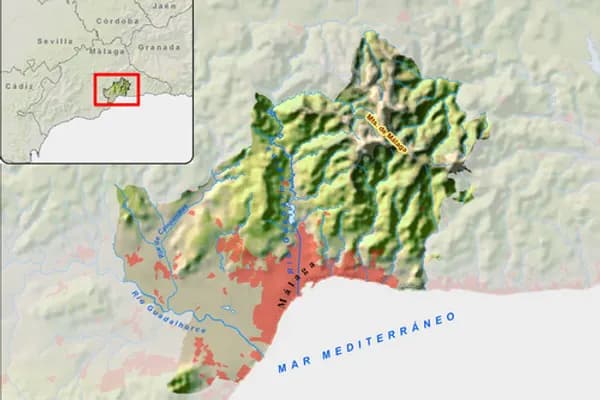
The urban planning of Málaga reflects the process of occupation and evolution of the construction in this Spanish city since its founding in the 8th century BC. Topographically, Málaga’s urban layout can be described as an inverted T, with the Guadalmedina River as the vertical axis, still marking a geographical and cultural divide in the city. Three physical factors have shaped Málaga’s urban development: the Mediterranean Sea, the Guadalmedina River, and the proximity of the Montes de Málaga. The eastern part of the city forms a narrow strip of land wedged between sea and mountains, while the western side, toward the broad plain between the Guadalhorce River and the Guadalmedina, known as the Hoya de Málagaes, has been the natural area of expansion, giving rise to large neighborhoods throughout the 20th century.
Known first as Malakaes and later as Malacaes, the history of Málaga spans about 2,700 years, but significant population growth and urbanization did not occur until the 19th century. During the 18th and 19th centuries, the core of what is now the Historic Centeres, east of the Guadalmedina, took shape. It features an irregular layout inherited from the Muslim period, with a mix of centuries-old residences (in varying states of preservation, many in ruins or under restoration), 19th-century buildings, and modern constructions.
In the eastern zone, except for the La Malaguetaes neighborhood, single-family homes predominate. These range from traditional fishermen’s houses along the coast to detached residences with gardens in neighborhoods like Pedregalejoes and El Limonares, a legacy of the 19th-century industrial bourgeoisiees. At the easternmost end lies the historic fishermen’s enclave of El Paloes, which retains modest homes, taverns, and a traditional maritime atmosphere, emblematic of Málaga’s heritage.
On the west bank of the Guadalmedina, the urban suburb and industrial zone historically housed workers, laborers, and other working-class residents, a pattern that persisted into the 20th century. The exception is El Perchel, an Arab suburb predating the Reconquista. The rural exodus, as in much of Spain, began in the late 1950s, replacing orchards, dairies, and industrial ruins with working-class neighborhoods populated by rural migrants drawn by job opportunities during the tourism and industrial boom. The result was poorly planned urbanism driven by speculative business interests, exploiting cheap land for maximum profit. Until the 1990s, many of these areas featured traditional corraloneses, some of which still survive in El Percheles and La Trinidades.
Origins
Phoenician Malaka
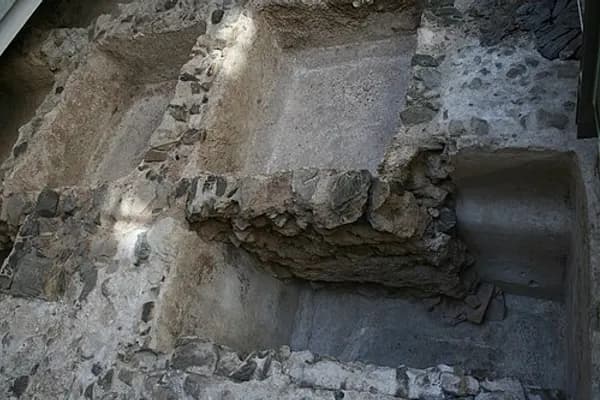
Little is known about Málaga’s urban structure before the Islamic period. Speculation has linked Málaga to the Greek colony of Mainake, but no definitive evidence supports this. However, traces of Phoenician and Roman civilizations have been uncovered. Remains of the Phoenician colony of Mlkes or Malaka include sections of the defensive walles beneath basements in the historic center, notably under the Museo Picasso Málaga and the former Post Office buildinges, as well as remnants of a sanctuary or temple on a plot in Calle Císteres.
Excavations indicate that the Phoenician settlement extended from the slopes of Gibralfaro to Calle Císter and the Ibn Gabirol gardens, reaching the sea, which at the time lapped against the current University Rectoryes building. The discovery of a Phoenician necropolis on Calle Andrés Pérez helped establish these boundaries, as Semitic peoples typically placed cemeteries outside populated areas, suggesting that Malaka was confined to this area. It was a small settlement oriented toward the sea, possibly with a rudimentary port or jetty, though no tangible remains have been found.
Roman Malaca
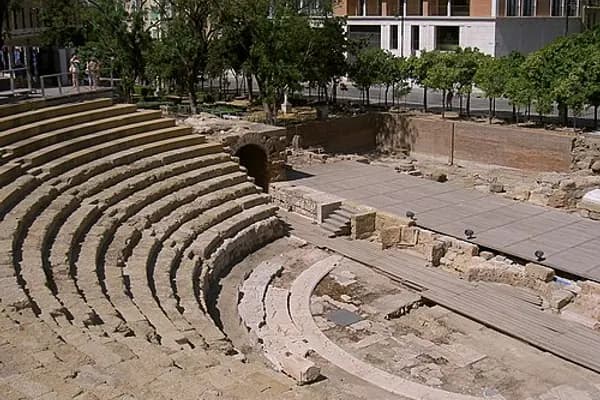
The Roman Malacaes was significantly larger than its Phoenician predecessor, with evidence of a pottery industry around the El Ejidoes hill and Calle Olleríases in the 1st century. The most prominent remains are those of the Roman Theatre of Málagaes, located next to the Alcazaba, along with fragments of the road system and large public baths in the area of Calle Alcazabillaes toward Calle Císteres. Beyond this area, the structure and layout of the Roman city are poorly understood. Several funerary sectors have been identified on the outskirts, some along communication routes, consistent with the urban planning standards of the Empire adopted generations after the arrival of the Romans.
The original Phoenician colony became peripheral as the Roman city expanded northward and westward. The forum has not yet been identified, with possible locations under the Palacio de la Aduana, Calle Alcazabillaes, or, less likely, the Plaza de la Merced or Plaza de la Constitución. Domestic areas have been confirmed, including a villa on the southern slope of Gibralfaro in the current Puerta Oscura gardenses and ancient dwellings north of the Plaza de la Constitución, particularly around Santa Lucía and San Telmo streets. The northward and westward growth is further evidenced by the evolution of funerary sites, with the necropolis at Calle Beatas shifting southwest in the 2nd century, extending toward the Teatro Cervantes and Calle Frailes in the late imperial period.
Under Roman rule, Malaca continued the Phoenician tradition of producing preserves and salts, with remains scattered across the city’s hinterland. A salting factory with eight vats, dated to the late 2nd century, was found near Calle Beatases. This area’s production was complemented by ceramic kilns at Calle Carreteríaes and an associated dump at Calle Álamos, expanding further north and west toward Calle San Juan de Letrán and Calle de la Compañíaes.
The late Roman defensive wall is partially preserved under buildings at Cortina del Muellees 17 and 19, along Calle Molina Larioes, Plaza del Obispoes, and Calle Strachan, with three points in the western old town. The Roman city extended beyond the fortified area, with evidence found in Calle Pozos Dulceses, near the Guadalmedina riverbed.
Byzantine and Visigothic Malaca
During the Byzantine period, starting in the mid-6th century, the Roman city’s structure was largely maintained. Warehouses for export goods were located along Calle Molina Lario and Strachan, aligning with the coastline of the time, as evidenced by an anchorage found in Calle Camas. Byzantine traces have also been detected across the Guadalmedina.
With the arrival of the Visigoths and a broader Mediterranean crisis, a process of feudalization began, driven by the decline of garum production and growing insecurity. The population fled en masse to the mountains, abandoning the city. The port disappeared by the 7th century, and Málaga did not recover until the arrival of the Arabs.
Muslim city
In 743, the Arabs entered the city, naming it Mālaqa (مالقة). Initially, its importance was comparable to neighboring settlements like Bezmilianaes or Archidona, the capital of the Cora of Rayya, an administrative division covering the current Province of Málaga. With the establishment of the Caliphate of Córdoba in 929, and as a provincial capital, Mālaqa gained prominence, which grew under the Hammudid dynasty and peaked during the Nasrid period.
Medina
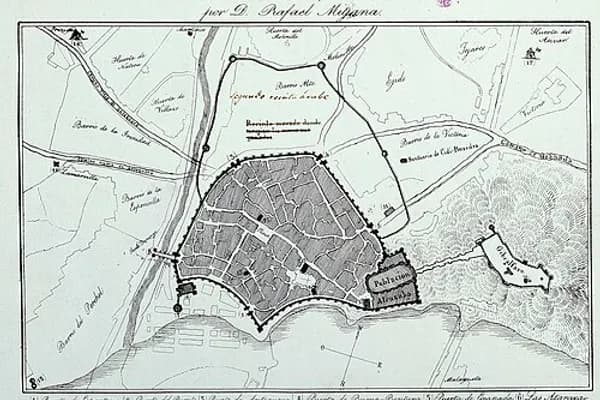
The morphology of Nasrid Mālaqa followed the classic model of medieval Islamic urbanism, comprising the medina, the castle, and the suburbs. The walled perimeter enclosed what is now considered the historic centeres. The central axis linked the Alcazaba with the Antequera gate, connecting the Plaza de las Cuatro Calles (now Plaza de la Constitución), the souk, and the main mosque. The city was organized along transverse axes, with Calle Granadaes extending from the plaza to the Granada royal road via the gate of the same name, hosting several mosques and stately homes. The remaining road network featured winding, narrow streets, some of which, like Calle Ascanio, survive today.
Alcazaba and Castle
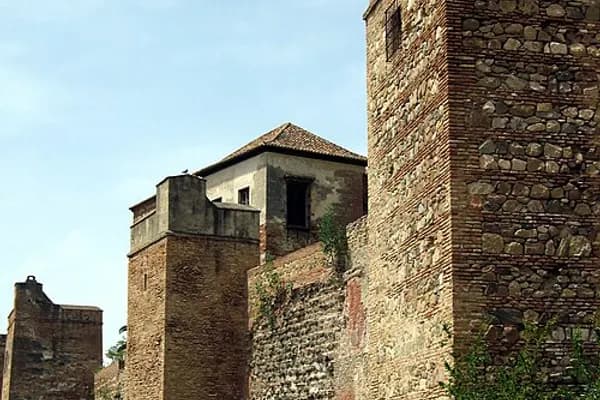
Construction of the Alcazaba began in 1065 under King Badis and was expanded during the Nasrid period. Located on the eastern side of the medina, it was enclosed by three walls. The outer enclosure housed the parade ground and accesses to the medina, while the inner enclosure contained palatial quarters and a small intramural neighborhood. The Alcazaba was connected to the Gibralfaro Castlees via a protected double-walled pathway, or corachaes, used to supply food to soldiers. The castle took its final form under Yusuf I (1333–1354), though parts date earlier. It consists of two walled enclosures and two inner areas: the upper, with the castle’s mosque, a Phoenician-origin well, baths, and the main tower; and the lower, with stables and troop residences.
The city’s defensive system was complemented by watchtowers scattered across the current municipal district and neighboring areas. Surviving examples include the Torre del Prado (also known as Torre de Fajardo or Campanillas tower) near Colmenarejo; the Torre de la Quirosa or Torre de la Alhaja in Los Almendrales; and the Torre de los Verdiales in the area of the same name. Only fragments remain of the towers of Cerrado de Calderónes, San Telmo, San Isidro, and del Río, while other standing towers are of Christian origin.
Walls
The medina’s wall, begun during the Caliphal period, extended from the Alcazaba in a straight line to the Granada gate, not encompassing the Alcazaba. It continued along the southern side of the Plaza de la Merced and Calle Álamos, enclosing the Fontanella suburb. It ran along Calle Puerta de San Buenaventura, the suburb’s entrance, and Calle Carreteríaes to the Antequera gate, then paralleled the Guadalmedina to the Atarazanases. It proceeded to the Genoese castle at the current Plaza de la Marinaes and along Cortina del Muelle back to the Alcazaba.
The walled enclosure opened to the exterior through several gates: the Granada gate (Bab al-Funtanalla), San Buenaventura, and Antequera (Bab al-Jawja) on the north, the latter being the main entrance; the Bridge gate by the river; the Sea gate (Bab al-Bahr), Baluarte, Espartería (Bab al-Faray), and Seven Arches on the south; and the Oscura and Caba gates linking the medina to the Alcazaba.
Suburbs
The urban area was surrounded by orchards, groves, and two suburbs, along with external cemeteries, Jewish quarters, and foreign commercial establishments, notably the Genoese castle near the port from 1278. The Fontanella suburb, the most populous, extended north of the medina, covering the current La Mercedes, San Felipe Neries, and much of La Goletaes neighborhoods, between the streets Frailes, Refino, Postigo, Cruz del Molinillo, and Gigantes. Protected by a smaller wall, it was dedicated to ceramic production, as evidenced by street names like Calle Olleríases. According to Repartimientoes documents, it included smaller suburbs like those of the Granada and Antequera gates, as well as orchard and livestock areas. It had all the medina’s amenities, including mosques, public baths, and schools. Pottery activities, inherited from the Romans, thrived due to abundant raw materials and water, expanding north and west. The defensive wall featured several towers and possibly two gates: the Alcohol gate, leading to the Yabal Faruhes cemetery, and another at Postigo de Juan Boyero, toward the Casabermeja road.
Across the river lay the Paja merchants’ suburb, or Attabanim, corresponding to the historic El Percheles neighborhood. Formed during the Hammudid period, it previously hosted orchards and small exploitation structures. It extended north to La Trinidad street and south to the beach, where wall fragments have been found. Its orthogonal layout featured homes around courtyards with wells, water supply, drainage, mosques, and baths. Main activities included dyeing, leatherwork, and agriculture. A royal Almohad residence, Qars al-Sayyid, destroyed during the Castilian siege, stood near the current Santo Domingo Churches, and the Zamarrilla tower was located in Calle Mármoleses.
Convent City
Under Castilian rule, the city’s functions changed, but urban layout alterations were minimal, mainly limited to the opening of Calle Nuevaes. Traced in 1491, this narrow street, by modern standards, facilitated the transport of goods between the Puerta del Mares at the port and the Antequera gate, the main entry for agricultural products from inland orchards, around which warehouses were located.
With the administrative shift, mosques were replaced by churches. The Cathedral of Málaga was built on the main mosque’s foundations, designed by Diego de Siloé. Churches and convents proliferated within the walled area, including San Juanes, Mártireses, and Santiagoes. The first religious order to settle was the Observant Franciscans in 1489, under the patronage of the Catholic Monarchs, founding the San Luis el Reales convent outside the city walls, near the Guadalmedina. This was followed by the Franciscan Convento de los Ángeleses and the Clarisas de la Concepción convent, built in 1505.
Religious orders also established convents outside the walls, creating radial communication routes from the city. Two were built where the Catholic Monarchs camped during the siege: the Convento de la Trinidades at Isabella’s camp, and the Convento de la Victoriaes at Ferdinand’s. Other convents shaping this radial system included Capuchinos, Santo Domingoes, and San Andréses.
Over time, these external churches and convents attracted populations, forming new suburbs often named after them, such as La Trinidades and Capuchinoses. By the 17th century, religious institutions occupied a third of the city, with 15 male and 9 female convents or monasteries. Notable secular buildings included the San Juan de Dios, Santo Tomás, and San Juliánes hospitals, the Consulate, the Alhóndiga, and the Town Hall.
Characteristic of Spanish cities of this era were wayside crosses. Málaga had four, located at the city’s edges along royal roads. Only the cross at Cruz del Humilladeroes plaza survives, once in an open area where the Cártama and Churriana roads met. Others stood on the Vélez-Málaga road at La Caletaes’s humilladero, the Granada road at Huerta del Acíbar near El Ejidoes, and Zamarrilla’s humilladero on Calle de los Mármoleses, the old Antequera road.
Enlightenment Transformations
In the 18th century, Málaga experienced economic and demographic growth driven by port trade, particularly from the third decade onward. The city expanded in several directions, notably toward San Andrés beaches, Capuchinoses, La Trinidades, and La Caletaes. With the dynastic change at the court, new urban concepts emerged in Spain, emphasizing urban beautification. In Málaga, this led to wide, geometric spaces and palatial residences, including the Aduana, Episcopal Palacees, Plaza del Obispoes, and the Society of Friends of the Countryes building, alongside the gradual demolition of the walls.
Creation of the Alameda
Encyclopedic content adapted from the Wikipedia article on Pedregalejo, used under CC BY-SA 4.0.