About the neighborhood
City in Thailand
This article contains Lanna text. Without proper rendering support, you may see question marks, boxes, or other symbolsinstead of Tai Tham script.
Chiang Mai is the largest city in northern Thailand, the capital of Chiang Mai province and the second-largest city in Thailand by urban population. It is 700km (435mi) north of Bangkok in a mountainous region called the Thai highlands, and has a population of approximately 127,000 within the city municipality and an urban population of about 1.2 million as of 2023.
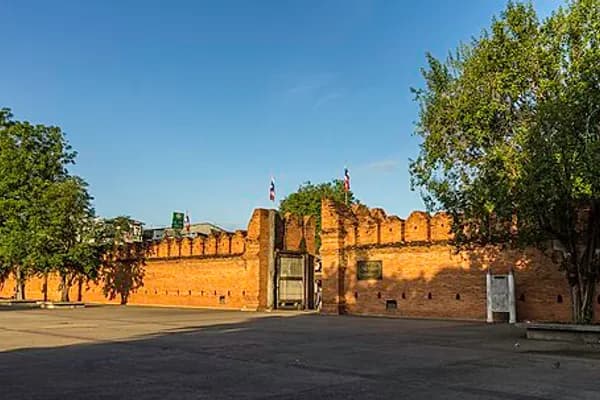
The heart of the city is commonly defined by a square area about 1.6km x 1.6km. It is bordered by ancient red brick walls (now only remnants) and has a moat surrounding it.
However, the greater urban area, including surrounding districts such as Hang Dong, San Sai, and Saraphi, forms a metropolitan region with an estimated population exceeding 1 million. At the provincial level, Chiang Mai had a projected population of 1.8 million in 2023, according to Thailand's National Statistical Office.
Chiang Mai (meaning "new city" in Thai) was founded in 1296 as the new capital of Lan Na, succeeding the former capital, Chiang Rai. The city's location on the Ping River (a major tributary of the Chao Phraya River) and its proximity to major trading routes contributed to its historic importance.
The city municipality of Chiang Mai (thesaban nakhon) officially only covers parts (40.2km) of the Mueang Chiang Mai district in the city centre and has a population of 127,000. This census area dates back to 1983 when Chiang Mai's municipal area was enlarged for the first and last time since becoming the first City Municipality in Thailand (then under Siam) in 1935. The city's sprawl has since extended into several neighboring districts, namely Hang Dong in the south, Mae Rim in the north, Suthep in the west and San Kamphaeng in the east, forming the Chiang Mai urban area with over a million residents.
The city municipality is subdivided into four khwaeng (electoral wards): Nakhon Ping, Sriwichai, Mengrai, and Kawila. The first three are on the west bank of the Ping River, and Kawila is on the east bank. Nakhon Ping District includes the northern part of the city. Sriwichai, Mengrai, and Kawila consist of the western, southern, and eastern parts, respectively. The city center—within the city walls—is mostly within Sriwichai ward.
Chiangmai was declared by the UNESCO Creative Cities Network for the City of Crafts and Folk Arts in 2017.
History
Mangrai founded Chiang Mai in 1294 or 1296 on a site that the Lawa people called Wiang Nopburi.
The city succeeded Chiang Rai as the capital of Lan Na. Phayu enlarged and fortified it and built Wat Phra Singh in honor of his father, Khamfu. With the decline of Lan Na, Chiang Mai lost importance and was occupied by the Toungoo Empire in 1556. It formally became part of the Thonburi Kingdom in 1774, by an agreement with Kawila, after the Thonburi king Taksin helped drive out the Burmese. Subsequent Burmese counterattacks led to Chiang Mai's abandonment between 1776 and 1791;
The modern municipality dates to a sanitary district (sukhaphiban) that was created in 1915; it was upgraded to a city municipality (thesaban nakhon) on 29 March 1935. First covering just 17.5 square kilometres (6.8sqmi), the city was enlarged to 40.2 square kilometres (15.5sqmi) on 5 April 1983.
In May 2006, Chiang Mai was the site of the Chiang Mai Initiative, concluded between ASEAN and the "ASEAN+3" countries, (China, Japan, and South Korea). Chiang Mai was one of three Thai cities contending for Thailand's bid to host the World Expo 2020. Ayutthaya was ultimately chosen by the Thai parliament to register for the international competition.
Chiang Mai was one of two tourist destinations in Thailand on TripAdvisor's 2014 list of "25 Best Destinations in the World", where it stood at number 24. Chiang Mai is also the place where the new idol group CGM48 was founded.
Emblem
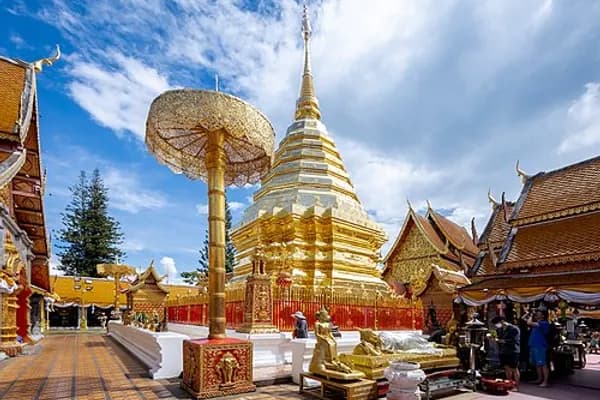
The city emblem shows the stupa at Wat Phra That Doi Suthep in its center. Below it are clouds representing the moderate climate in the mountains of northern Thailand. There is a nāga, the mythical snake said to be the source of the Ping River, and rice stalks, which refer to the fertility of the land.
Demography
Population
Following the municipal city area's enlargement to 40.2km in 1983, no changes or updates have been made to it, even with the population increasing substantially in the years after. In 1983, Chiang Mai's urban area, with a population of 127,000, already exceeded the municipal city limits, and has grown to over one million people in 2022.
Chiang Mai Municipality has now become a small part of the current city-scape, making up only most parts of the capital district Amphoe Mueang Chiang Mai in the inner city. To reflect the city's growth beyond the municipal borders, official government documents by the Chiang Mai Provincial Administrative Organization and the Department of Public Works and Town & Country Planning Archived 2023-03-28 at the Wayback Machine - published in the Royal Thai Government Gazette - regularly update and outline the current city boundaries. The first revision of such an updated urban area (Thai: เขตเมือง) was published in 1989, with the second one following in 1999. The third revision from 2012 expands the old municipal city border inside Muaeng Chiang Mai district to Mae Rim in the north, San Kamphaeng and Doi Saket in the east, Hang Dong and Saraphi in the south, and Suthep in the west. This new extent, with a size of 405km, serves as Chiang Mai's principal city border and urban area.
The urban area has a combined population of 1,198,000 residents, making Chiang Mai the second largest city in Thailand after Bangkok (10.7 million people) and twice as big as the third largest city Nakhon Ratchasima (Estimate: 500,000 people). As neither the Department of Local Administration (DLA) nor the National Statistics Office (NSO) count expatriates, non-permanent residents, migrant workers (except ASEAN migrants for the year 2017) and citizens from other Thai provinces living and renting in Chiang Mai in their official population figures, it is estimated that the real population figure for Chiang Mai could be as high as 1.5 million.
As of 2022, a fourth revision of Chiang Mai's urban area is under way and currently up for debate by the public. Proposals show the expansion of the current urban area into more adjacent subdistricts and large forest areas, especially around Doi Suthep.
Since Thailand's outdated census methods prevent the determination of official metropolitan areas outside of Bangkok, presently there are no official sources indicating how large the extended metropolitan area is.
Geography
Chiang Mai Municipality covers an area of 40.2 square kilometres (15.52 sq mi), while the urban city covers an area of 405 square kilometres (156.371 sq mi). The city's sprawl reaches into six neighboring districts: Mae Rim, Doi Saket, San Kamphaeng, Hang Dong, Saraphi and Suthep. Chiang Mai is the only city outside Bangkok to reach into other districts.
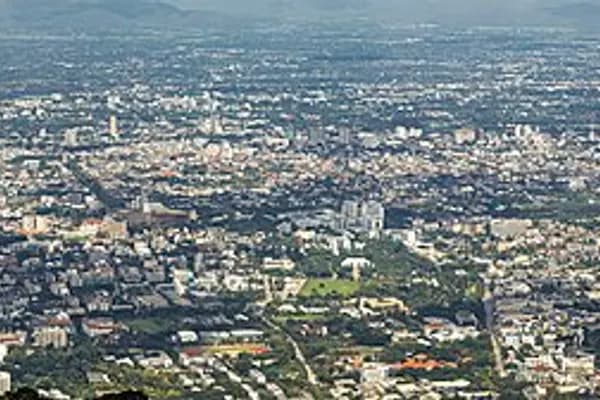
The city is situated in a broad basin in the Thai highlands and lies at an average elevation of 300m (1,000ft) elevation above sea level. Chiang Mai's city centre sits west of the Ping River, a tributary to the Chao Phraya River. The city's sprawl extends outward in all directions, especially north, south, and east. East of the city is the Khun Tan mountain range. Abutting the west side of Chiang Mai lies the Thanon Thong Chai mountain range, with the twin peaks of Doi Pui and Doi Suthep prominently rising above the city with elevations of over 1700 and 1600 metres, respectively.
Parks and green spaces
There are several parks and green spaces inside the city. Buak Hat Public Park, located in the south west corner of the old city is the most frequented public park in Chiang Mai. Directly opposite, to the south-west, is Kanchanaphisek Park, a park with remnants of the old extended city walls. Bigger parks include Lanna Rama 9 Park to the north in Chang Phueak district and Ang Keaw Reservoir, located near the northern entrance to Chiang Mai University. As of 2024, there are plans to reopen the Chiang Mai Railway Park opposite of the central train station.
Climate
Chiang Mai has a tropical savanna climate (Köppen Aw), tempered by the low latitude and moderate elevation, with warm to hot weather year-round, though nighttime conditions during the dry season can be cool and much lower than daytime highs. The maximum temperature ever recorded was 42.5°C (108.5°F) in May 2016. Cold and hot weather effects occur immediately but cold effects last longer than hot effects and contribute to higher cold related mortality risk among old people aged more than 85 years.
Government
The Administration of Chiang Mai Municipality is responsible for an area that covers approximately 40.216 square kilometers and consists of 4 Municipal Districts, 14 sub-districts, 94 municipal communities, and 89,656 households.
According to Municipal Act B.E. 2496 (1953, reviewed in 2003), the duties of the Municipality cover a lot of areas which include clean water supply, waste and sewage disposal, communicable disease control, public training and education, public hospitals and electricity, etc.
The mayor, or the highest executive, is directly elected by the eligible voters in the municipal area. The mayor serves a four-year term and is assisted by no more than four deputy mayors appointed directly by the mayor. The mayor will thus be permitted to appoint deputies, secretaries and advisors including the mayor himself or herself totally no more than 10. The current mayor is Tussanai Burabupakorn, as of June 2018.
The Municipal Council is the legislative body of the municipality. It has the power to issue ordinances by laws that do not contradict with the laws of the country. The municipal council applies to all people living in the municipal area. The Chiang Mai City Municipal Council is composed of 24 elected members from 4 municipal districts who each serves a 4-year term.
Economy
Development initiatives
In February 2017, the Digital Economy Promotion Agency (DEPA) (under Thailand's Digital Economy and Society Ministry) announced that 36.5 million baht would be invested into developing Chiang Mai into an innovation-driven "smart city". Chiang Mai was the second city in Thailand, after Phuket and along with Khon Kaen, to be developed using the "smart city" model. The model aims to capture and populate multiple levels of information (including building, social, environmental, governmental, and economic data) from sources like sensors, real-time traffic information, and social forums for access by managers, governments, and citizens using mobile apps, tablets, and dashboards. The "Smart City" outlook (integrating Information and Communications Technology (ICT) with the Internet of Things (IOT)), is viewed to be critical both for secondary cities with burgeoning urban population like Chiang Mai, as well as part of Thailand's move to be digital hub of ASEAN. The role of private sector investment, together with public sector partnership, is key to promote digital entrepreneurship. Prosoft Comtech, a Thai software company, has spent 300 million baht to build its own "Oon IT Valley" on a 90 rai plot of land as a community for tech start-ups, Internet of Things technology, software programmers and business process outsourcing services. It is aimed to both increase the size of Chiang Mai's digital workforce, as well as attract foreign digital talent to Chiang Mai.
Smart transportation
In January 2018, it was announced that Chiang Mai would be launching "Mobike In", a bike-sharing app that would see the introduction of some 500 smart bikes on the streets. The smart bikes would be available for use for both locals and tourists. It is reported that as a start, the bikes would be placed at convenient locations including the Three Kings monument, Tha Phae Gate and Suan Buak Haad Park, as well as in the old town. The "Mobike In" project is sponsored by Advanced Info Service (Thailand's largest mobile phone operator), in collaboration with the Tourism Authority of Thailand (Chiang Mai Office), together with local universities, public and private sectors. The project aims to promote non-motorised transportation and support eco-tourism. Speaking at the launch at the Lanna Folklife Museum, Deputy Governor Puttipong Sirimart stated that the introduction of such "smart transportation" was a positive move in Chiang Mai's transformation into a "Smart City" (part of the "Thailand 4.0" vision).
Smart agriculture
DEPA has also provided funding to Chiang Mai's Maejo University, to develop wireless sensor systems for better farmland irrigation techniques, to reduce use of water sprinklers and increase productivity. The university is also developing agricultural drones that can spray fertilizers and pesticides on crops which, if successful, will result in lower costs. The drones may also detect and monitor fires and smoke pollution.
Under the 2011 IBM "Smarter Cities Challenge", IBM experts recommended smarter food initiatives focused on creating agricultural data for farmers, including price modelling, farmer-focused weather forecasting tools, an e-portal to help farmers align crop production with demand, as well as branding of Chiang Mai produce. Longer-term recommendations included implementing traceability, enabling the tracking of produce from farm to consumer, smarter irrigation as well as flood control and early warning systems.
Smart healthcare
Encyclopedic content adapted from the Wikipedia article on Old City, used under CC BY-SA 4.0.