About the neighborhood
Borough of Berlin in Germany
Mitte (German: ˈmɪtə ) is the first and most central borough of Berlin. The borough consists of six sub-entities: Mitte proper, Gesundbrunnen, Hansaviertel, Moabit, Tiergarten and Wedding.
It is one of the two boroughs (the other being Friedrichshain-Kreuzberg) which were formerly divided between East Berlin and West Berlin. Mitte encompasses Berlin's historic core and includes some of the most important tourist sites of Berlin like the Reichstag and Berlin Hauptbahnhof, Checkpoint Charlie, Museum Island, the TV tower, Brandenburg Gate, Unter den Linden, Potsdamer Platz and Alexanderplatz. The latter six of which were in former East Berlin.
Geography
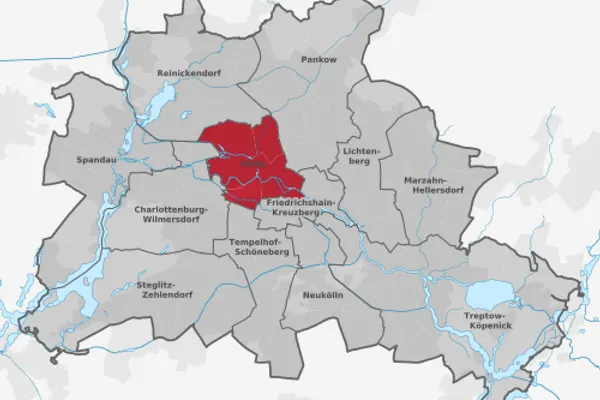
Mitte (German for "middle", "centre") is located in the central part of Berlin along the Spree River. It borders on Charlottenburg-Wilmersdorf in the west, Reinickendorf in the north, Pankow in the east, Friedrichshain-Kreuzberg in the southeast, and Tempelhof-Schöneberg in the southwest.
In the middle of the Spree lies Museum Island (Museumsinsel) with its museums, Berlin Cathedral (Berliner Dom) and Berlin Palace (Berliner Schloss). A central square in Mitte is Alexanderplatz with the prominent Fernsehturm (TV tower), Germany's highest building, and the large railway station with connections to many subway (U-Bahn), tramway (Berlin trambahn), city trains (S-Bahn) and buses.
There are some important streets which connect Mitte with the other boroughs, e.g. the boulevard Unter den Linden which connects Berlin Palace with Brandenburg Gate and runs further as Straße des 17. Juni to the Victory Column and the centre of former West Berlin in Charlottenburg, or Karl-Marx-Allee from Alexanderplatz to Friedrichshain and the eastern suburbs.
History
The former Mitte district had been established by the 1920 Greater Berlin Act and comprised large parts of the historic city around Alt-Berlin and Cölln. Brandenburg Gate was the western exit at the Berlin city boundary until 1861.
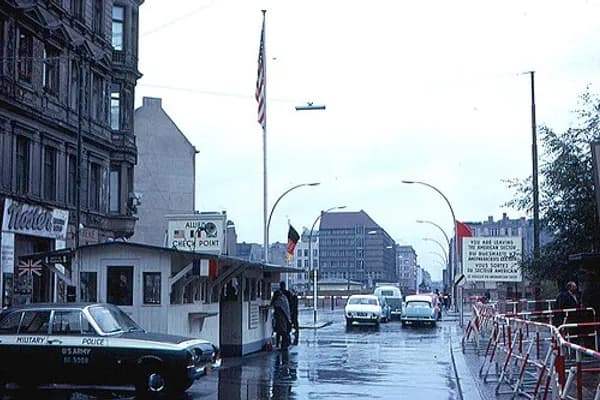
Between 1961 and 1990, the area's East Berlin portion was surrounded by the Berlin Wall on the north, south and west. There were some border control points, the most notable of which was Checkpoint Charlie between Kreuzberg and Mitte, which was operated by the United States Army and was open to foreigners and diplomats.
Two other checkpoints were at Heinrich-Heine-Straße/Prinzenstraße east of Checkpoint Charlie, open to citizens of West Germany and West Berlin and on Invalidenstraße in the north on the border with the West Berlin Tiergarten district (the present-day Moabit locality).
Regierungsviertel (Government District)
The government district is located in the locality of Tiergarten around the Reichstag Building. Most institutions of the German government have their seat at the Regierungsviertel
Bundestag, the German parliament in the old Reichstag Building
Bellevue Palace, seat of the Federal President
German Chancellery
Offices of the Abgeordneten, members of the parliament, in the Paul-Löbe-Haus and the Marie-Elisabeth-Lüders-Haus
Federal Ministry of the Interior
Historische Mitte (Historic center)
The historic center is located in the locality of Mitte proper around the Berlin Palace.
Berlin Palace / Humboldt Forum
Berlin Cathedral
Museum Island
Nikolaiviertel
Gendarmenmarkt
Unter den Linden
Brandenburg Gate
Fotografiska Berlin
Botschaftsviertel (Embassy Quarter)
Many embassies and the Federal Ministry of Defence in the historic embassy quarter in the south of the Tiergarten Park.
Tiergarten Park
Großer Tiergarten is the name of the biggest urban park in Mitte, located in the same-named locality. Tiergarten Park was established as a hunting ground in the 16th century by the Prussian kings. Today it is enclosed by densely built-up areas by Hansaviertel and Moabit in the north, the Government District in the east and the City West and the Embassy Quarter in the southwest.
Many cultural monuments and memorials are located in the Tiergarten Park, like the Siegessäule, the Soviet War Memorial and a historic rose garden. The Memorial to the Murdered Jews of Europe, the biggest victim group of the Nazi dictatorship, is located on the east side of the park, near the Brandenburg Gate and near the place where Hitler's New Reich Chancellery once was.
Kulturforum
The Kulturforum was built in the 1950s and 1960s at the edge of West Berlin, after most of the once unified city's cultural assets had been lost behind the Berlin Wall. The Kulturforum is characterized by its innovative modernist architecture; several buildings are distinguished by the organic designs of Hans Scharoun, and the Neue Nationalgalerie was designed by Mies van der Rohe, albeit originally as a private house.
Among the cultural institutions housed in and around the Kulturforum are:
Neue Nationalgalerie
Gemäldegalerie
Museum of Decorative Arts
Musical Instrument Museum
Kupferstichkabinett (Print room)
Art Library
Berliner Philharmonie
Chamber Music Hall
Berlin State Library
Ibero-American Institute
Wissenschaftszentrum
St. Matthäus-Kirche
In arts and literature
Berlin Alexanderplatz, a 1929 novel by Alfred Döblin
Mitte 1, a 2013 novel by Albrecht Behmel
Berlin-Mitte, Norman Ohler
Unter diesem Einfluss, Henning Kober
Subdivision
The present-day borough of Mitte consists of six localities:
Demographics
As of 2010, the borough had a population of 322,919, of whom 144.000 (44.5%) had a migration background. In the former West Berlin areas of Wedding, Gesundbrunnen and Moabit, foreigners and Germans of foreign origin compose nearly 70% of the population, while in Mitte proper the share of migrants is relatively low. The immigrant community is quite diverse, however, Turks, Africans, Eastern Europeans and East Asians form the largest groups.
Politics
Borough assembly
The governing body of Mitte is the borough assembly (Bezirksverordnetenversammlung). It has responsibility for passing laws and electing the borough administration, including the mayor. The most recent borough assembly election was held on 26 September 2021, and led to a coalition between the Greens and the social democrats.
The 2021 results were as follows:
Borough government
The borough mayor (Bezirksbürgermeister) is elected by the borough assembly, and positions in the borough administration (Bezirksamt) are apportioned based on party strength. Stefanie Remlinger of the Greens was elected mayor on 20 October 2022. Since the 2021 municipal elections, the composition of the borough administration is as follows:
Twin towns – sister cities
Mitte is twinned with:
Beyoğlu (Istanbul), Turkey (2008)
Bottrop, Germany (1983)
Central AO (Moscow), Russia (2006)
Chaoyang (Beijing), China (2004)
Chiyoda (Tokyo), Japan (1994)
Drøbak, Norway (1990)
Higashiōsaka, Japan (1959)
Holon, Israel (1970)
Kassel, Germany (1979)
Petrogradsky (Saint Petersburg), Russia (1994)
Schwalm-Eder-Kreis, Germany (1992)
Shinjuku (Tokyo), Japan (1994)
Tourcoing, France (1995)
Tsuwano, Shimane, Japan (1995)
Gallery
View over Mitte from Berlin Cathedral See also
Germany portal
Berlin-Mitte (electoral district)
References
External links
Wikimedia Commons has media related to Bezirk Mitte.
Official homepage (in German)
Official homepage of Berlin (in English)
Encyclopedic content adapted from the Wikipedia article on Mitte, used under CC BY-SA 4.0.