About the neighborhood
Capital city of Canada
Ottawa (/ˈɒtəwə/, /ˈɒtəwɑː/; Canadian French: ɔtawɑ) is the capital city of Canada. It is located in the southern portion of the province of Ontario, at the confluence of the Ottawa River and the Rideau River. Ottawa borders Gatineau, Quebec, and forms the core of the Ottawa–Gatineau census metropolitan area (CMA) and the National Capital Region (NCR). As of 2021, Ottawa had a city population of 1,017,449 and a metropolitan population of 1,488,307, making it the fourth-largest city and fourth-largest metropolitan area in Canada.
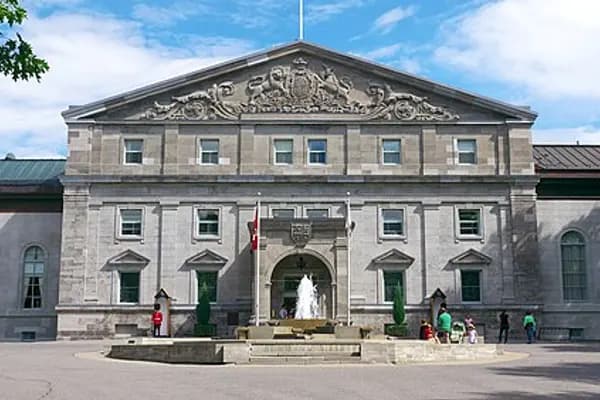
Ottawa is the political centre of Canada and the headquarters of the federal government. The city houses numerous foreign embassies, key buildings, organisations, and institutions of Canada's government; these include the Parliament of Canada, the Supreme Court, the residence of Canada's viceroy, and the Office of the Prime Minister.
Founded in 1826 as "Bytown", incorporated in 1850, and renamed "Ottawa" in 1855, its original boundaries were expanded through numerous annexations and were ultimately replaced by a new city incorporation and amalgamation in 2001. The municipal government of Ottawa is established and governed by the City of Ottawa Act of the Government of Ontario. It has an elected city council across 24 wards and a mayor elected city-wide, each elected using the first-past-the-post voting election system.
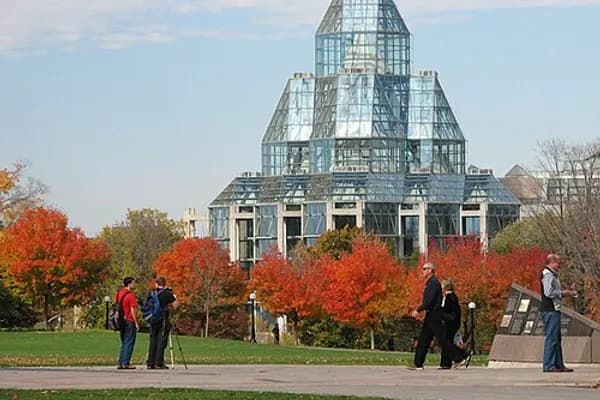
Ottawa has the highest proportion of university-educated residents among Canadian cities and is home to several colleges, universities, and research and cultural institutions, including the University of Ottawa, Carleton University, Algonquin College, Collège La Cité, the National Arts Centre, and the National Gallery of Canada, as well as numerous national museums, monuments, and historic sites. It has a generally high standard of living and is one of the most visited cities in Canada, with over 11million visitors annually, including over 6 million vacationers.
Etymology
The city name "Ottawa" was chosen in 1855 in reference to the Ottawa River, whose name is itself derived from the Algonquin adawe, meaning "to trade". In modern Algonquin, the city is known as Odàwàg.
History
Early history
The Ottawa Valley became habitable around 10,000 years ago, following the natural draining of the Champlain Sea. The first evidence of human presence in the Ottawa Valley were spearpoints dated 8000-8500 years before present. By 6000 years before present, there were robust trading and communications networks. Approximately 3000-3500 years before present, there is definitive evidence of continuously existing settlements, including likely hearths and heavy tools. In closer proximity to the modern bounds of the City of Ottawa, there has been documentation of specific settlements at the mouth of the Gatineau River dating back to 3000-3500 years prior to post-Columbian contact. These findings suggest that these Algonquin people were engaged in foraging, hunting and fishing, but also trade and travel. Three major rivers meet within Ottawa, making it an important trade and travel area for thousands of years. This period ended with the arrival of settlers and colonization of North America by Europeans during and after the 15th century.
European exploration and early development
In 1610, Étienne Brûlé became the first documented European to navigate the Ottawa River, passing what would become Ottawa on his way to the Great Lakes. Three years later, Samuel de Champlain wrote about the waterfalls in the area and about his encounters with the Algonquin people.
The first non-Indigenous settlement in the area was created by Philemon Wright, a New Englander. Wright founded a lumber town in the area on 7 March 1800 on the north side of the river, across from the present-day city of Ottawa in Hull. He, with five other families and twenty-five labourers, also created an agricultural community, which was named Wright's Town, which would later become Gatineau. Wright pioneered the Ottawa Valley timber trade (soon to be the area's most significant economic activity) by transporting timber by river from the Ottawa Valley to Quebec City.
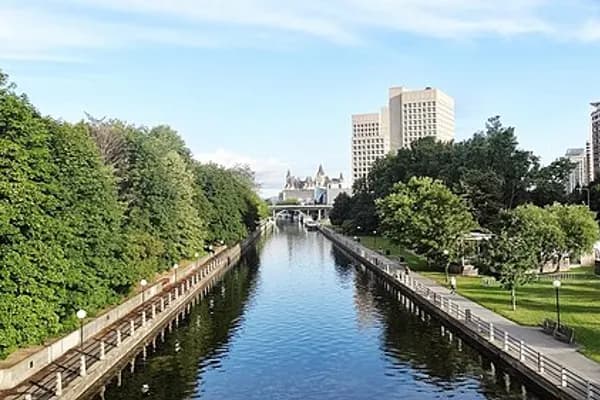
In 1820s, news of the British military's impending construction of the Rideau Canal led to land speculation by John Le Breton, a local businessman who bought a land lot on the prediction of the upcoming construction, which led to an alternative canal course being selected. A town was established in 1826, and in 1827, was named after the British military engineer Colonel, John By, who was responsible for the Rideau Waterway construction project. The Rideau canal provided a secure route between Montreal and Kingston on Lake Ontario. It bypassed a vulnerable stretch of the St. Lawrence River bordering the state of New York that had left re-supply ships bound for southwestern Ontario easily exposed to enemy fire during the War of 1812.
Colonel By set up military barracks on the site of today's Parliament Hill. He also laid out the streets of the town and created two distinct neighbourhoods named "Upper Town" west of the canal and "Lower Town" east of the canal. Similar to its Upper Canada and Lower Canada namesakes, historically, "Upper Town" was predominantly English-speaking and Protestant, whereas "Lower Town" was mostly French, Irish and Catholic. Bytown's early pioneer period saw Irish labour unrest during the Shiners' War from 1835 to 1845.
Bytown's population grew to 1,000 as the Rideau Canal was completed in 1832. The settlement was incorporated as a town in 1850. In 1855, Bytown was renamed Ottawa and obtained city status. William Pittman Lett was installed as the first city clerk, serving from 1844 to 1891, guiding Ottawa through 36 years of development, leading the hiring of key municipal roles, founding civic organizations, and proposing a set of by-laws for the city.
Starting in the 1850s, entrepreneurs known as lumber barons began to build large sawmills, which produced tens of millions of board feet of timber, such as producing 39 million in 1855 after the USA began accepting imports, against approximately 480 million board feet imported from across Canada in Britain a decade earlier, and eventually rising to 613 million in the early 20th century. Rail lines built in 1854 connected Ottawa to areas south and, from 1886 to the transcontinental rail network via Hull and Lachute, Quebec. By 1885 Ottawa was the only city in Canada whose downtown street-lights were powered entirely by electricity.
Selection as capital
The selection of Ottawa as a capital city predates the confederation of Canada. The choice was contentious and not straightforward, with the parliament of the United Province of Canada holding more than 200 votes over several decades to attempt to settle on a legislative solution to the location of its capital. In Ottawa, political dissension was evident in the 1849 Stony Monday Riot, when Tories objected to consideration of Bytown as the capital of the Province of Canada.
The governor-general of the Province of Canada designated Kingston as the capital in 1841. This was controversial: the cities of Toronto and Montreal, as well as the former capital of Lower Canada, Quebec City, all had legislators dissatisfied with Kingston as the capital, although anglophone merchants in Quebec were the leading group supportive of the Kingston arrangement. In 1842, a vote rejected Kingston as the capital, and study of potential candidates included the then-named Bytown, but that option proved less popular than Toronto or Montreal. In 1843, a report of the Executive Council recommended Montreal as the capital as a more fortifiable location and commercial centre; however, the governor-general refused to execute a move without a parliamentary vote. In 1844, the Queen's acceptance of a parliamentary vote moved the capital to Montreal.
In 1849, after an Orange mob burned the Parliament building in Montreal, several votes were held on a permanent location. Kingston and Bytown were again considered potential capitals. However, the winning proposal was for two cities to share capital status and the legislature to alternate sitting in each: Quebec City and Toronto, in a policy known as perambulation. Logistical difficulties made this an unpopular arrangement, and an 1856 vote passed for the lower house of parliament to relocate permanently to Quebec City. The move did not proceed as the upper house refused to approve funding for the relocation.
The funding impasse led to the ending of the legislature's role in determining the seat of government. The legislature requested the Queen determine the seat of government. The Queen then acted on the advice of her governor general Edmund Head, who, after reviewing proposals from various cities, selected the recently renamed Ottawa. The Queen sent a letter to colonial authorities selecting Ottawa as the capital, effective 31 December 1857. George Brown, briefly a co-premier of the Province of Canada, attempted to reverse this decision but was unsuccessful. The Parliament ratified the Queen's choice in 1859, with Quebec serving as interim capital from 1859 to 1865. The relocation process began in 1865, with the first session of Parliament held in the new buildings in 1866. The buildings were generally well received by legislators.
Ottawa was chosen as the capital for two primary reasons: first, Ottawa's isolated location, surrounded by dense forest far from the Canada–US border and situated on a cliff face, would make it more defensible from attack. Second, Ottawa was on the border between Canada West and Canada East, making the selection an important political compromise. Other minor considerations also favoured Ottawa. Despite the city's regional isolation, there was water transportation access from spring to fall, both to Montreal via the Ottawa River, and to Kingston via the Rideau Waterway. Additionally, by 1854 it also had a modern all-season railway (the Bytown and Prescott Railway) that carried passengers, lumber and supplies 82 kilometres (51 miles) to Prescott on the Saint Lawrence River and beyond. Ottawa's small size was also thought to be less prone to politically motivated mob violence, as had happened in the previous Canadian capitals. Finally, the government already owned the land that eventually became Parliament Hill, which it thought would be an ideal location for the Parliament buildings.
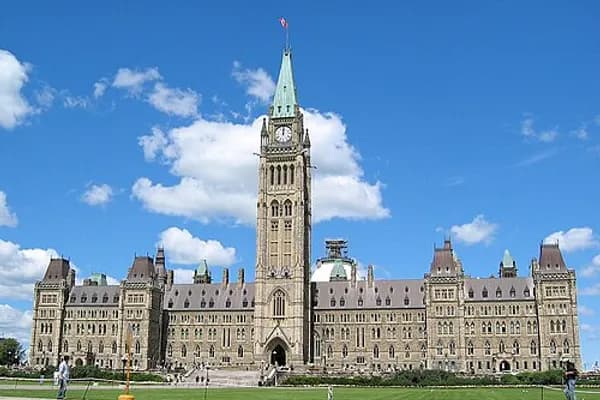
The original Parliament buildings, which included the Centre, East and West Blocks, were constructed between 1859 and 1866 in the Gothic Revival style. Public Works Canada and its architects were not initially well prepared for the relatively shallow-lying bedrock involved in construction, and as a result had to redesign architectural drawings, leading to delays. The Library of Parliament and Parliament Hill landscaping were completed in 1876.
Post-Confederation
In 1889, the Government developed and distributed 60 "water leases" to mainly local industrialists which gave them permission to generate electricity and operate hydroelectric generators at Chaudière Falls. Public transportation began in 1870 with a horsecar system, overtaken in the 1890s by an electric streetcar system that operated until 1959 and peaked at trackage of 90.5km, including an extension to Hull.
The Hull–Ottawa fire of 1900 destroyed two-thirds of Hull, including major lumber employers and main street buildings. It began as a chimney fire in Hull on the north side of the river, but due to wind, spread rapidly throughout the widespread wooden buildings. In Ottawa, it destroyed about one-fifth of the buildings from the Lebreton Flats south to Booth Street and down to Dow's Lake. The fire had a disproportionate effect on west-end lower-income neighbourhoods. It had also spread among many lumber yards, a major part of Ottawa's economy. The fire destroyed approximately 3200 buildings and caused an estimated $300 million in damage (in 2020 Canadian dollars). An estimated 14% of Ottawans and 40% of Hull residents were left homeless.
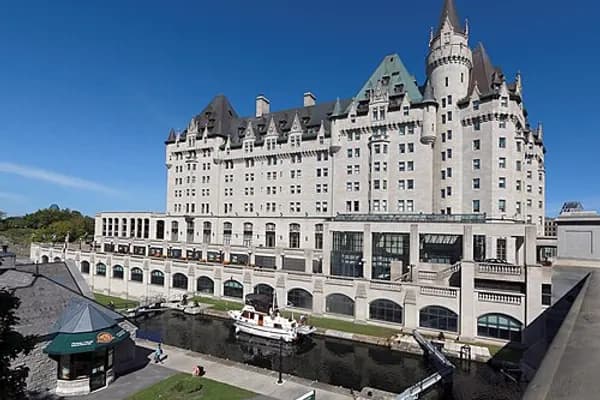
On 1 June 1912, the Grand Trunk Railway opened both the Château Laurier hotel and its neighbouring downtown Union Station. On 3 February 1916, the Centre Block of the Parliament buildings was destroyed by a fire. The House of Commons and Senate was temporarily relocated to the recently constructed Victoria Memorial Museum, now the Canadian Museum of Nature until the completion of the new Centre Block in 1927. The centrepiece of the new Parliament Buildings, is a dominant Gothic Revival-styled structure known as the Peace Tower.
The location of what is now Confederation Square was a former commercial district centrally located in a triangular area downtown surrounded by historically significant heritage buildings, including the Parliament buildings. It was redeveloped as a ceremonial centre in 1938 as part of the City Beautiful Movement. It became the site of the National War Memorial in 1939 and was designated a National Historic Site in 1984. A new Central Post Office (now the Privy Council of Canada) was constructed in 1939 beside the War Memorial because the original post office building on the proposed Confederation Square grounds had to be demolished.
Post–Second World War
Ottawa's former industrial appearance was vastly altered by the 1950 Gréber Plan. Prime Minister Mackenzie King hired French architect-planner Jacques Gréber to design an urban plan for managing development in the National Capital Region, to make it more aesthetically pleasing and a location more befitting for Canada's political centre. Gréber's plan included the creation of the National Capital Greenbelt, National Arts Centre, the Kichi Zibi Mikan parkway and Queensway highway system. His plan also called the moving of downtown Union Station (now the Senate of Canada Building) to the suburbs, the removal of the street car system, the decentralization of selected government offices, and the relocation of industries and removal of substandard housing from the downtown. While not every recommendation in the Grébér Plan was actioned, such as a city hall on the east side of the canal, the plan's open space recommendations did lead to the creation spaces such as the Rideau Canal and Ottawa River pathways. A major precondition to the creation of the Rideau Canal pathway was the elimination of direct rail service into downtown, leading to the abandonment of the Ottawa Train Station as the main train station for the city.
Encyclopedic content adapted from the Wikipedia article on Glebe, used under CC BY-SA 4.0.