About the neighborhood
Neighbourhood in Vancouver, Canada
Gastown is the original settlement that became the core of the city of Vancouver, British Columbia, Canada, and a national historic site and a neighbourhood in the northwest section of the Downtown Eastside, adjacent to Downtown Vancouver.
Its historical boundaries – the waterfront (now Water Street and the CPR tracks), Carrall Street, Hastings Street, and Cambie Street – followed the borders of the 1870 townsite survey, the proper name and postal address of which was Granville, B.I. ("Burrard Inlet"). The official boundary does not include most of Hastings Street except for the Woodward's and Dominion Buildings, and stretches east past Columbia Street, to the laneway running parallel to the west side of Main Street.
History
Events
Timeline of Vancouver historyv
t
e
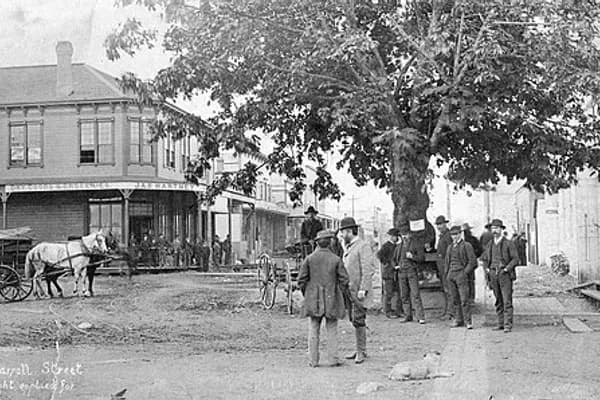
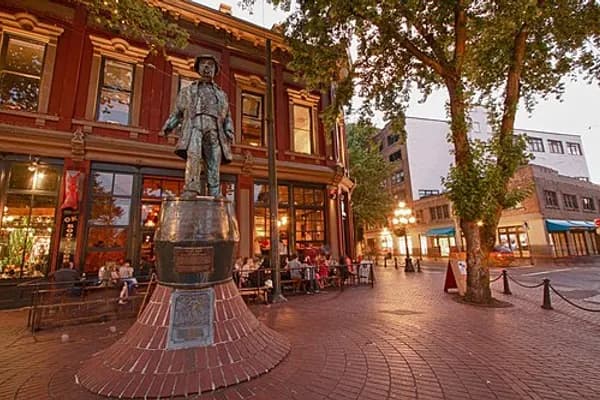
Gastown was Vancouver's first neighbourhood and was named for "Gassy" Jack Deighton, a Yorkshire seaman, steamboat captain and barkeep who arrived in 1867 to open the area's first saloon. He was famous for his habit of talking at length (or "gassing") and the area around his saloon came to be known as "Gassy's town," a nickname that evolved to "Gastown." The town soon prospered as the site of Hastings Mill sawmill, seaport, and quickly became a general centre of trade and commerce on Burrard Inlet as well as a rough-and-rowdy resort for off-work loggers and fishermen as well as the crews and captains of the many sailing ships which came to Gastown or Moodyville, on the north side of the inlet (which was a dry town) to load logs and timber.
In the 1960s, citizens became concerned with preserving Gastown's distinctive and historic architecture, which like the nearby Chinatown and Strathcona was scheduled to be demolished to build a major freeway into the city's downtown. A campaign led by businesspeople and property owners, as well as the counterculture and associated political protestors gained traction to save Gastown. Henk F. Vanderhorst, a Dutch immigrant to Canadian citizen, opened the 'Exposition Gallery', an art gallery on Water Street which started, flourished and encouraged a flow of other fledgling business startups to boom in the Gastown core. His influence with the revitalization of Gastown was acknowledged in 1976 by being awarded 'The First Pioneer Citizen of Gastown' award by Mayor Art Phillips. "A key to the city". Vanderhorst's efforts, in part, pressured the civic, provincial and federal governments to declare Gastown a historical site, protecting its heritage buildings to this day.
Gastown was designated a National Historic Site of Canada in 2009.
21st century
In February 2013, The Gastown Gazette began publishing local news and stories about the ongoing protests against gentrification in the Downtown Eastside and Gastown area of Vancouver. The community paper has since gathered provincial and national attention for reports on the neighbourhood.
Gastown has become a hub for technology and new media. It has attracted companies such as Zaui Software, Idea Rebel, MetroQuest, BootUp Labs Entrepreneurial Society, SEOinVancouver and MarketR.
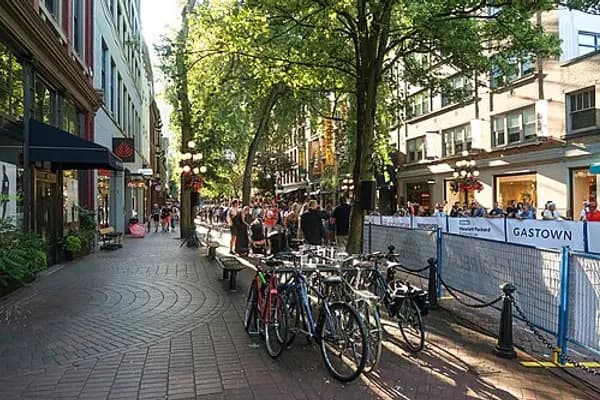
Popular annual events that take place on the cobblestone streets of Gastown include the Vancouver International Jazz Festival and the Global Relay Gastown Grand Prix international bicycle race.
In June 2004, Storyeum opened in Gastown. It was a lively theatrical 65-minute show that re-enacted the history of BC using eight sets that were all located below street level. Unfortunately, due to mounting debt, the attraction closed its doors in October 2006.
The Gassy Jack statue was toppled on February 14, 2022, by protesters during the 31st annual Memorial March for Missing and Murdered Indigenous Women and Girls.
In the summer of 2024, as a pilot project, Water Street was converted into a pedestrian zone with car-free and car-light areas from Richards Street to Carrall Street.
Gastown steam clock
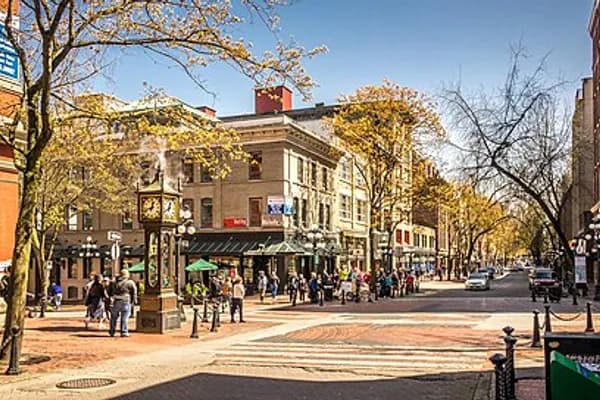
Gastown's most famous (though nowhere near oldest) landmark is the steam-powered clock on the corner of Cambie and Water Street. It was built in 1977 to cover a steam grate, part of Vancouver's distributed steam heating system, as a way to harness the steam and to prevent street people from sleeping on the spot in cold weather. Its original design was faulty and it had to be powered by electricity after a breakdown. The steam mechanism was completely restored with the financial support of local businesses as it had become a major tourist attraction, and is promoted as a heritage feature although it is of modern invention.
The steam used is from a low-pressure downtown-wide steam heating network (from a plant adjacent to the Georgia Viaduct) and powers a miniature steam engine, in the base of the clock, driving a chain lift. The chain lift moves steel balls upward, where they are unloaded and roll to a descending chain. The weight of the balls on the descending chain drives a conventional pendulum clock escapement, geared to the hands on the four faces. The steam also powers the clock's sound production, with whistles being used instead of bells to produce the Westminster "chime" and to signal the time.
In October 2014, the clock was temporarily removed for major repairs by its original builder, and it was reinstalled in January 2015.
References
External links
Wikimedia Commons has media related to Gastown.
Wikivoyage has a travel guide for Gastown-Chinatown.
Official Gastown Community Website
Gastown at Virtual Vancouver Archived 2008-02-09 at the Wayback Machine
Global Relay Gastown Grand Prix
Club Zone.com "Gastown Bars" page Archived 2008-11-19 at the Wayback Machine
The Gastown Gazette, community newspaper
Gastown page, Vancouver Then and Now website, comparisons of old photos with modern locations
Archival photos
View of Gastown from offshore, 1884, prior to announcement of CPR terminus
View of Gastown from offshore, 1886
View of Alexander Street, Gastown c.1911
View of Water Street from jct. Cordova Street, c.1890
View of Water Street from Maple Tree Square, 1887 (Sunnyside Hotel at right)
View of Cordova Street from above intersection of Carrall; July 1, 1890 Dominion Day celebrations
View of Cordova Street from above intersection of Cambie; c.1900 when this was still the city's principal shopping district
West SideEast SideOther locations False Creek
Granville Island
Stanley Park
University Endowment Lands
UBC Vancouver
Italics indicate neighbourhoods now defunct.
Conservancies Alty
Banks Nii Łuutiksm
Bishop Bay – Monkey Beach
Bishop Bay – Monkey Beach Corridor
Broughton Archipelago
Burdwood Group
Calvert Island
Cascade-Sutslem
Cetan/Thurston Bay
Crab Lake
Č̓icy̓i
Daawuuxusda Heritage
Dean River
Duu Guusd Heritage
Dzawadi/Upper Klinaklini River
Ecstall Headwaters
Ecstall-Sparkling
Ecstall-Spokskuut
Ellerslie-Roscoe
Ethelda Bay – Tennant Island
Europa Lake
Fiordland
Forward Harbour/ƛ̓əx̌əᵂəyəm
Gitxaala Nii Luutiksm/Kitkatla
Gunboat Harbour
Hakai Lúxvbálís
Hanna-Tintina
Hotsprings-No Name Creek
Kamdis
Huchsduwachsdu Nuyem Jees / Kitlope Heritage
Hunwadi/Ahnuhati-Bald
Indian Lake – Hitchcock Creek/Át Ch'îni Shà
Jump Across
Kennedy Island
K'distsausk/Turtle Point
Khtada Lake
Khutzeymateen Inlet
Khyex
Kiišḥniqʷus
Kitasoo Spirit Bear
K’lgaan/Klekane
K’mooda/Lowe-Gamble
K'nabiyaaxl/Ashdown
Koeye
K’ootz/Khutze
Ksgaxl/Stephens Island
Ksi X’anmaas
Ksi xts'at'kw/Stagoo
Ktisgaidz/MacDonald Bay
Kts'mkta'ani/Union Lake
Kunx̱alas Heritage
K'uuna Gwaay Heritage
K'waal
Kʷuḥaa
Lady Douglas-Don Peninsula
Lax ka’gaas/Campania
Lax Kul Nii Luutiksm/Bonilla
Lax Kwaxl/Dundas and Melville Islands
Lax Kwil Dziidz/Fin
Lockhart-Gordon
Lucy Islands
ƛułp̓ic
Mahpahkum-Ahkwuna/Deserters-Walker
Maxtaktsm'aa/Union Passage
Moksgm’ol/Chapple–Cornwall
Monckton Nii Luutiksm
Nakina – Inklin Rivers (Kuthai Area)/Yáwu Yaa
Nakina – Inklin Rivers/Yáwu Yaa
Namu
Nang Xaldangaas Heritage
Neʼāhʼ
Neǧiƛ/Nekite Estuary
Outer Central Coast Islands
Owikeno
Pa-aat
Pałəmin/Estero Basin
Phillips Estuary/ʔNacinuxʷ
Polkinghorne Islands
Q’altanaas/Aaltanhash
Qudǝs/Gillard-Jimmy Judd Island
Qwiquallaaq/Boat Bay
Shearwater Hot Springs
Sup̓itsaqtuʔis
Tenh Dẕetle
Tlall Heritage
Tsa-Latĺ/Smokehouse
Tutshi Lake/T’ooch’ Áayi
Ugʷiwa’/Cape Caution
Unaacuł-Ḥiłsyakƛis
Upper Elaho Valley
Upper Gladys River/Watsíx Deiyi
Upper Kimsquit River
Upper Rogers kóḻii7
Upper Soo
Wanačas-Hiłḥuuʔis
W̓aw̓aƛ/Seymour Estuary
Waʔuus Č̓aʔakm̓inḥ
Willison Creek – Nelson Lake/Sít’ Héeni
Xʷak̓ʷəʔnaxdəʔma/Stafford Estuary
Yaaguun Gandlaay
Yaaguun Suu
ʔaʔukmin
ʔuuʔinmitis
Ecological reserves Aleza Lake
Ambrose Lake
Anne Vallée (Triangle Island)
Baeria Rocks
Ballingall Islets
Baynes Island
Bednesti Lake
Beresford Island
Big Creek
Big White Mountain
Blackwater Creek
Bowen Island
Bowser
Browne Lake
Buck Hills Road
Burnt Cabin Bog
Byers-Conroy-Harvey-Sinnett Islands
Canoe Islets
Checleset Bay
Claud Elliott Creek
Columbia Lake
Drizzle Lake
Duke of Edinburgh (Pine/Storm/Tree Islets)
Dewdney and Glide Islands
East Redonda Island
Gamble Creek
Gingietl Creek
Gladys Lake
Ilgachuz Range
Klanawa River
Misty Lake
Mount Derby
Mount Elliott
Mount Tzouhalem
Nitinat Lake
Race Rocks
Robson Bight
Rose Spit
San Juan River Estuary
Sikanni Chief River
Solander Island
Tow Hill
Trial Islands
Tsitika Mountain
Vladimir J. Krajina
Protected areas Anarchist
Brent Mountain
Brim River Hot Springs
Chukachida
Churn Creek
Craig Headwaters
Damdochax
Homathko River - Tatlayoko
Klua Lakes
Lac du Bois Grasslands
Lucy Islands
Nechako Canyon
Pitman River
Snowy
South Okanagan Grasslands
Thinahtea
Thunderbird's Nest (T'iitsk'in Paawats)
Upper Raush
Vaseux
White Lake Grasslands
Recreation areas Coquihalla Summit
Kettle River
Mount Edziza (former)
Category
BC Parks
Commons
Encyclopedic content adapted from the Wikipedia article on Gastown, used under CC BY-SA 4.0.