About the neighborhood
United States historic place
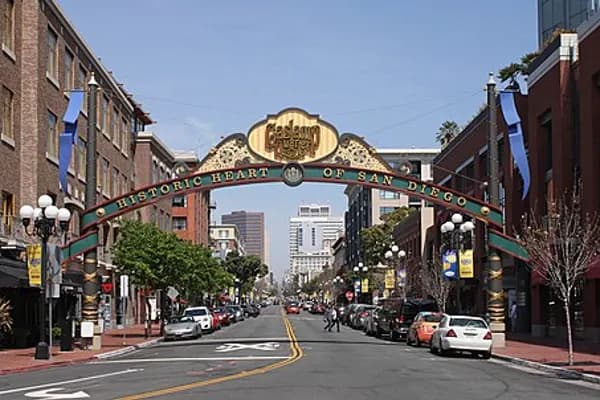
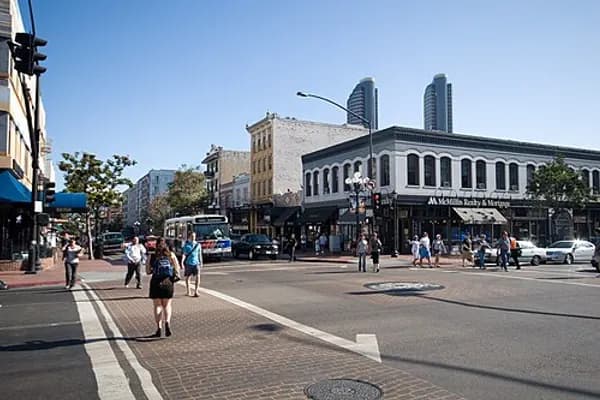
The Gaslamp Quarter is a historic neighborhood in downtown San Diego, California. It extends from Broadway to Harbor Drive and from 4th to 6th Avenue. The neighborhood is listed as a historic district on the National Register of Historic Places as the Gaslamp Quarter Historic District. It includes over 90 historic buildings, most of which were constructed in the Victorian era; many are in use as restaurants, shops, entertainment venues, and nightclubs.
The Gaslamp Quarter is known for its nightlife. It is the site of various events and festivals, including Mardi Gras in the Gaslamp, Taste of Gaslamp, and ShamROCK, a St. Patrick's Day event. Petco Park, home of the San Diego Padres, is one block away in the East Village neighborhood.
History
In the 1860s, the area was known as New Town, in contrast to Old Town, the original Spanish colonial settlement of San Diego. Intensive development began in 1867, when Alonzo Horton bought the land in hopes of creating a new city center closer to the bay, and chose 5th Avenue as its main street.
After a period of urban decay, the neighborhood underwent urban renewal in the 1980s and 1990s.
It was rebranded the "Gaslamp Quarter" during the redevelopment and preservation efforts that occurred during the 1980s, though the streets were generally lit by arc lights, not gaslamps.
Timeline
1850: William Heath Davis bought 160 acres (0.65km) in what would eventually become the Gaslamp Quarter. Despite heavy investment from Davis, little development happened in this period.
1867: Real estate developer Alonzo Horton arrived in San Diego and purchased 800 acres (3.2km) of land in New Town for $265. Major development began in the Gaslamp Quarter.
1880s to 1916: Known as the Stingaree, the area was a working class area, home to San Diego's first Chinatown, "Soapbox Row" and many saloons, gambling halls, and bordellos.
1912: Stingaree was the site of a free speech fight between socialists and city politicians which led to riots and the abduction by vigilantes of Emma Goldman's husband.
1916: the entire neighborhood of Stingaree was demolished and renamed by anti-vice campaigners.
1950s-1970s: The decaying Gaslamp Quarter became known as a "Sailor's Entertainment" district, with a high concentration of pornographic theaters, bookshops and massage parlors.
1970: Public interest in preserving buildings downtown started, especially in Gaslamp Quarter.
1976: The city adopted the Gaslamp Quarter Urban Design and Development Manual, aimed at preserving buildings in the area, and the redevelopment of Gaslamp Quarter as a national historic district.
1982: Gaslamp Quarter became the major focus of the redevelopments in downtown by the city of San Diego.
1992: Gaslamp Quarter Archway is installed and dedicated.
See also
California portal
List of Gaslamp Quarter historic buildings
U.S. Grant Hotel
References
Media related to Gaslamp Quarter, San Diego at Wikimedia Commons
Government Mayor
City Attorney
City Council
Libraries
Port
Emergency services Hospitals
Fire
Police crime
Transportation Airport
Metropolitan Transit System bus
trolley
Education List of primary and secondary schools
San Diego USD
Coronado USD
Poway USD
Escondido UHSD
Grossmont UHSD
San Dieguito UHSD
Sweetwater UHSD
Escondido Union ESD
Del Mar Union ESD
Lemon Grove ESD
National ESD
San Pasqual Union ESD
San Ysidro ESD
Santee SD
Solana Beach ESD
South Bay Union SD
Valley Center-Pauma USD
Universities and colleges
Minato School
San Diego County
San Diego–Tijuana metropolitan area
Encyclopedic content adapted from the Wikipedia article on Gaslamp Quarter, used under CC BY-SA 4.0.
What makes Gaslamp Quarter special
Gaslamp Quarter stands out among San Diego’s neighborhoods for its distinctive character: san diego's historic downtown. It tops our ranking of the best neighborhoods in San Diego, it offers the kind of experience that defines a great city trip — a place where the streets themselves tell a story and every block rewards curiosity.
Best for
Our take on Gaslamp Quarter
Gaslamp Quarter is the neighborhood we send friends to first when they visit San Diego. It earns the top spot in our ranking not because it is the most famous district in the city, but because it delivers the most complete neighborhood experience — the kind of place where every block rewards curiosity and every return visit reveals something new.
Walking through Gaslamp Quarter is like reading a history book with your feet. The architecture tells the story of decades — sometimes centuries — of evolution, and the neighborhood has managed to preserve its historical character without becoming a museum piece. People still live here, still run businesses here, still argue about parking here. That living quality is what separates a great historic neighborhood from a pretty but lifeless one.
Our editors recommend budgeting at least half a day here — enough time to walk the main streets, sit down for coffee, and discover the side streets where Gaslamp Quarter's real character lives.
Living in Gaslamp Quarter
Gaslamp Quarter is connected to the rest of San Diego by public transit, and most visitors find it straightforward to reach from the city center or airport. Once you arrive, the neighborhood is best explored on foot — the scale is human and the streets reward wandering.
Day-to-day life in Gaslamp Quarter has the rhythm of a genuine residential neighborhood. You will find grocery stores, pharmacies, cafés with morning regulars, and the kind of small independent shops that only survive where locals support them. For visitors, this means the infrastructure you need — good coffee, a decent meal, a quiet place to sit — is always within a short walk.
Accommodation in Gaslamp Quarter ranges from boutique hotels to short-term rentals. We generally recommend staying within the neighborhood itself rather than commuting from a hotel elsewhere in San Diego — the experience of waking up inside a great neighborhood is fundamentally different from visiting one as a day trip.
What locals say about Gaslamp Quarter
Long-term residents of Gaslamp Quarter tend to describe their neighborhood with a mix of pride and protectiveness. Like any district with genuine character, Gaslamp Quarter inspires loyalty — the kind of place people move to and never quite leave, or leave and spend years trying to get back to.
Long-time residents speak about Gaslamp Quarter with a historian's eye — they know which buildings are original, which streets have been renamed, which family has run the corner shop for decades. This accumulated knowledge gives the neighborhood a depth that guidebooks cannot replicate. The best way to access it is simply to talk to people.
Like any neighborhood that has earned attention, Gaslamp Quarter is navigating the tension between popularity and preservation. Rents have risen, new businesses have arrived, and long-time residents occasionally grumble that the neighborhood is not what it was. But the fundamentals — the walkability, the food, the community — remain strong, and most locals we speak to believe the neighborhood is still gaining more than it is losing.
Visitor tips
- Gaslamp Quarter is located in San Diego, United States. The neighborhood is accessible by public transport, taxi, or rideshare from most parts of the city.
- Morning is often the best time to explore — the streets are quieter, the light is better for photography, and cafes are at their most welcoming.
- Wear comfortable walking shoes — the best way to experience Gaslamp Quarter is on foot, wandering the side streets and discovering what lies around each corner.
- Save the neighborhood's location on your phone before you arrive. Offline maps are especially useful for navigating the smaller side streets.