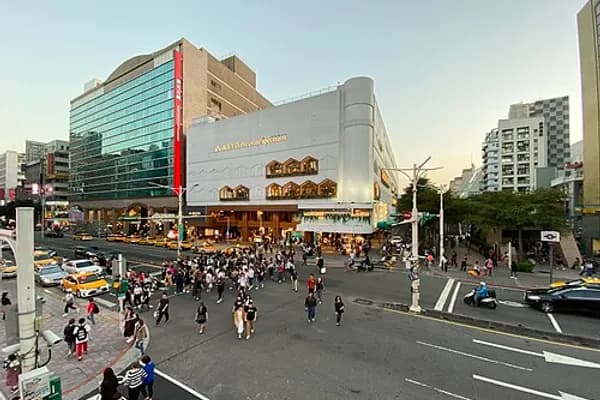
About the neighborhood
District in Taipei, Taiwan
Twatutia (old name)TraditionalChinese大稻埕
Datong District or Tatung is a district of Taipei City, Taiwan. It is located between the Taipei Metro Red Line and eastern shore of the Tamsui River, and between Civic Boulevard and the Sun Yat-sen Freeway. The southern part of this district is known as Twatutia, one of the first settlements in what is now Taipei and once the commercial center. Taipei's commercial center has since shifted southeast to Zhongzheng, Da'an and Xinyi, and Datong is far less important economically. Some of the last vestiges of Twatutia's commercial importance is preserved on Dihua Street. The old town of Daronpon is in the northern part of the district.
History
During the Qing dynasty, the district was named Daronpon (Chinese 大浪泵; Pe̍h-ōe-jī Tōa-lông-pōng), Paronpon, and other variants, but was renamed Toaliongtong (大隆同; Toā-liông-tông) in 1844. Following the Second Opium War, a port was opened in Twatutia for international trade. Foreign trade resulted in the economic development of the district.
In 1946, the district's name was changed to Tatung (大同), which means "Great Unity", the Confucian notion of utopia which is in the lyrics of the National Anthem of the Republic of China. In 1990, the district merged with neighboring Jiancheng and Yanping Districts to create today's enlarged Datong District. The spelling became "Datong" due to switching to the Pinyin Chinese romanization system.
Administrative divisions
The district consists of Bao'an, Dayou, Guangneng, Guoqing, Guoshun, Jiangong, Jianming, Jiantai, Jingxing, Laoshi, Linjiang, Longhe, Minquan, Nanfang, Penglai, Shuanglian, Siwen, Xingming, Yangya, Yanping, Yongle, Yuquan, Zhaoyang, Zhisheng and Zhongqing urban villages.
Government institutions
Ministry of Labor
Tourism
Dihua Street is most notable for its Qing period and Japanese period architecture. It is also famous for street market during the Lunar New Year holidays. The market sells dried fruits, nuts, dried meats, dried seafood, snacks, and health drinks.
Other attractions in Datong include:
Tianma Tea House
Taiwan New Cultural Movement Memorial Hall
Chen Tian-lai Residence
Ama Museum
Chiang Wei-shui Memorial Park
Chen Dexing Ancestral Hall
Museum of Contemporary Art Taipei
Customs Museum
Taipei Confucius Temple
Bao-an Temple
Xia Hai City God Temple
Cisheng Temple
Also in the district are Qsquare shopping mall, Yongle Market (also on Dihua Street), Ningxia Night Market, Yansan Night Market and Dalong Night Market.
Transportation
Metro
Datong is served by the following stations of the Taipei Metro:
Shuanglian metro station
Yuanshan metro station
Beimen metro station
Daqiaotou metro station
Zhongshan metro station
Minquan West Road metro station
Road
By road, the district is served by National Highway No. 1, Provincial Highway No. 1, and Provincial Highway No. 2.
It is also the location of the Yuanshan Bus Station and Taipei Bus Station, the largest bus terminal in the city.
Ferry
The Dadaocheng Wharf is located within the district.
Notable natives
Chiang Chia, manager of Chinese Taipei national football team (1981–1985)
Chiang Peng-chien, chairperson of Democratic Progressive Party (1986–1987)
Frank Hsieh, Premier of the Republic of China (2005–2006)
Huang Tien-fu, member of Legislative Yuan (1981–1984, 1996–1999)
Kuo Chin-fa, former singer
Tsai Eng-meng, businessperson
Yeh Ching-chuan, Minister of the Department of Health (2008–2009)
See also
Taiwan portal
District (Taiwan)
References
External links
Wikimedia Commons has media related to Datong District, Taipei.
Official website (in Chinese)
Datong District travel guide from Wikivoyage
Tourist attractionsPlaces of worshipSkyscrapers Taipei 101
The Sky Taipei
Taipei Nan Shan Plaza
Fubon Xinyi A25
Shin Kong Life Tower
Cathay Landmark
Farglory Financial Center
Far Eastern Plaza
Yihwa International Residential Towers A & B
Huaku Sky Garden
Hua Nan Bank Headquarters
Uni-President International Tower
Kee Tai Zhongxiao
Taipei City Hall Bus Station
Marriott Taipei
Sports venues Arena
Bailing
Basketball
Dome
Gymnasium
Municipal Stadium
National Taiwan University
Tianmu Baseball Stadium
Zhongshan Soccer Stadium
Sports teams Baseball Dacin Tigers
Gida
Mercuries Tigers
Wei Chuan Dragons
Basketball Fubon Braves
TaiwanBeer HeroBears
Rugby Baboons
Soccer Bravo
Leopard Cat FC
Royal Blues F.C.
Tennis Open
Grand Prix
TransportationUniversities Arts
Business
Chengchi
City
China Science and Technology
China Technology
Culture
Education
Medical
Ming Chuan
National Taipei
Normal
Nursing and Health Science
Shih Chien
Shih Hsin
Takming
Tatung
Soochow
Taipei
Taipei Technology
Taiwan
Taiwan Science and Technology
Yang Ming Chiao Tung
Category
Cities¹ — Mountain indigenous district
25°03′35″N 121°30′51″E / 25.05972°N 121.51417°E / 25.05972; 121.51417
Encyclopedic content adapted from the Wikipedia article on Datong, used under CC BY-SA 4.0.
What makes Datong special
Datong stands out among Taipei’s neighborhoods for its distinctive character: old taipei, dihua street. Ranked #3 in Taipei, it offers the kind of experience that defines a great city trip — a place where the streets themselves tell a story and every block rewards curiosity.
Best for
Our take on Datong
Datong is one of the strongest neighborhoods in Taipei, and it consistently appears in our editors' personal favorites lists. It may not always get the same attention as the city's most famous district, but among travelers who know Taipei well, Datong is often the first recommendation.
What makes Datong worth the visit is the texture of daily life here. It is a neighborhood that functions for the people who live in it — not just for the visitors who pass through. The shops serve local needs, the restaurants feed local appetites, and the streets have a rhythm that reflects genuine community rather than tourism infrastructure. That is the quality our editors prize most, and Datong has it in abundance.
Our editors recommend budgeting at least half a day here — enough time to walk the main streets, sit down for coffee, and discover the side streets where Datong's real character lives.
Living in Datong
Datong is connected to the rest of Taipei by public transit, and most visitors find it straightforward to reach from the city center or airport. Once you arrive, the neighborhood is best explored on foot — the scale is human and the streets reward wandering.
Day-to-day life in Datong has the rhythm of a genuine residential neighborhood. You will find grocery stores, pharmacies, cafés with morning regulars, and the kind of small independent shops that only survive where locals support them. For visitors, this means the infrastructure you need — good coffee, a decent meal, a quiet place to sit — is always within a short walk.
Accommodation in Datong ranges from boutique hotels to short-term rentals. We generally recommend staying within the neighborhood itself rather than commuting from a hotel elsewhere in Taipei — the experience of waking up inside a great neighborhood is fundamentally different from visiting one as a day trip.
What locals say about Datong
Long-term residents of Datong tend to describe their neighborhood with a mix of pride and protectiveness. Like any district with genuine character, Datong inspires loyalty — the kind of place people move to and never quite leave, or leave and spend years trying to get back to.
What locals appreciate most about Datong is its consistency — the feeling that the neighborhood works the same way on a Tuesday morning as it does on a Saturday night. It is not a place that performs for visitors and then goes quiet. The rhythm is genuine, the community is real, and the daily experience of living here is what draws people and keeps them.
Compared to the more famous districts in Taipei, Datong has maintained a lower profile, which many residents consider an advantage. The neighborhood evolves gradually rather than being reshaped by sudden attention, and the result is a community that still feels organic rather than curated.
Visitor tips
- Datong is located in Taipei, Taiwan. The neighborhood is accessible by public transport, taxi, or rideshare from most parts of the city.
- Morning is often the best time to explore — the streets are quieter, the light is better for photography, and cafes are at their most welcoming.
- Wear comfortable walking shoes — the best way to experience Datong is on foot, wandering the side streets and discovering what lies around each corner.
- Save the neighborhood's location on your phone before you arrive. Offline maps are especially useful for navigating the smaller side streets.