About the neighborhood
Local implementation of a style of architecture and design
Art Nouveau, in Turin, spread in the early twentieth century.
This new stylistic current involved various artistic disciplines including the applied arts and, predominantly, architecture. In the specific panorama of Turin, Art Nouveau was influenced, in its major works, by the important Parisian and Belgian schools, becoming one of the greatest Italian examples of this current, so much so as to establish Turin as one of the Italian capitals of the Art Nouveau style, not without also undergoing inevitable eclectic and Art Deco incursions.
Due to the success of this stylistic current and the type of buildings that arose in the first decades of the twentieth century, Turin became one of the landmarks of Italian Art Nouveau, often renamed "floral style," so much so that conspicuous architectural evidence of that period can still be perceived today.
History and historical-artistic context
The transition from the 19th to the 20th century in Europe was marked by a fervent renewal of artistic expressions, strongly influenced by technical progress and the enthusiastic positivist exaltation of the important achievements of science. The evolutions of the artistic avant-garde at the end of the nineteenth century first involved the applied arts, taking on different names in different geographical areas: in the French-speaking area it took the name Art Nouveau, in Germany jugendstil, in Austria sezessionstil, modern style in Britain and modernismo in Spain.
In Italy, and particularly in Turin, the new current initially established itself as "new art," translating the term directly from French. In the overall and varied national panorama, this new current, which later also took on the name "floral style," never consolidated into a true Italian school of reference but established itself, albeit with a slight delay compared to the major European countries, experiencing its heyday in the first years of the twentieth century. In its first decade, in fact, one can speak of Art Nouveau, a term that eventually became more widely established in Italy and derived from the famous London warehouses of Arthur Lasenby Liberty, among the first to display and disseminate objects and prints of exotic taste that flaunted the sinuous forms typical of this new style.
Art Nouveau, therefore, found its greatest success in architecture, leaving posterity one of its most enduring testimonies. At the beginning of the 20th century, the upper middle class, by then definitively established as the hegemonic class of Italian society, found in Art Nouveau its own specific distinguishing element, that is, an opportunity to show its superiority and at the same time emphasize its detachment from the old aristocratic class and its neoclassical and baroque mansions. However, its innovative aspect was not only the opposition to neo-Gothic and eclecticism but also a greater consideration of the applied arts as an implicit strength, since Art Nouveau trusted, thanks in part to the growing development of technology, in a large-scale production of an art that in its emblematic beauty was accessible to the majority of the social fabric of the time; despite these premises, even in Turin this initial populist vocation of Art Nouveau waned; the ideal of a "socialism of beauty" evolved into a rich triumph of floral motifs, threadlike ribbing, bold metal decorations of clear phytomorphic inspiration but soon became only a privilege of the wealthier social classes. This new stylistic trend was facilitated by the presence of many Italian and especially English or Swiss industrialists such as: Abegg, Bich, Caffarel, Caratsch, Kind, Krupp, Leumann, Miller, Menier, Metzger, Remmert, and Scott, who contributed to that "international breath" and to the future industrial vocation of the Piedmontese capital, and who set up new and numerous works in the Piedmontese capital precisely in the years between the nineteenth and twentieth centuries.
As a result of this stylistic season, often considered "frivolous" and perhaps naively optimistic, the added value of technique and industry prevailed, just as "function" prevailed over "form," but modernity soon erupted into the horrors of the Great War, which, not only symbolically, decreed the end of the Art Nouveau season.
Turin between the 19th and 20th centuries: Art Nouveau
Turin, while boasting an architectural landscape predominantly characterized by the Juvarra-esque connotation of the numerous noble palaces and Savoy residences, in the two decades between the 19th and 20th centuries allowed itself to be permeated by this new stylistic current.
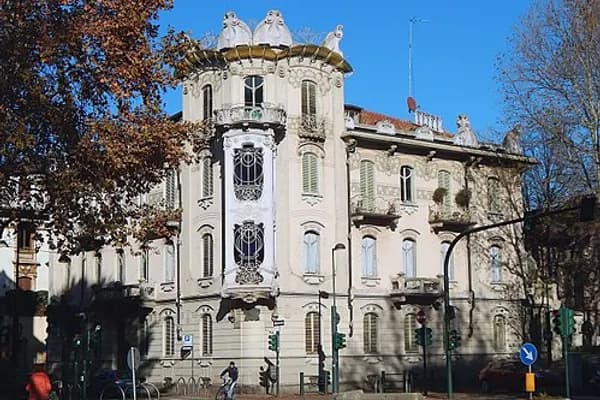
Initially known as "new art" or, according to Turin journalist Emilio Thovez, "floral art," this new style astonished for being so "faithfully naturalistic and in substance distinctly decorative." Following the editions of the International Exhibition of Modern Decorative Art, Turin saw the growing proliferation of this new style in the predominantly architectural sphere, celebrating a kind of "renaissance of the decorative arts," making use of contributions from leading authors of the time such as Raimondo D'Aronco and the Turin-born Pietro Fenoglio, who made a name for himself through his fruitful activity as an engineer and who made Turin's Art Nouveau one of the most shining and coherent examples of the varied Italian architectural scene of the time.
A significant contribution also came from industry, which, involved in the forefront of the renewal process in the Piedmontese capital, played the role of privileged client but also of interlocutor able to offer the technique and solid support for the benefit of those workers necessary for the full affirmation of this new current in Turin. Decisive, to cite one example, was the work of the Turin-based Impresa Porcheddu, which, owing to the resourcefulness of its owner Giovanni Antonio Porcheddu, as early as 1895 was the first construction company to import and use exclusively for Italy the innovative Systéme Hennebique, the first patent for the construction of "fireproof structure and floors" in reinforced concrete filed by French engineer François Hennebique.
Universal Expositions and the advent of 1902
In this cohort of lively cultural agitation,Turin saw the birth of the Turin edition of the Italian General Exhibition in 1884,which led, on the wave of late Romanticism, to the construction of some neo-Gothic-inspired buildings, such as the so-called Dragon House in Corso Francia. Very different was the creation of the Medieval Village and Castle in Valentino Park, initially conceived as the Pavilion of the Piedmont-Aosta Valley Region: the choice of the historical period was undoubtedly influenced by the prevailing tastes, but it was not a matter of inventing ex novo something "in style," because all the buildings contained in the complex are a faithful reproduction, and in most cases in the original size, of something that the curious traveler of the Belle Époque could find traveling through the region.
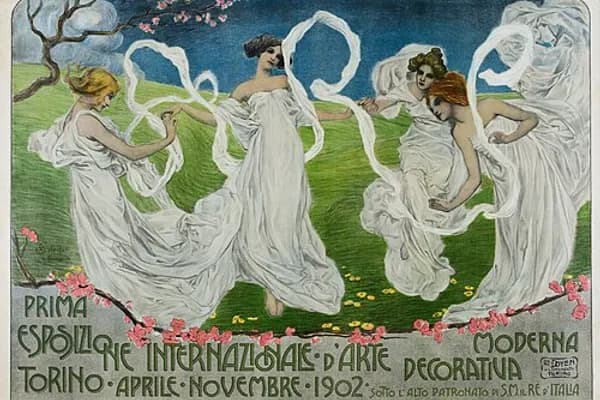
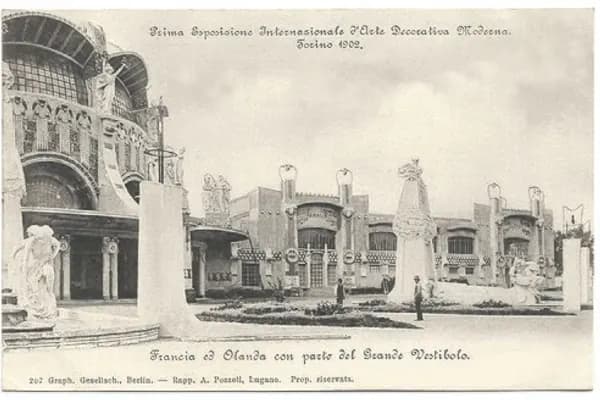
At first such events garnered lukewarm enthusiasm, however, subsequent editions were increasingly successful seeing the gradual establishment of Art Nouveau and, giving a decisive impetus to its spread, was the more ambitious goal of 1902, with the International Exhibition of Modern Decorative Art, which, in its many styled pavilions, saw it welcome prominent foreign guests including Peter Behrens, Hendrik Petrus Berlage, Victor Horta, René Lalique, Charles Rennie Mackintosh, and Henry van de Velde as well as fostering a climate that contributed to the erection of a variety of public and private buildings, thus decreeing the definitive consecration of Art Nouveau as the new dominant artistic style.
A further contribution was also made by the publishing industry, which in Turin counted the presence of important publishers such as Camilla & Bertolero, Crudo & Lattuada, Editrice Libraria F.lli Fiandesio & C. and the longest-lived of them all, Roux and Viarengo, all active since the late nineteenth century.
The former as early as 1889 published the periodical L'architettura pratica, a specialized magazine founded by the architect Andrea Donghi and later directed by his colleague Giuseppe Momo. Also published by Camilla & Bertolero was the trade magazine L'Arte Decorativa Moderna, founded in 1902 in Turin on the initiative of the Turin painter Enrico Reycend, relying on distinguished colleagues such as: Davide Calandra, Leonardo Bistolfi, Giorgio Ceragioli, and the writer Enrico Thovez. Other notable periodicals were Emporium, l'Architettura Italiana, and La Casa Bella, a title later directed by Gio Ponti and which still exists today as Casabella.
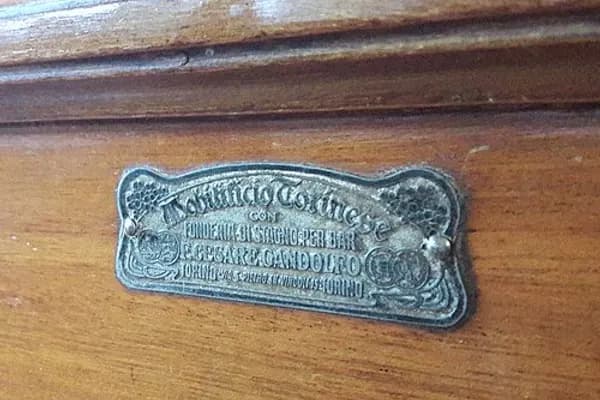
The furniture sector was also an active participant in the flourishing Art Nouveau period, an excellent field for the applied arts; although still not part of an industrial reality, it could count on competent workers and represented a highly appreciated craftsmanship. Some notable exponents are the Albano&Macario glassworks, which among its various works produced the Solferino Terrace, and the Torinese furniture factory F. Cesare Gandolfo that also produced many furnishings for cafes, restaurants and hotels, including the Albergo Rocciamelone in Usseglio for which it made the whole interior design.
Turin thus lived intensely the Art Nouveau season, which, although relatively short-lived, became an important point of reference for Italy, able to attract contributions from internationally prominent figures such as the Friulian architect Raimondo D'Aronco who, back from his recent realizations in Istanbul, designed the Great Vestibule for the 1902 Turin Exposition. On the wave of the exposition's success, Turin continued to be a fertile ground for a variety of experiments, albeit very coherent and restrained, by a large group of architects and engineers such as: Eugenio Ballatore di Rosana, Angelo Evasio Barberis, Giovanni Battista Benazzo, Pietro Betta, Eugenio Bonelli, Paolo Burzio, Carlo Ceppi, Camillo Dolza, Andrea Donghi, Michele Frapolli, Giuseppe Gallo, Giuseppe Gatti, Giovanni Gribodo, Quinto Grupallo, Gottardo Gussoni, Giuseppe Hendel, Giacomo Mattè Trucco, Eugenio Mollino, Giuseppe Momo, Ludovico Peracchio, Alfredo Premoli, Giovanni Reycend, Annibale Rigotti, Paolo Saccarelli, Carlo Sgarbi, Annibale Tioli, Giovanni Tirone, Giovanni Vacchetta, Antonio Vandone di Cortemilia, Giuseppe Velati Bellini, Genesio Vivarelli; however, the most prolific figure and undisputed protagonist of Turin's Art Nouveau was Pietro Fenoglio.
Fenoglio's work
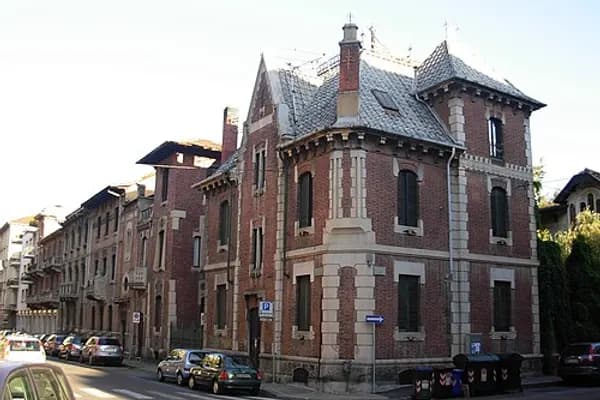
The major protagonist of Art Nouveau in Turin was Pietro Fenoglio, whose prolific activity delivered to Turin some of the greatest Italian examples of this new style. He devoted himself for about thirteen years to the realization of more than three hundred projects including villas and palaces, some of them concentrated in the area of Corso Francia and adjacent streets, as well as a variety of industrial buildings commissioned by Turin's new ruling class; however, his contribution was not only that of an esteemed professional, he was also called upon to intervene at the political level, holding positions as a city councilor and consultant for the study of the new town plan completed in 1908.
Fenoglio was also among the organizers of the 1902 and 1911 editions of the International Exhibition, but he was also active in the field of publishing, appearing among the founders and most important contributors to the magazine L'architettura italiana moderna. At the same time as his intense architectural activity, he also became part of the emerging industrial and financial bourgeoisie in Turin, enriching his skills and intensifying his influence in the construction sector; Fenoglio held the position of vice-president of the well-known Impresa Porcheddu, of the Società Anonima Cementi del Monferrato, as well as that of partner of the Accomandita Ceirano & C. and managing director of the nascent Banca Commerciale Italiana.
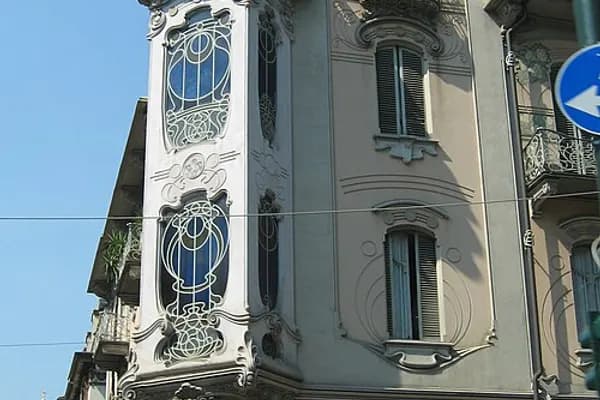
Fenoglio's work is characterized by the skillful use of pastel hues, wall decorations alternating floral subjects with circular geometric elements, and the extensive use of litho-cement frames juxtaposed with the sometimes bold decorative elegance of iron and glass, electing them as favored materials. Among his best-known works are: the Villino Raby (1901), the famous Villa Scott (1902), a triumph of loggias, turrets, stained-glass windows, bay windows, and, above all, his best-known and most appreciated work: Casa Fenoglio-Lafleur (1902), considered "the most significant example of Art Nouveau style in Italy."
Other noteworthy buildings that repurposed decorative elements derived from the success of Casa Fenoglio-Lafleur are Casa Rossi-Galateri (1903) on Via Passalacqua and Casa Girardi (1904) at 54 Via Cibrario. Fenoglio's work turned out to be relatively short-lived but fruitful, and numerous other similar buildings can also be mentioned: Casa Rey (1904), Casa Boffa-Costa (1904), Casa Macciotta (1904), Casa Balbis (1905), Casa Ina (1906), Casa Guelpa (1907), until he pushed out of Piedmont, with the realization of the Villa Magni-Rizzoli in Canzo, near Como.
Fenoglio also had as clients the nascent world of industry, which found Turin a favorable place to establish headquarters for new settlements. Among the best known are: the Fiorio Tannery (1900), the Boero Plant (1905), the Ballada Foundries (1906), the Officine Diatto automobile plant (1907), and the large building of Italy's first brewery, Bosio & Caratsch, with its adjoining manor house (1907), and the Leumann Village.
The Leumann Village
With his experience in industrial factory design, Fenoglio was also involved in the vast Leumann Village project. It was the brainchild of an entrepreneur of Swiss origin, Napoleone Leumann, who moved his textile company's factory from Voghera to Turin, benefiting from the facilities offered by the Piedmontese capital, a remnant of the capital's disputed move first to Florence and then to Rome; in addition, the ample supply of skilled labor at reduced costs completed the process of attracting capital and entrepreneurs, including foreign ones such as Abegg, Geisser, Kind, Metzger, Menier, Remmert, and Scott, contributing to making Turin the new capital of industry. The choice fell on the vast plot of land of about 60,000 sq. m. in the countryside surrounding Collegno, at that time a small town on the outskirts of the city. Also crucial in the choice of the site was the presence of irrigation canals and the proximity of the new railway, which, running along the axis of today's Corso Francia, allowed a rapid connection with Turin, nearby Rivoli but also with the Susa Valley and France through the new Fréjus tunnel.
Encyclopedic content adapted from the Wikipedia article on Crocetta, used under CC BY-SA 4.0.