About the neighborhood
Place in Bagmati, Nepal
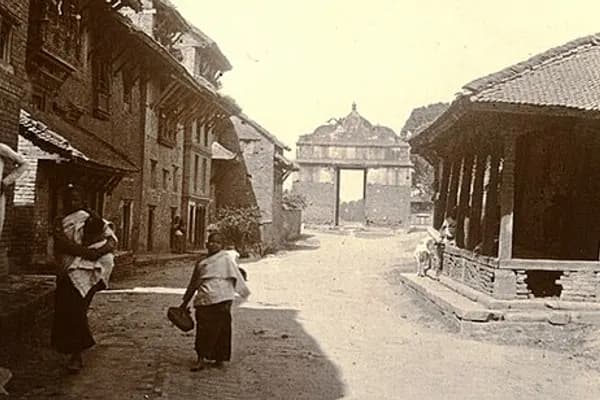
Bhaktapur (Nepali and Sanskrit: भक्तपुर, pronounced ˈbʱʌkt̪ʌpur ; lit. "City of Devotees"), known locally as Khwopa (Nepal Bhasa: 𑐏𑑂𑐰𑐥𑑅, Khvapa) and historically called Bhadgaon, is a city in the east corner of the Kathmandu Valley in Nepal located about 13 kilometres (8.1mi) from the capital city, Kathmandu. Bhaktapur is the smallest municipality of Nepal by size as well as the most densely populated. Along with Kathmandu and Lalitpur, Bhaktapur is one of the three main cities of the Kathmandu Valley and is a major Newar settlement of the country. The city is also known for its Newar tradition, cuisine and artisans. Bhaktapur suffered heavy damage in the April 2015 earthquake.
As part of the Kathmandu Valley, it shares its history, culture and language with the other cities of the valley. Although chronicles like the Gopal Raj Vamshavali put the foundation of Bhaktapur in the 12th century, it has been the site of numerous settlements since at least the Licchavi dynasty. The capital place of Kasthamandu was Bhaktapur Nepal during the first half of Malla dynasty from the 12th century to 1482 when Nepal split into three independent kingdoms. The Malla dynasty is considered a golden period for Bhaktapur and even after its division in 1428, Bhaktapur managed to stay as a wealthy and a powerful Newar kingdom, mostly due to its position in the ancient India-Tibet trade route. In 1769, Bhaktapur was attacked and annexed into the expanding Gorkha Kingdom (which later became the Kingdom of Nepal). After its annexation, Bhaktapur remained largely isolated from other parts of Nepal which led to stagnation in the development of its economy and arts and to allowed it to remain as a homogeneous Newar city. Due to being isolated and overlooked by the central government in Kathmandu, its infrastructure and economy deteriorated and the 1934 earthquake further exacerbated the situation. Bhaktapur's economy and infrastructure would only improve from the 1980s, largely due to tourism and aid provided by West Germany as part of the Bhaktapur Development Project.
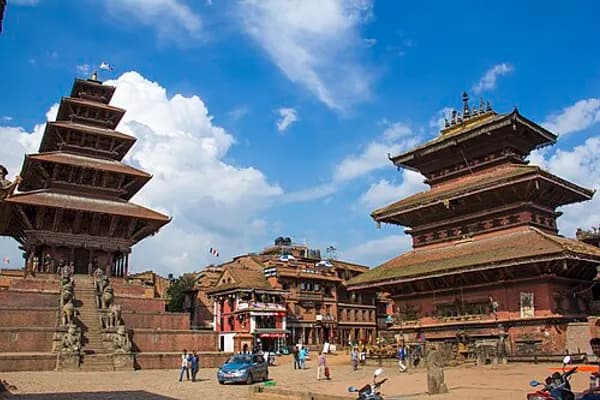
Compared to other Newar settlements, Bhaktapur is predominantly Hindu and speaks a distinct dialect of Nepal Bhasa. Bhaktapur is one of the most visited tourist destination of Nepal with the city attracting 301,012 tourists in 2014. The Nyatapola, a five roofed pagoda completed in 1702 is the most famous structure of Bhaktapur and along with the former royal palace, it forms the tourism center of Bhaktapur. The city is also famous for its numerous festivals and carnivals like the spring festival of Biskā jātrā and the carnival of Sāpāru (or Gai jatra) both of which are significant part of the local culture and contribute well to tourism. Bhaktapur is also called the "Capital of Music and Dance" (Nepali: नाचगानको राजधानी) in Nepal due to presence of over 200 types of traditional dances, most of which are masked dances and except for a few, are a part of the annual carnival of Sāpāru (or Gai jatra). It is also famous for its cuisine with the jūjū dhau, a type of yogurt made from buffalo milk being the most popular. Bhaktapur's potters and handicraft industries are also known nationwide. Due to its well preserved medieval nature, UNESCO inscribed Bhaktapur as a World Heritage Site since 1979.
Etymology
The earliest use of the name "Bhaktapur" is from an inscription from 928. It is widely accepted that the name is a Sanskrit translation of the city's name in the native language, an early form of the Newar language, Khōpring. The earliest use of this name is from a Licchavi dynasty inscription from 594. The name Khōpring is a combination of two words from an early form of the Newar language, "kho" and "pring" which translate to "cooked rice" and "village," respectively. The city was also sometimes referred as Bhaktagrāma instead of Bhaktapura where grāma denoted a village as opposed to pura which denoted a town in Sanskrit.
From Khopring also evolved, Khwopa , the name of the city in the classical and modern form of the native Newar language. Khwopa as the name for the city, appeared for the first time in a manuscript from 1004. The term Khwopa was used to describe the city in almost all of the inscriptions, manuscripts and documents from the Malla dynasty.
Another popular name for the city was "Bhatgaon", the Hindustani and Khas translation of "Bhaktagrama". This name became particularly popular after the conquest of Bhaktapur by the Gorkhali armies of Prithivi Narayan Shah in 1769. It is believed that the official name was changed back to Bhaktapur in the 1930s by the decree of the Prime Minister Juddha Shumsher Rana, after witnessing the numerous temples in the city and the devotion of the locals towards it, decreed that the city should be referred as Bhaktapur as in "City of devotees" instead of Bhatgaon. "Bhakta" in Bhaktapur also means cooked rice in Sanskrit.
History
Antiquity
The folklore of the Kathmandu Valley states that the entire valley and as such Bhaktapur itself was once an enormous lake. Geological surveys conducted by Swiss geologist Toni Hagen proved that the Kathmandu Valley was in fact a lake which formed when the Lower Himalayan Range was being created due to the collision between the Indian and Eurasian plate. The lake water started eroding the limestone hills of Chobhar and starting from around thirty thousand years ago, the lake started to drain. Plain lands appeared in the valley and between 30,000 and 15,000 years, most of the valley was drained. In folklore, the credit of draining the valley is given to the Bodhisattva Manjushri . Believed to be a saint from Greater China, Manjushri is said to have cut a gorge from his sword in order to drain the valley so that he could worship and gain wisdom from Swayambhunath Buddha who resided in the lake. Manjushri is believed to have entered the Katmandu Valley from the east and his resting place has been made into a shrine where the people of Bhaktapur make a pilgrimage to every year during late winter and before the festival of Shree Panchami.
Apart from above, much of the early history of Bhaktapur is largely unknown. It is clear that people started to settle in the Kathmandu Valley after it was drained due to its fertile soil owing to it being a lakebed. The Gopal Raj Vamshavali, a 14th-century Newar language manuscript states that a clan known as Gopāla first settled the Kathmandu Valley. The manuscript further says that Gopāla, who were cow herders, were overthrown by the Mahispāla, who were buffalo herders. Soon, the Kirata King Yalambar conquered the valley and established his own Kirānta dynasty. Although no direct proof of the existence of the first three ruling dynasties as mentioned in the Gopal Raj Vamshavali has been found, indirect proof such as place names and mentions in the inscriptions of the Licchavi period has been used to support the existence of at least the Kirānta dynasty. For Bhaktapur as well, the existence of a non-Sanskrit name, Khopring, in the Sanskrit language stone inscriptions of the Licchavi dynasty supports the existence of a settlement before the arrival of the Licchavi clan from Vaishali. The modern day Jyāpu community of the Newars is believed to be the descendants of the Kirānta clan and the modern day Newar language is believed to derived from the language that he Kirānta clan spoke.
Licchavi dynasty
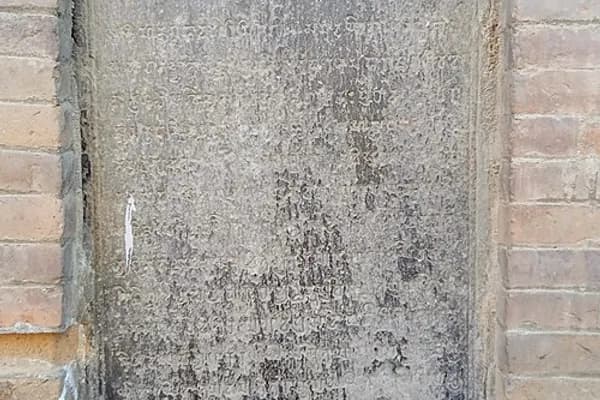
Three stone inscriptions from the Licchavi dynasty has been recovered so far in Bhaktapur. One of them dated to 594 was recovered in Gomārhi district in the eastern part of Bhaktapur was made during the reign of Amshuverma. Another similar inscription from 594, recovered from Tulāche district in the central part of Bhaktapur was also made during the reign of Amshuverma. The Gomārhi inscription contains a decree from Amshuverma that "people from Mākhopring draṅga should be given more rights for a self rule." Similarly, the Tulāche inscription contains a similar message but the settlement has been referred as "khōpring grāma". During the Licchavi dynasty, settlements with a minimum of 100 houses and a maximum of 500 houses were classified as "grāma" and wealthy settlements were classified as "draṅga". So, the settlements around the present day Gomārhi district were wealthier than the settlements around the present day Tulāche district. In Nepal Bhasa, Mā is a prefix meaning "main or principal", meaning Mākhopring was a sub-division of Khopring, most likely the main part of Khopring. Finally, a third inscription recovered at Tālako district in the southwestern part of Bhaktapur mention the place name as "mākhoduluṃ" which was probably a separate village from Khōpring.
Bhaktapur's oldest hiti is also dated from the Licchavi dynasty. It is said that the Rajkulo canals, which supplies water in hitis were built and managed by Tulā Rāni, a mythical queen who is believed to have lived in Bhaktapur during the Licchavi dynasty. In folklore, Tulā Rāni made and repaired the Rajkulo canals as she is said to only weigh a single tola or 11 grams and hence float on water.
Foundation
In the 14th century Gopal Raj Vamshavali, Ananda Deva, who ruled Nepal Mandala from 1146 to 1167 is credited to have established the city of Bhaktapur. Since there were already settlements in Bhaktapur like Mākhopring and Mākhoduluṃ during the Licchavi dynasty, it was more likely that Ananda Deva unified these smaller settlements into a single unit. It is traditionally believed that Bhaktapur contained 12,000 houses at the time of its foundation. Ananda Deva also established a royal court named Tripura Rājkula in the central part of Bhaktapur and declared it as the new capital of Nepal. The Gopal Raj Vamsavali also state the foundation of shrines of eight Matrikas surrounding the city and a ninth and the most important shrine, that of Tripura Sundari, at the centre of the town. This arrangement of the shrines of mother goddess is used to conceptualize the entire town as a sacred Mandala. Within the city itself, there are also ten minor shrines of the Mahavidya established by Ananda Deva as well. The later 19th century chronicles state that Ananda Deva was directed to establish Bhaktapur by the Goddess Annapurna.
Capital city of Nepal
As Bhaktapur became the seat of the government, it also became the target for numerous foreign invasions. The main reasons for these attacks was the internal division among the royal family of Nepal. Soon after Ananda Deva's death, a new royal house emerged from within. Believed to have been started by Ari Malla, they used Malla as their surname replacing their ancestral surname, Deva. When the conflictions between both houses worsened, the House of Tripura sought help from Tirhut while the House of Yuthunimam sought help from Khasa Kingdom. Thus, both of these kingdoms started interfering in the internal politics of Nepal. In the 1310s, the monarch Rudra Malla in order to improve Nepal Mandal's relation with Tirhut married off his sister Devaladevi to the Tirhut king, Harisimhadeva. After the marriage, the relation between the two kingdoms smoothed and Tirhut's attack on Nepal ceased.
In the month of January 1326, Devaladevi along with son, Jagatsimhadeva and her court departed from Tirhut after it was invaded and captured by Ghiyas-ud-din Tughlaq, the Sultan of the Delhi Sultanate. Her husband Harisimhadeva died on the way while Devaladevi and her family arrived at her birth kingdom of Nepal Mandala where she was welcomed by her brother Rudra Malla. In July 1326, just six months after the arrival of Devaldevi, her brother Rudra Malla died. Nayakdevi, Rudra Malla's daughter became the new ruler of Nepal Mandala under the regency of her grandmother Padma Lakshmi. In 1326, Nayakdevi was married to Harishchandra, the prince of Kashi by her grandmother but the court rebelled against him after the death of Padma Lakshmi at the age of sixty seven in July 1332 and was eventually assassinated in May 1335. After Harischandra's death, Devaladevi in a bid to gain political power married her son Jagatsimhadeva to her niece Nayakdevi. In January 1347, Nayakdevi gave birth to a daughter who was named Rajya Laksmhi Devi (Rajaldevi in short). Nayakdevi died ten days after giving birth to Rajaldevi. Her death triggered a chain of unrests in the palace during which Jagatsimha was imprisoned and he died in custody. Devaldevi established her own rule in Nepal Mandala as regent for her granddaughter/grandniece, Rajaldevi.
In 1349, Nepal suffered one of the most devastating attack in its history. Shamsuddin Ilyas Shah, the Sultan of Bengal and his armies plundered the Nepal Valley for a week in the winter of 1349. Bhaktapur suffered the most from this attack as not only it was the capital at that time, the city was also in the eastern part of the valley, the same direction the 20,000 forces came from. According to the Gopal Raj Vamshavali, Bhaktapur was ransacked and set on fire by the invaders which lasted for seven days and the populace were either killed or escaped in the mountains. Some historians cite this invasion as the reason for the disappearance of monuments from the Licchavi and the early Malla dynasty. After the invasion, which destroyed much of the city, Bhaktapur was entirely rebuilt under Devaldevi, who like Ananda Deva, did so on the basis of Sanskrit treatises in architecture. The layout of the old part of the city has remained mostly the same since then.
In September 1354, a nine year old Jayasthiti, a Danwar noble from Mithila was brought into Bhaktapur and was eventually married to Rajalladevi Malla in January 1355. After Devaladevi died in 1366, Rajalladevi and her king consort Jayasthiti Malla took control of Nepal Mandala and under their reign Nepal experienced a period of stability and cultural as well as economic growth. Jayasthiti Malla defeated warring nobles and unified Nepal Mandala under a singular monarch. It is said that Jayasthiti Malla brought Brahmins from Mithila and South India and under their recommendation, revived and improved the already present Hindu caste system based on occupation. Jayasthiti Malla is also credited for making the Newar language as the language of administration, literature and religion. The influential Gopal Raj Vamshavali, a Newar language manuscript about the history of Nepal, was commissioned by Jayasthiti Malla. Jayasthiti Malla was also the first monarch of Nepal to claim a divine heritage as the Gopal Raj Vamshavali states him as the one blessed by Swayambhunath and the incarnation of the Buddha, a claim inherited by all future monarchs.
Encyclopedic content adapted from the Wikipedia article on Bhaktapur, used under CC BY-SA 4.0.