About the neighborhood
Historical aspects of Heidelberg
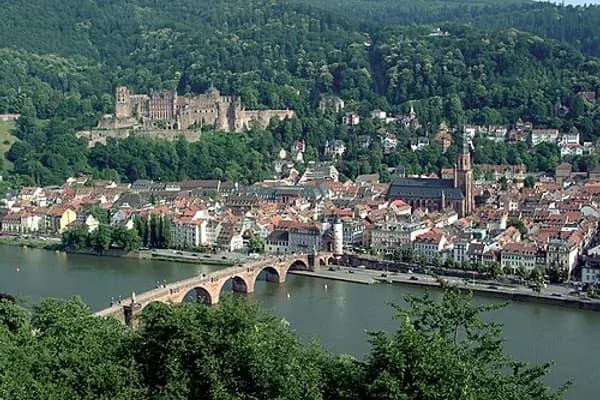
The history of Heidelberg dates back to settlements in the Heidelberg area during the Celtic and Roman periods, long before the city was first mentioned in a document in 1196. In the 13th century, the castle was built, the city was laid out according to plan, and it became the residence of the Counts Palatine of the Rhine. This marked the beginning of about five hundred years of prosperity for the city on the Neckar as the capital of the Palatinate. The University of Heidelberg was founded in 1386 as the first university in what is now Germany. During the War of the Palatinate Succession, French troops destroyed the city in 1693, which was rebuilt on its medieval foundations in the Baroque style. In 1720, the electoral residence moved to Mannheim. In 1803, Heidelberg became part of Baden. In the 19th century, poets and thinkers worked in the city, earning Heidelberg the nickname "City of Romanticism". Heidelberg became a center of science and a tourist destination. In the 19th and 20th centuries, the city expanded through incorporations and construction projects and remained largely undamaged during the Second World War. After the war, Heidelberg was the headquarters of the U.S. Army in Europe until 2013.
Before the city was founded
Prehistory
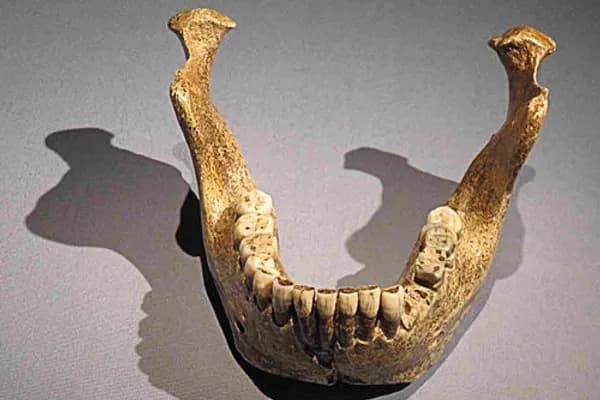
The ancestor of Neanderthals, the fossil species Homo heidelbergensis, was named after its first scientific description in Heidelberg. The approximately 600,000-year-old lower jaw from Mauer, discovered in 1907 by laborer Daniel Hartmann in a sand pit in the village of Mauer, southeast of Heidelberg, is the type specimen of Homo heidelbergensis and the oldest fossil of the genus Homo found in Germany to date.
The first permanent settlement in the Heidelberg area dates to the Neolithic Age, based on archaeological finds from the 5th millennium BC, attributed to the Linear Pottery, Rössener, and Michelsberg cultures. A significant find from this period is a large pit, approximately 12 × 14 meters in diameter and 3.80 meters deep, used as a waste disposal site for a village of the Rössen culture (around 4500 BC). A multiple burial site with six individuals (three adults and three children) discovered in the Handschuhsheim district dates to the Michelsberg culture, around 3800 BC. The individuals were killed during a raid and buried together. These Stone Age settlement traces are concentrated in the districts to the north and west of the city center, where the Neckar emerges from the Odenwald and was located in the river's alluvial fan in prehistoric times. This provided fertile soil, which, together with the favorable climate and natural protection from the east provided by the Odenwald, created very favorable conditions for settlement.
During the Bronze Age, members of the tumulus and urnfield cultures inhabited the Heidelberg area and appear to have established a settlement that was very dense by prehistoric standards in parts of the city.
Celtic period
In the 5th and 4th centuries BC, Heiligenberg, located above Heidelberg, developed into an important settlement center for the Celts, who built a large, fortified settlement there. Its double ring wall can still be seen today. Finds show that the site was the cultural and religious center of the region and that iron was mined and processed there on a large scale. However, in the 3rd century, the hilltop settlement was abandoned for reasons that are not entirely clear. It may have lost its function as a central location to a place further down the Rhine valley, which was easier to reach by transport. However, archaeological finds indicate that Heiligenberg continued to be visited by the local population in the centuries that followed. Parallel to the settlement activities on the mountain, various structures were also built in the rest of Heidelberg during the Celtic period. Their traces are spread relatively evenly on both sides of the Neckar River across various districts of the city, but the fragmentary findings do not allow for a more precise reconstruction of the structure and significance of these presumably small farming settlements. Also found near the river is the fragment of the head of a larger-than-life stone sculpture, discovered in a Roman burial ground in the Bergheim district, thought to have belonged to the tomb of a powerful resident of Heidelberg (a so-called "princely tomb").
In the 1st century BC, however, Celtic settlement came to a complete halt, as it did in many places in the wider area. This phenomenon is often linked to reports from later ancient sources, according to which the Celtic tribe of the Helvetians left their ancestral settlements between the Rhine, Main, and Black Forest under pressure from the advancing Germanic Suebi and moved to Gaul.
Roman rule
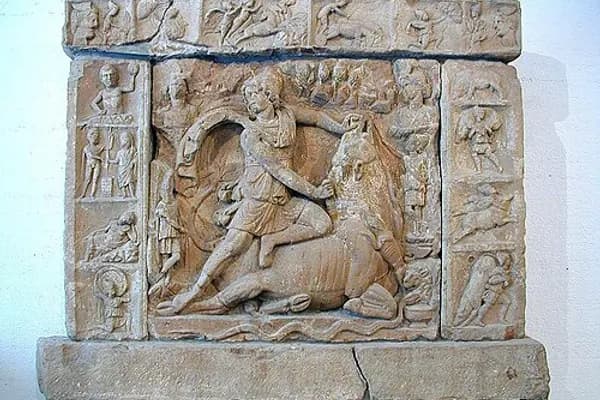
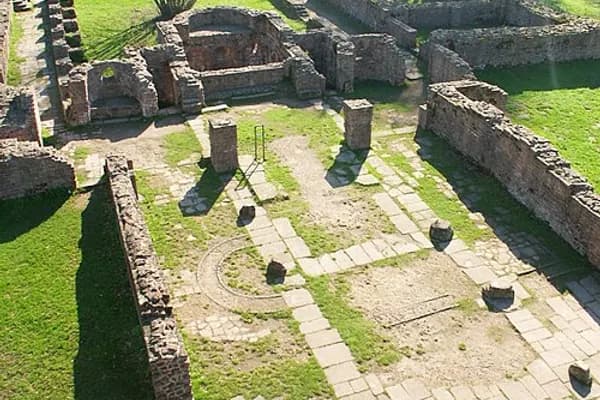
During the reign of Emperor Tiberius (14–37 AD), the Romans settled allied Germanic tribes from the Neckarsueben tribe in the area east of the Neckar estuary to create a buffer zone between the Rhine, the outer border of the Roman Empire, and Germania. Under Emperor Vespasian (69–79), the Romans pushed their border into the area on the right bank of the Rhine and established a military camp in what is now the Heidelberg city area. In 90 AD, a stone fort was built to replace the previous wooden structures. The Romans first built a wooden bridge over the Neckar River, then a 260-meter-long stone pier bridge around 200 AD. A temple to Mercury was built on the summit of the Heiligenberg, and the cult of Mithras was also widespread in Heidelberg. During Roman times, the main town in the region was neighboring Lopodunum (now Ladenburg), but a thriving pottery center also developed around the military camp in Heidelberg (whose Latin name is unknown).
In the 3rd century, the Romans were driven out by the Alamanni. From 233 onwards, this Germanic tribe broke through the Limes and invaded Roman territory. Raids and pillaging also became more frequent in the Heidelberg area. After 260, the Romans were forced to retreat to the Rhine, and the Alamanni eventually settled in the Roman borderlands in what is now southwestern Germany.
The Frankish Empire and Christianisation
Little is known about the history of Heidelberg in the centuries that followed. However, following the victory of the Merovingian king Clovis I over the Alamanni in 506, Heidelberg eventually became part of the Frankish Empire and belonged to the Lobdengau. The most visible consequence of the new rule was the Christianisation of the area. In the 8th century, the nearby Lorsch Abbey developed into an important political center, which competed with the Diocese of Worms for supremacy in the region. To consolidate his influence in the Heidelberg area, the abbot of Lorsch, Thiotroch, founded the Michaelskloster monastery as a branch monastery on the Heiligenberg in 870 on the site of the old temple of Mercury. Two centuries later, another branch monastery, the Stephanskloster, was built on the Michelsberg, the foothill of the Heiligenberg. In 1130, the Stift Neuburg was built at the foot of the mountain.
Many of Heidelberg's villages were founded during the Frankish period in the 6th century. They were first mentioned in documents in the 8th century in the Lorsch Codex – Neuenheim and Handschuhsheim in 765, Rohrbach in 766, Wieblingen and Kirchheim in 767, and Bergheim in 769. This means that the districts of Heidelberg that date back to these villages are several centuries older than the city itself.
Heidelberg in the Middle Ages
The beginnings of Heidelberg
The name Heidelberch was first mentioned in a document from the Schönau monastery in 1196. At that time, the site was still owned by the diocese of Worms. However, a castle on the northern slope of the Königstuhl had probably already been built at the end of the 11th or beginning of the 12th century. It is unclear whether this first castle was a predecessor of today's Heidelberg Castle on the Jettenbühl or whether it was located on the Molkenkur at a higher point on the mountainside, with the predecessor of the castle not built until the 13th century. What is certain, however, is that today's castle has little in common with the first phase of construction due to numerous alterations and extensions.
The name Heidelberg (also Heydelberg) originally referred to the castle and was later transferred to the city, although the etymology is not entirely clear. The "berg" in the name probably refers to the Königstuhl. The first part could be derived from the landscape term "Heide", which means "free land" in the sense of uninhabited communal land. The modern use of "Heide" to mean an unwooded area can also be justified, as the earliest depictions of the Königstuhl show its peak as unwooded. However, it is less likely that Heidelberg is derived from "Heidenberg" and refers to Celtic and Roman worship on the Heiligenberg. The derivation from the Old High German personal name Heidilo has also been rejected.
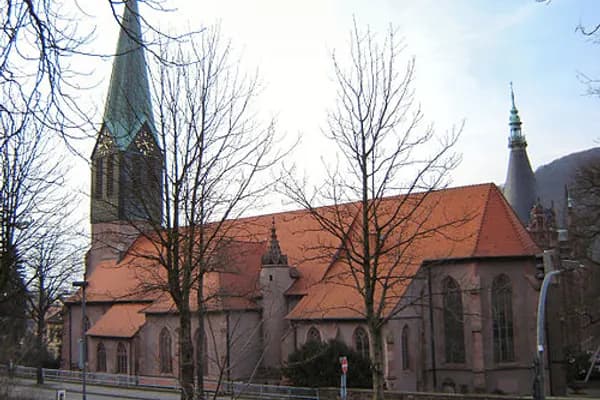
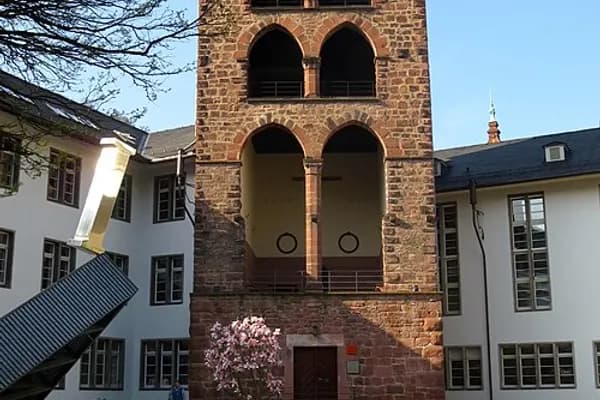
The city of Heidelberg was planned and built later in the area between Königstuhl and the Neckar. While it was long assumed that Heidelberg was founded between 1170 and 1180, more recent findings suggest that the city was not founded until around 1220. The rectangular layout with three streets running parallel to the river and connecting cross streets, as well as the market square in the center, has been preserved to this day. This town plan covered the eastern part of today's old town, known as the core old town, up to the Grabengasse. It was surrounded by a city wall, of which only the so-called Hexenturm (Witches' Tower) in the courtyard of the New University remains. A bridge over the Neckar is first mentioned in 1284. Although it was to remain Heidelberg's main church for a long time, St. Peter's Church and the surrounding old castle district, later called Bergstadt, lay outside the city limits until the 18th century.
Ascension to the capital of the Electoral Palatinate
In 1156, Emperor Frederick I Barbarossa appointed his half-brother Conrad the Staufer as Count Palatine of the Rhine. Counts Palatine already existed in Frankish times, originally as senior royal officials at court with mainly administrative and judicial duties. Under Konrad, the northern Upper Rhine region became the center of the Palatinate, which over time developed into a larger territorial state within the Holy Roman Empire. After a brief reign by the Welf dynasty, the office passed to the Wittelsbach dynasty in 1214. In 1225, the Count Palatine of the Rhine received Heidelberg, formerly part of Worms, as a fiefdom.
At the beginning of their reign, the Palatine Counts did not have a permanent residence but stayed at various locations within their territory. However, Heidelberg had already developed the character of a royal seat under Louis II (1253–1294). When the traditional practice of traveling between residences was abandoned in the 14th century, Heidelberg became the permanent residence.
In the House Treaty of Pavia in 1329, the Wittelsbach territory was divided between a Palatinate and a Bavarian line. According to the treaty, the electoral dignity, the right to elect the Roman German king, was to alternate between the two lines. However, in the Golden Bull of 1356, only the Counts Palatine of the Rhine were granted the right to elect the emperor. From then on, they were known as the Electors Palatine and were among the most influential German rulers. In the following period, their territory came to be known as the Electorate Palatinate.
University foundation
In 1386, Elector Ruprecht I founded the University of Heidelberg. After the universities of Prague (founded in 1348) and Vienna (1365), it was only the third university in the Holy Roman Empire and is the oldest of the universities in what is now the Federal Republic of Germany. The founding of the university increased Heidelberg's importance and contributed to establishing it as the capital of the Electoral Palatinate. Ruprecht's political ambitions may have played a role in his motivation to found the university, as he gained considerable reputation for Heidelberg and the Electoral Palatinate by promoting science, while training the clergy, doctors, lawyers, and teachers needed to administer his territory. Another important reason was that, after the Great Western Schism, German academics could no longer study at the Sorbonne in Paris, the leading European university of the Middle Ages, because Germany supported Pope Urban VI in Rome, while France supported the Avignon antipope Clement VII.
Although the city on the Neckar River was remarkably small for a university town at the time of the university's founding, with a population of just 5,000, and had no academic tradition, and although it faced competition from other universities founded in the following years, such as in Cologne (1388), Heidelberg's "Hohe Schule" (high school) established itself as a medium-sized university. The university had its own jurisdiction, and its members enjoyed numerous privileges. During the 15th century, there were several violent clashes between the townspeople and the university students. However, Heidelberg did not experience the kind of class warfare common in the large imperial cities.
Urban expansion and subsequent development
Under Elector Ruprecht II, Heidelberg underwent extensive expansion in 1392. The western city limits were pushed forward to the level of today's Bismarckplatz, doubling the area of Heidelberg. The inhabitants of the village of Bergheim were forcibly resettled in the newly created suburb. The city limits now extended to what is today the old town and remained unchanged until the 19th century. However, the suburbs remained sparsely built up for a long time. At the same time as the city was expanded, the Jewish community that had lived in Heidelberg since the 13th century was expelled. Their synagogue was converted into a chapel dedicated to the Virgin Mary, which also served as an auditorium for the university.
In 1400, Elector Ruprecht III was elected Roman German King, the first and only Elector of the Palatinate to hold this title. Although Ruprecht's imperial politics were not always successful, his residence city of Heidelberg benefited greatly from his royal status. The Ruprechtsbau, the oldest surviving part of Heidelberg Castle, was built during his reign. Ruprecht also had the chapel on the market square expanded into the prestigious Heiliggeistkirche (Church of the Holy Spirit). The Heiliggeistkirche replaced St. Peter's Church as the parish church and became the burial place of the Palatinate electors. Ruprecht's successor, Louis III, bequeathed his private library to the Heilig-Geist-Stift, thus laying the foundation for the famous Bibliotheca Palatina, which was kept in the galleries of the church.
Encyclopedic content adapted from the Wikipedia article on Bergheim, used under CC BY-SA 4.0.